 Visual Paradigm Desktop |
  Visual Paradigm Online


Businesses do not operate in a vacuum. Every decision made within an organization is influenced by forces outside its direct control. These external pressures shape markets, dictate consumer behavior, and determine the viability of long-term plans. Understanding these dynamics is not optional; it is a fundamental requirement for survival and growth. This guide explores the macro environmental factors that define the strategic landscape, focusing heavily on the PEST analysis framework.
Navigating the complexities of the external environment requires a structured approach. It involves looking beyond the immediate competitors and focusing on the broader currents that move the entire ocean. When leaders fail to scan the horizon, they risk making decisions based on outdated assumptions. By systematically analyzing Political, Economic, Social, and Technological factors, organizations can build strategies that are resilient and adaptable.
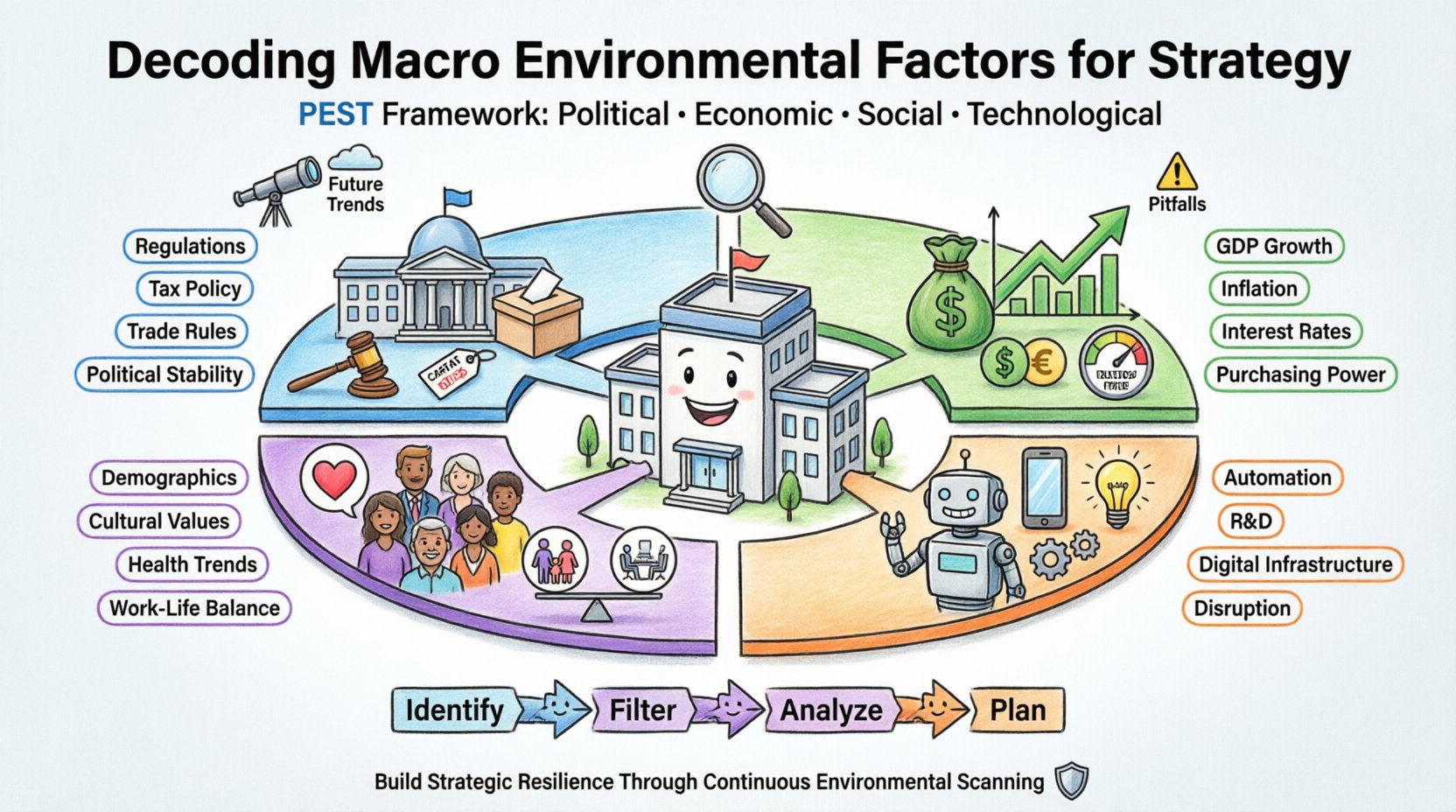
The macro environment refers to the larger societal forces that affect an organization, often referred to as the external environment. Unlike the micro environment, which includes suppliers, customers, and competitors, the macro environment consists of factors that are largely beyond the control of the business entity.
These forces are global or national in nature. They create opportunities and threats simultaneously. For instance, a shift in demographic trends might open a new market segment for a product line while simultaneously shrinking another. The key to managing these factors lies in anticipation rather than reaction.
Strategic planning relies on accurate data regarding these factors. Without this context, a strategy is essentially a guess. A robust strategic framework integrates these external realities to ensure alignment with the future state of the world.
PEST analysis is a strategic tool used to identify and analyze the macro environmental factors. It stands for Political, Economic, Social, and Technological. This acronym serves as a checklist to ensure no major external category is overlooked during the planning phase.
While simple, the framework is powerful when applied with depth. It forces decision-makers to look at the business through different lenses. It moves the conversation from internal capabilities to external realities. Below is a breakdown of how these four pillars interact with business strategy.
| Factor | Key Focus Area | Strategic Question |
|---|---|---|
| Political | Government intervention | How do regulations impact operations? |
| Economic | Financial conditions | What is the purchasing power of consumers? |
| Social | Demographics and culture | How do lifestyle changes affect demand? |
| Technological | Innovation and infrastructure | What new tools change our production? |
Using this table as a reference ensures a comprehensive scan. It prevents tunnel vision where a company focuses solely on sales figures without understanding the economic context driving them.
Political factors encompass the extent to which a government intervenes in the economy. They include government policy, tax policy, labor law, environmental law, trade restrictions, tariffs, and political stability. These elements create the rules of the game. When the rules change, the strategy must change.
Regulations often dictate the cost structure of an organization. Compliance costs can be significant. They include legal fees, administrative overhead, and potential fines for non-compliance. In highly regulated industries like healthcare or finance, political factors are the primary driver of strategy.
Investment requires stability. In regions with frequent political upheaval, the risk premium increases. Organizations may demand higher returns to compensate for the risk of asset seizure or contract cancellation. Conversely, stable political environments attract capital.
Strategic planners must assess the risk of policy shifts. A change in administration can lead to a complete overhaul of industry standards. Scenario planning becomes essential here. What happens if the current policy is reversed? Having a contingency plan mitigates the shock.
Economic factors determine the purchasing power of potential customers and the cost of capital. They are often cyclical, moving through periods of expansion, recession, stagnation, and recovery. Understanding the current phase of the economic cycle is vital for resource allocation.
Economic growth rates indicate the overall health of the market. High growth usually correlates with higher demand. However, inflation erodes purchasing power. If prices rise faster than wages, consumer spending drops. This directly impacts revenue projections.
For businesses operating internationally, exchange rates are critical. A strong domestic currency makes exports expensive and imports cheap. A weak currency does the opposite. This volatility can wipe out profit margins on foreign sales overnight.
Strategies must account for currency hedging. Relying on a single currency for revenue creates vulnerability. Diversifying revenue streams across different economic zones can balance exposure. Financial teams must work closely with strategy teams to model these scenarios.
Social factors involve the demographic and cultural aspects of the external environment. They include population growth, age distribution, career attitudes, health consciousness, and lifestyle trends. These factors drive consumer demand. If a strategy ignores social shifts, it will likely fail to resonate.
The age structure of a population dictates what products are needed. An aging population increases demand for healthcare, retirement services, and accessibility. A younger population drives demand for education, entry-level housing, and entertainment.
Migration patterns also play a role. Urbanization trends shift where people live, affecting retail location strategies. Rural depopulation might reduce demand in certain areas while increasing it in city centers. Understanding these flows helps in site selection and logistics planning.
Values change over time. There is a growing emphasis on sustainability and ethical sourcing. Consumers increasingly prefer brands that align with their personal values. This is not just a marketing tactic; it is a strategic imperative.
Ignoring these cultural shifts leads to brand irrelevance. A brand that feels outdated or out of touch loses market share rapidly. Continuous social listening is required to keep pace with these evolving values.
Technological factors include the rate of technological change, automation, and the research and development (R&D) activity. Technology can disrupt entire industries. It creates new products, new channels, and new business models. It is often the fastest-moving variable in the PEST analysis.
Automation reduces labor costs and increases precision. However, it also displaces certain job roles. Organizations must plan for workforce transitions. The technology available today changes the cost structure of production.
Investment in technology is not just about buying tools. It is about integrating systems that allow for data flow and decision-making. Legacy systems can become bottlenecks. Upgrading infrastructure is a strategic necessity to remain competitive.
Innovation creates new markets. The rise of the internet changed retail. The rise of mobile changed communication. Organizations must monitor R&D trends in their sector. What is being developed in the labs today will be the standard tomorrow.
Failure to adopt relevant technology leads to obsolescence. However, chasing every new trend is also a waste of resources. The goal is to identify technologies that provide a sustainable advantage.
Conducting a PEST analysis is not an end in itself. The value lies in how the insights are integrated into the broader strategy. A list of factors is useless if it does not inform decision-making. The output of the analysis must be actionable.
Once factors are identified, they must be prioritized. Not all factors are equal. Some pose existential threats, while others offer minor inconveniences. The organization must focus its resources on the high-impact areas.
This process ensures that the strategy is grounded in reality. It moves the organization from intuition-based planning to evidence-based planning.
The macro environment is dynamic. A factor that is stable today might change tomorrow. Continuous monitoring is required. Strategy is not a one-time document. It is a living process that evolves with the environment.
Regular reviews of the PEST factors should be scheduled. Quarterly or semi-annual reviews keep the leadership team alert to shifting tides. This agility is a competitive advantage in itself.
Even with a solid framework, mistakes happen. Understanding common errors helps organizations avoid them. These pitfalls can render the analysis ineffective.
Recognizing these pitfalls early allows for correction. It ensures the strategic planning process remains robust and reliable.
The PEST framework is evolving. New variants like PESTLE (adding Legal and Environmental) are becoming common. The integration of Environmental factors is particularly relevant given the focus on climate change. Social factors are also expanding to include digital behavior.
Data analytics is changing how these factors are monitored. Real-time data feeds allow for faster reaction times. Instead of annual reports, organizations are moving towards continuous intelligence systems. This shift allows for more responsive strategies.
As the world becomes more interconnected, the lines between these factors blur. A technological breakthrough can trigger social change, which prompts political regulation. Strategic leaders must understand these complex systems.
Decoding macro environmental factors is about building resilience. It is about preparing for a future that is uncertain. By understanding the political, economic, social, and technological forces, organizations can navigate change with confidence.
Strategy is not about predicting the future perfectly. It is about being prepared for multiple futures. The PEST analysis provides the structure to do this effectively. It turns external noise into actionable intelligence.
Organizations that invest time in this analysis gain a significant advantage. They see the waves before they break. They position themselves to ride the currents rather than being swept away. This is the essence of strategic management.
Start by auditing your current understanding of the macro environment. Identify the gaps in your knowledge. Then, begin the process of systematic scanning. The effort required is substantial, but the return on investment is clarity and direction.
Remember that strategy is a discipline. It requires rigor, honesty, and a willingness to adapt. The tools are available. The framework is proven. The responsibility lies with the leadership to use them.