 Visual Paradigm Desktop |
  Visual Paradigm Online


Entering the market with a new venture involves navigating a complex landscape of external forces. While internal capabilities and product quality matter, the environment dictates whether a business survives. The PEST analysis framework offers a structured approach to understanding these macro-environmental factors. For founders and strategic planners, this tool provides clarity on risks and opportunities before committing significant resources. This guide details how to apply this framework effectively to build resilient strategies.
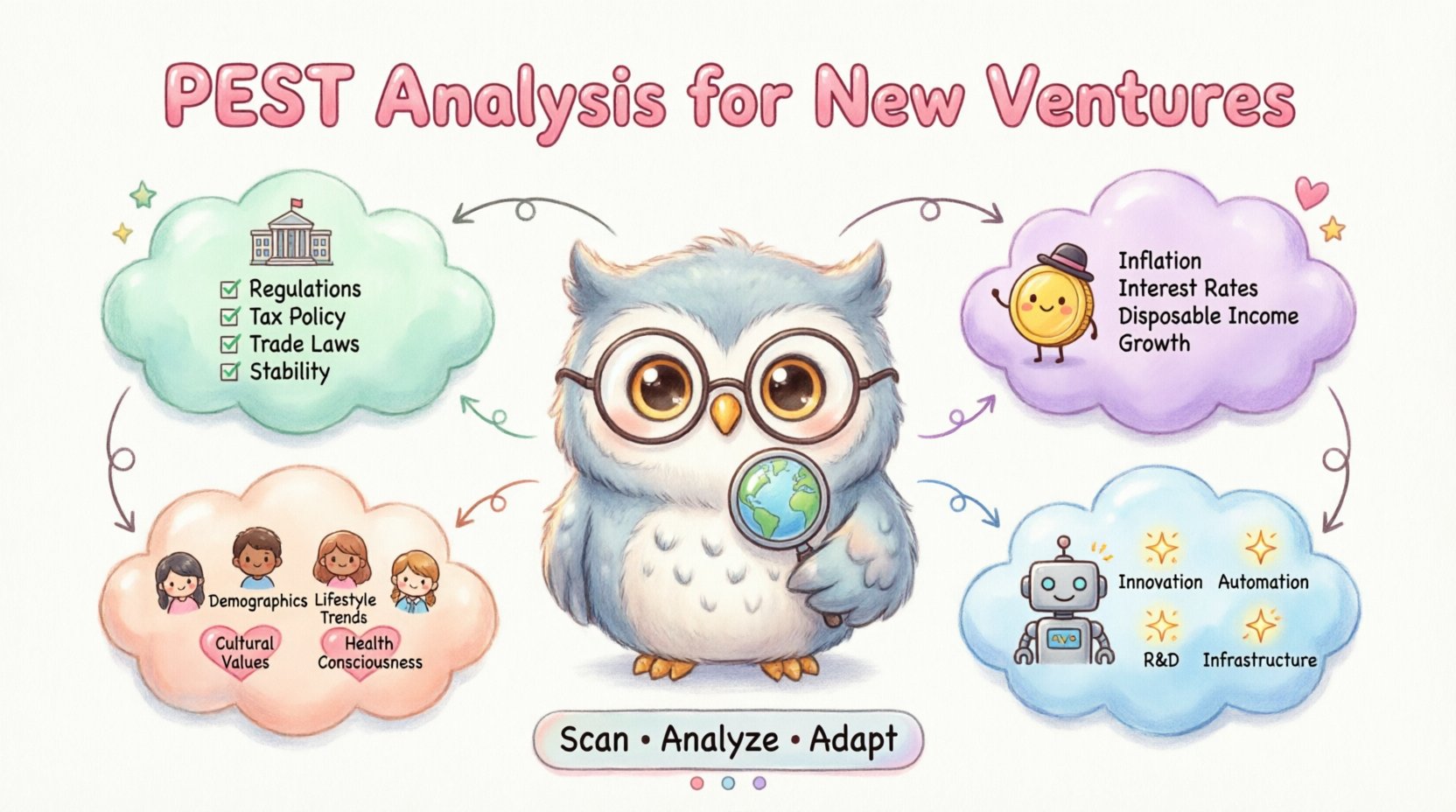
PEST stands for Political, Economic, Social, and Technological. It is a strategic tool used to scan the external macro-environment. Unlike internal audits, which focus on strengths and weaknesses, this analysis looks outward. New ventures often fail because they underestimate external pressures. A startup might have a brilliant product, but if regulations change or economic conditions tighten, success becomes elusive.
This framework helps organizations:
For a new venture, this analysis is not a one-time task. It is a living document that evolves as the market matures. Regular reviews ensure the business remains agile. Below is a summary of what each component represents.
| Factor | Focus Area | Key Questions |
|---|---|---|
| Political | Government influence, laws, stability | Are there trade restrictions? Is the tax environment favorable? |
| Economic | Growth, interest rates, inflation | How does disposable income affect demand? |
| Social | Demographics, culture, lifestyle | What are the population growth rates? Are values shifting? |
| Technological | Innovation, automation, R&D | What new tech disrupts the industry? Is infrastructure ready? |
Political factors refer to the extent to which government intervention affects the economy. For a new venture, this is often the most volatile category. Government actions can open doors or close them entirely. These factors include tax policy, labor law, environmental law, trade restrictions, and political stability.
When analyzing political factors, consider the following:
For example, a fintech startup must navigate complex banking regulations. Changes in anti-money laundering laws can require significant operational pivots. Monitoring legislative agendas helps founders prepare for these shifts. It is not enough to know current laws; one must anticipate future ones.
Economic factors determine the purchasing power of potential customers and the cost of capital. This section of the analysis looks at how macroeconomic conditions impact the business environment. Key indicators include inflation, interest rates, economic growth, exchange rates, and unemployment levels.
Consider these economic drivers:
Economic conditions vary by region. A venture might thrive in a booming market but struggle in a stagnant one. Diversifying revenue streams can mitigate these risks. Additionally, economic forecasting helps in setting realistic financial targets. Do not base projections on ideal scenarios. Stress-test your financial model against downturns.
Social factors relate to the cultural and demographic aspects of the external environment. This includes population growth, age distribution, health consciousness, and career attitudes. Understanding the target audience is crucial for product-market fit.
Key social trends to monitor:
Social analysis helps in marketing and product design. If a demographic is shrinking, the market potential is limited. Conversely, emerging trends can signal a blue ocean opportunity. For instance, the rise of health consciousness drove the growth of plant-based food ventures. Ignoring these shifts can lead to obsolescence.
Technological factors involve the impact of new innovations on the industry. This includes research and development activity, automation, and technological change. In the modern economy, technology is often the fastest-moving variable.
Focus on these technological elements:
Technology acts as both a tool and a disruptor. A venture must decide whether to adopt new tech to gain efficiency or to innovate to create new value. Failing to keep pace with technological advancements is a common reason for startup failure. Regular audits of the tech stack ensure relevance.
Conducting a PEST analysis requires discipline and access to reliable data. The process involves gathering information, interpreting it, and translating it into strategy. Follow these steps to execute the analysis effectively.
During this process, involve cross-functional teams. Sales teams know customer pain points, while finance teams understand economic pressures. Collaboration ensures a holistic view. Do not treat this as a paperwork exercise. The output must drive decision-making.
Completing the analysis is only the first step. The value lies in integration. How does this data influence your business plan? The results often feed into a SWOT analysis (Strengths, Weaknesses, Opportunities, Threats). External factors identified in PEST often become Opportunities or Threats in SWOT.
Consider these integration strategies:
Strategy is dynamic. As external factors shift, the plan must adapt. This is why regular reviews are essential. A quarterly review cycle is often sufficient for fast-moving sectors. Annual reviews work for slower-moving industries.
Even experienced strategists make mistakes when analyzing the environment. Being aware of these pitfalls helps maintain accuracy.
Imagine a startup launching a healthy meal delivery service in a major city. Applying the PEST framework reveals the following insights:
By synthesizing this data, the venture can price competitively, target the right demographic, and invest in the necessary logistics technology. This clarity reduces the risk of launching into a market that cannot support the business model.
It depends on the industry speed. For tech or fashion, update quarterly. For utilities or infrastructure, annual updates may suffice.
PESTLE includes Legal and Environmental factors. PEST is the core framework. For new ventures, PESTLE offers a more comprehensive view, especially regarding sustainability.
Yes. Internal teams can conduct this if they have access to market data. Consultants add value through specialized industry insights.
Conflicts are common. For example, economic growth might boost demand, but political instability might hinder operations. Prioritize based on your risk tolerance and strategic goals.
External environments shape the boundaries of business success. Ignoring them is a gamble. Using the PEST framework provides a disciplined method to navigate uncertainty. For new ventures, this clarity is invaluable. It transforms vague anxieties about the market into actionable intelligence.
Success is not just about having a great idea. It is about timing and fit. This analysis helps ensure the timing is right and the fit is solid. By continuously monitoring these four pillars, new ventures can build strategies that withstand external shocks. Adaptability remains the key to longevity in a changing world.
Start your analysis today. Gather the data. Map the landscape. Build a plan that accounts for the world as it is, and as it will be.