 Visual Paradigm Desktop |
  Visual Paradigm Online


Creating a structured list of work items is the foundation of any successful Agile initiative. This document outlines the process of constructing a functional Agile Product Backlog. We focus on practical steps that can be completed rapidly while maintaining quality and clarity. The goal is to establish a clear roadmap for your team without getting bogged down in administrative overhead.
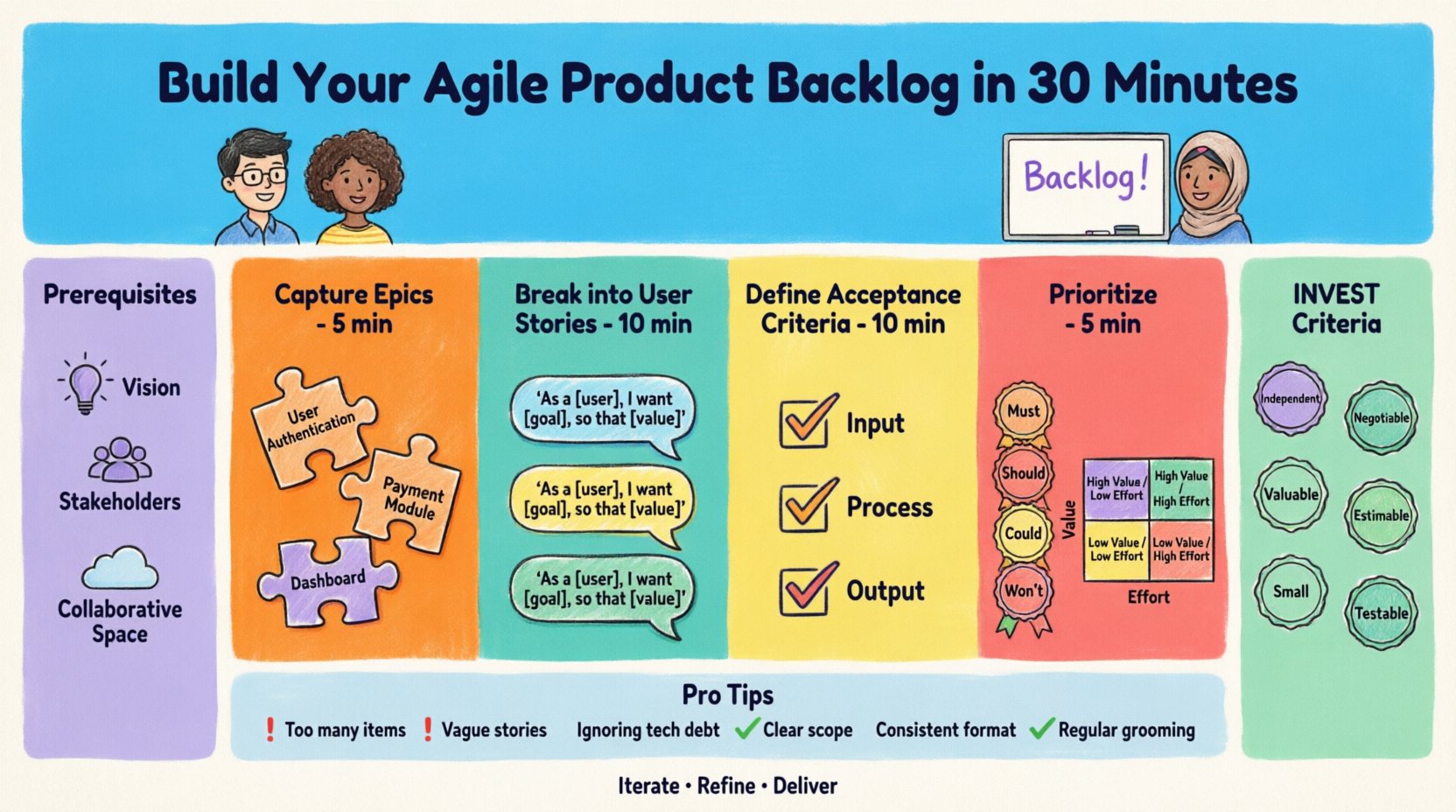
An Agile Product Backlog is an ordered list of everything that is known to be needed in the product. It is the single source of requirements for any changes to be made to the product. It is not merely a to-do list; it is a dynamic artifact that evolves as the product and market conditions change.
Without a well-maintained backlog, teams risk working on low-value features, missing critical dependencies, or burning out through scope creep. This guide ensures you have a solid starting point.
Before you begin populating the list, ensure you have the following elements in place. This preparation saves time during the actual creation phase.
Define the long-term goal of the product. What problem are you solving? Who is the target audience? Without a clear vision, backlog items will lack direction.
Gather initial requirements from key stakeholders. You do not need every detail, but you need the high-level needs to start framing epics.
Identify a physical or digital space where the team can view and edit the backlog. This could be a whiteboard, a shared document, or a management board. Avoid specific vendor names; focus on the utility of the tool.
This section details the process of filling out your backlog efficiently. We aim to complete the core structure in 30 minutes.
Start with the big picture. Epics are large bodies of work that can be broken down into smaller tasks. Do not worry about details yet.
Example:
Epics are too large for a single sprint. Break them down into User Stories. A User Story describes a feature from the perspective of the person who desires it.
Use the standard format:
As a [type of user], I want [some goal] so that [some reason].
Example Breakdown from Epic A:
A User Story is not complete without clear criteria for success. These are the conditions that must be met for the story to be considered done.
Use bullet points to list specific requirements. This removes ambiguity during development and testing.
| Component | Definition | Example |
|---|---|---|
| Input | What data is required? | Email address, Password |
| Process | What happens when the action is taken? | Validation check, Email sent |
| Output | What is the result? | Success message, Dashboard redirect |
Order the backlog items based on value and priority. The items at the top should be the most critical for the next sprint. Use a prioritization framework to make objective decisions.
Common methods include:
To ensure you are building the right things, use a structured approach for ordering items. This table outlines two common methods.
| Method | Best Used For | How It Works |
|---|---|---|
| MoSCoW | Regulatory compliance or strict deadlines | Categorize every item into one of four buckets. Focus only on “Must Have” for the first release. |
| Value vs. Effort | Resource-constrained teams | Score items on a 1-5 scale for Value and a 1-5 scale for Effort. Prioritize high value, low effort items. |
The quality of your backlog depends on the quality of your User Stories. Vague stories lead to wasted effort and misaligned expectations. Follow these guidelines to ensure clarity.
Ensure your stories meet these standards:
Write for the end-user, not the developer. Instead of saying “Implement API endpoint,” say “Allow users to retrieve their profile data.” This keeps the focus on value.
Include screenshots, mockups, or links to design files if available. Visual aids reduce interpretation errors significantly.
Building the backlog is not a one-time event. It requires continuous refinement, often called grooming. This ensures the top of the list remains ready for the next sprint.
During these sessions, the team should:
Even experienced teams make mistakes when setting up their backlog. Be aware of these common errors.
Once your backlog is populated, you need to estimate the effort required. This helps in sprint planning.
Use relative sizing rather than hours. Assign points (e.g., Fibonacci sequence: 1, 2, 3, 5, 8) based on complexity, effort, and risk.
Gather the team to vote on estimates. This encourages discussion and ensures shared understanding of the requirements.
Technical debt accumulates when quick solutions are chosen over robust ones. It must be managed explicitly in the backlog.
Ignoring debt will eventually slow down development. Treat it as a first-class citizen in your planning.
A backlog is a living document. It requires care to remain useful.
Consistency is key. If you stop updating the backlog, it becomes a historical record rather than a planning tool.
The backlog is a communication tool. It bridges the gap between business needs and technical execution.
Ensure the backlog is visible to everyone. If stakeholders cannot see the plan, they cannot provide feedback.
During refinement sessions, ensure developers and product owners agree on what “done” looks like.
Make sure the information is easy to find. Avoid burying critical details in long documents.
Requirements will change. This is normal in Agile. Do not resist change; adapt your backlog.
Never ignore a stakeholder request if it adds value. Re-evaluate the order and adjust the plan accordingly.
How do you know if your backlog is healthy? Look for these indicators.
| Indicator | Healthy State | Unhealthy State |
|---|---|---|
| Top Items | Well-defined, ready for sprint | Vague, missing acceptance criteria |
| Bottom Items | Low priority, possibly archived | High priority, buried deep in list |
| Size | Manageable, fits in view | Thousands of unlinked items |
| Updates | Updated weekly or bi-weekly | Static for months |
Building an Agile Product Backlog is a foundational skill for delivering value. By following these steps, you create a clear path for your team to follow. The process is iterative. As you gain experience, you will refine your own methods.
Focus on clarity, collaboration, and continuous improvement. A well-maintained backlog empowers your team to deliver high-quality products consistently. Start with the basics outlined here, and evolve your process as your product grows.
Remember, the goal is not perfection on day one. The goal is progress. Begin with a vision, break it down, prioritize, and start working. The backlog will mature alongside your product.