 Visual Paradigm Desktop |
  Visual Paradigm Online


In the complex landscape of software development and enterprise architecture, a disconnect often exists between high-level business strategy and the actual code running on servers. The Visual Paradigm ecosystem bridges this gap by harnessing the transformative synergy of AI, TOGAF ADM, ArchiMate, and UML. Rather than functioning as isolated disciplines, these components operate within a unified platform to create a seamless bridge from abstract ideas to implementation-ready blueprints.

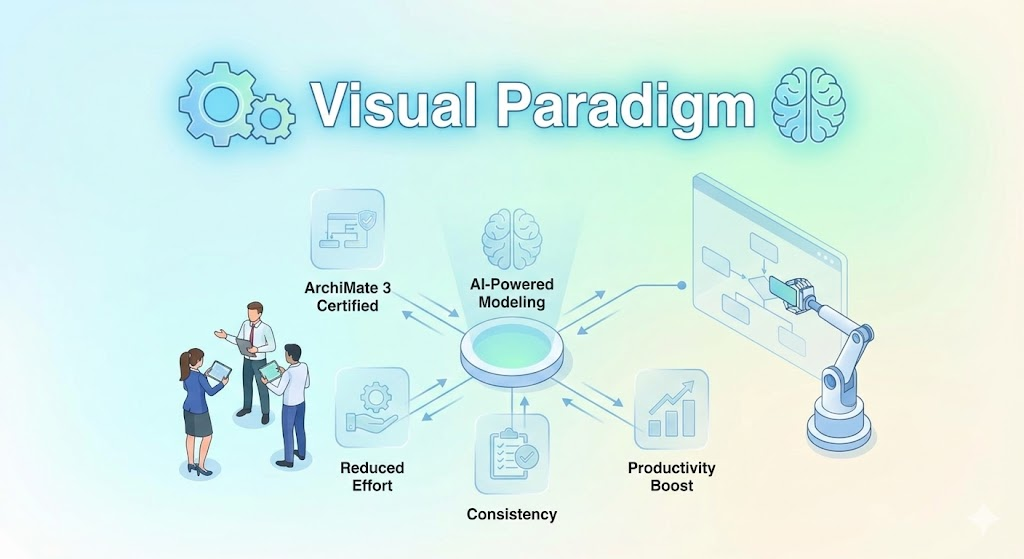
At the core of this ecosystem is Artificial Intelligence, acting as the engine that democratizes complex modeling standards. Traditionally, creating compliant models required deep expertise and hours of manual labor. Visual Paradigm’s AI transforms this into an automated, conversational workflow.

The AI component offers two distinct advantages:
While AI provides the speed, the TOGAF Architecture Development Method (ADM) provides the direction. It serves as the governance roadmap, ensuring that enterprise-scale transformations are managed through a structured lifecycle.
Visual Paradigm implements TOGAF ADM through specific features:
If TOGAF dictates the “how,” ArchiMate defines the “what.” It is the visual language used to describe the organization at an enterprise level, connecting business strategy to technology infrastructure.
ArchiMate facilitates this connection through:
As the architecture transitions from planning to execution, UML (Unified Modeling Language) provides the high-fidelity detail developers require. In the Visual Paradigm ecosystem, UML is not merely for documentation; it is an active development tool.
The true value of the Visual Paradigm ecosystem is realized when these four elements—AI, TOGAF, ArchiMate, and UML—are integrated into a single workflow. This eliminates the “blank canvas” problem and ensures all stakeholders share a conceptual baseline.
A typical integrated workflow proceeds as follows:
To visualize how these components interact, consider the construction of a building:
| Component | Analogy | Function |
|---|---|---|
| TOGAF ADM | The Building Code & Timeline | Ensures safety, compliance, and proper project sequencing. |
| ArchiMate | The City Map | Shows how the building fits into the neighborhood and connects to utilities. |
| UML | Blueprints (Electrical/Plumbing) | Provides the detailed instructions needed by the builders (developers). |
| AI | The Expert Architect & CAD System | Drafts the plans instantly and checks that pipes don’t hit wires before construction starts. |
By leveraging this integrated ecosystem, organizations can move from abstract strategy to concrete code with greater speed, accuracy, and alignment.
Streamlining Class Diagrams with Visual Paradigm’s AI: This article explains how Visual Paradigm’s AI-powered tools reduce the complexity and time required to create accurate class diagrams for software projects.
Mastering Sequence Diagrams with Visual Paradigm: AI Chatbot Tutorial: A beginner-friendly tutorial using Visual Paradigm to create sequence diagrams, illustrated through a real-world e-commerce chatbot use case.
Visual Paradigm AI: Streamlining Diagram Creation with AI: A YouTube tutorial demonstrating how Visual Paradigm’s AI features simplify the process of generating and refining software diagrams in real time.
Integrating AI Activity Diagrams into Your Visual Paradigm …: Sep 12, 2025 · Learn how to use AI -powered modeling software to generate and refine activity diagrams with natural language. Discover the benefits of AI chatbot diagram generation in UML workflows.
AI-Powered UML Class Diagram Generator by Visual Paradigm: An advanced AI-assisted tool that automatically generates UML class diagrams from natural language descriptions, streamlining software design and modeling.
Real-Life Case Study: Generating UML Class Diagrams with Visual Paradigm AI: A detailed case study showcasing how Visual Paradigm’s AI assistant successfully transformed textual requirements into accurate UML class diagrams in a real-world project.
Comprehensive Tutorial: Generate UML Class Diagrams with Visual Paradigm’s AI Assistant: Step-by-step guide demonstrating how to use Visual Paradigm Online’s AI assistant to create precise UML class diagrams from plain text input.
Creating a UML Class Diagram for a Library System Using AI and Visual Paradigm: A practical blog post that walks through building a UML class diagram for a library management system using Visual Paradigm’s AI assistant.
Interactive AI Chat for UML Class Diagram Generation: A conversational AI interface that allows users to generate UML class diagrams through natural language interaction directly in the browser.
AI-Assisted UML Class Diagram Generator – Visual Paradigm AI Toolbox: A dedicated AI-powered application that enables developers to generate UML class diagrams from text descriptions with minimal manual input.
Building a Hotel Reservation System Class Diagram with Visual Paradigm AI: A hands-on tutorial guiding users through the creation of a comprehensive UML class diagram for a hotel reservation system using Visual Paradigm’s AI capabilities.
Visual Paradigm – AI-Powered UML Sequence Diagrams: Learn how to generate UML sequence diagrams instantly using AI within Visual Paradigm’s advanced modeling suite.
AI-Powered Use Case Diagram Example for Smart Home System: A community-shared AI-generated use case diagram illustrating interactions between users and a smart home system, demonstrating real-world application of AI in UML modeling.
AI-Powered Use Case Diagram Refinement Tool by Visual Paradigm: A smart AI feature that enhances and refines existing use case diagrams by suggesting improvements, identifying missing actors, and optimizing structure.
AI Use Case Description Generator by Visual Paradigm: An AI-powered tool that automatically generates detailed use case descriptions from user inputs, speeding up system analysis and documentation.
Master AI-Driven Use Case Diagrams: A Short Tutorial: A concise tutorial from Visual Paradigm on leveraging AI to create, refine, and automate use case diagram development for faster delivery.
AI-Powered Sequence Diagram Refinement Tool | Visual Paradigm: Discover how Visual Paradigm’s AI Sequence Diagram Refinement Tool enhances UML modeling by automatically improving and optimizing sequence diagrams with intelligent suggestions.
AI Sequence Diagram Refinement Tool | Visual Paradigm: Use AI to automatically refine and optimize your sequence diagrams for better readability, correctness, and consistency.
From Simple to Sophisticated: AI-Powered Sequence Diagram Refinement Tool: Explore how Visual Paradigm’s AI-powered tool evolves simple diagrams into sophisticated, accurate models with minimal effort.
Generate Activity Diagrams from Use Cases Instantly with Visual Paradigm’s AI: Discover how Visual Paradigm’s AI engine enables rapid, accurate conversion of use cases into professional activity diagrams with minimal effort.