 Visual Paradigm Desktop |
  Visual Paradigm Online


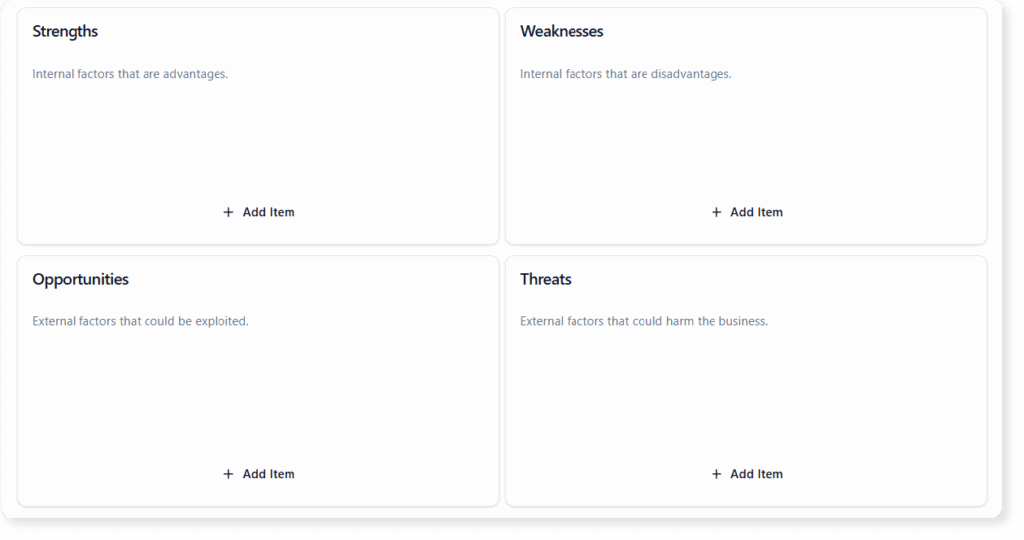
In the fast-paced world of business, relying on intuition alone is a recipe for failure. Strategic planning requires a structured approach to dissecting an organization’s position within the market. The SWOT Analysis Canvas serves as this foundational framework, allowing businesses to visualize their trajectory by examining internal and external factors.
However, the traditional method of brainstorming with sticky notes is evolving. With the integration of Artificial Intelligence (AI), strategic planning has shifted from a static exercise to a dynamic, data-driven process. This guide explores the core methodologies of SWOT analysis and demonstrates how modern AI toolkits, such as those provided by Visual Paradigm, are revolutionizing the way strategies are formulated.
Before diving into advanced AI applications, it is crucial to understand the four pillars of the SWOT framework. These categories help distinct internal attributes from external environmental conditions.
A common point of confusion is differentiating between internal and external factors. A simple rule of thumb is control. Internal factors (Strengths and Weaknesses) are within your organization’s control and can be changed. External factors (Opportunities and Threats) happen outside the organization; you cannot change them, but you can adapt to them.
To better understand how the SWOT Analysis Canvas applies across industries, consider the following real-world examples.
A community-focused bookstore in a downtown area faces pressure from online giants but thrives on local engagement.
| Category | Analysis Points |
|---|---|
| Strengths | Strong community ties, knowledgeable staff, curated selection of local authors. |
| Weaknesses | Limited inventory space, higher prices compared to Amazon, limited e-commerce presence. |
| Opportunities | Hosting author events/workshops, partnering with local coffee shops, creating a subscription book box. |
| Threats | Rising rent costs, digital e-readers, supply chain disruptions. |
A new project management SaaS tool is entering a highly crowded market dominated by established players.
| Category | Analysis Points |
|---|---|
| Strengths | Agile development team, modern UI/UX, AI-native features. |
| Weaknesses | Low brand recognition, limited marketing budget, small customer support team. |
| Opportunities | Remote work trends increasing demand, potential for API integrations with niche tools. |
| Threats | Aggressive pricing from giants (e.g., Jira, Asana), data privacy regulations (GDPR). |
A high-level look at the electric vehicle and clean energy leader.
Modern strategic planning tools have moved beyond simple diagramming. Visual Paradigm’s AI model canvas toolkit introduces intelligent automation to the SWOT process, solving the common problem of “blank page syndrome.”
Instead of spending days researching a competitor, AI can generate a baseline analysis instantly. By inputting a simple prompt, the system scrapes known data and market sentiment to populate the canvas.
Example Prompt: “SWOT Analysis for Starbucks”
AI Output Result: The AI generates a comprehensive breakdown listing global brand presence as a strength, market saturation as a threat, and expansion into tea-drinking markets as an opportunity.
Stuck on identifying ‘Opportunities’? The AI engine can analyze your stated ‘Strengths’ against current market trends to suggest avenues for growth. This ensures that your strategy is not just introspective but also market-aware.
Strategic analysis requires concentration. Tools like Focus Mode allow teams to isolate specific quadrants, such as ‘Threats’. In this mode, users can:
A SWOT analysis is useless if it does not lead to action. This is where the TOWS Matrix comes into play. It is a derivative framework that matches internal factors with external factors to generate strategic options.
Visual Paradigm’s Strategic AI Analysis automates this synthesis:
Strategic planning is rarely a solo endeavor. Modern toolkits facilitate real-time collaboration, allowing board members and stakeholders to contribute simultaneously. Once the session is complete, the data—including the AI-generated Action Plan—can be exported to professional Word documents or PDF reports, ready for stakeholder presentation.
It is a strategic planning framework used to identify and analyze an organization’s Strengths, Weaknesses, Opportunities, and Threats. It helps businesses leverage what they do well, improve where they are lacking, seize new opportunities, and minimize risks.
To turn analysis into action, use the TOWS Matrix method. This involves cross-referencing your internal strengths and weaknesses with external opportunities and threats to define specific strategic initiatives, such as “Use Strength X to Capitalize on Opportunity Y.”
It streamlines the entire lifecycle by using AI to generate initial content, suggest missing data points, organize complex information via Focus Mode, and automatically synthesize strategies using the TOWS framework.
What Is the Business Model Canvas? Why Use Visual Paradigms & AI Tools: This comprehensive guide explains the Business Model Canvas, its core components, and how visual paradigms and AI-powered tools enhance strategic planning and business innovation.
AI-Powered Business Model Canvas Builder – Instant Strategy Design: An AI-driven tool that automates the creation of business model canvases, offering intelligent suggestions and real-time insights to accelerate business planning.
AI Canvas Tool – Intelligent Design for Business Frameworks: An AI-powered canvas application that helps users generate and refine business models, value propositions, and strategy frameworks with smart suggestions and automation.
AI Business Model Canvas Tool – Smart Strategy Development: A comprehensive AI-enhanced solution for building and refining business models with intelligent insights, real-time feedback, and collaborative features.
AI Canvas Editor Release Update: Introduces an AI-powered canvas editor that enhances diagram creation through intelligent suggestions and automated layout optimization.
AI-Powered Business Model Canvas Tool Guide: A step-by-step guide on using an AI-enhanced tool to generate and refine business model canvases with intelligent input and real-time recommendations.
Mission Model Canvas | AI-Powered Strategy Tool by VP: October 28, 2025 – Coordinate live sessions with your team using the built-in timer and export your final canvas or reports into professional formats such as Word, Markdown, or CSV. … The Mission Model Canvas is specifically designed for non-profits, government agencies, social enterprises, and any organization where the primary goal is mission achievement rather than profit.
Comprehensive Tutorial: AI-Powered Business Canvas Toolkit with Visual Paradigm: This page provides a detailed guide on using an AI-enhanced Business Model Canvas toolkit integrated with Visual Paradigm for automated business strategy development.
AI Canvas Tool – Visual Paradigm: An AI-driven tool within Visual Paradigm that enables users to generate and refine business canvases through intelligent automation and natural language input.
Mastering the Business Model Canvas with AI: Step-by-Step Guide Using Visual Paradigm: This blog post offers a structured walkthrough of leveraging AI capabilities in Visual Paradigm to create, customize, and optimize Business Model Canvases efficiently.
How the AI Business Model Canvas Builder Works – Visual Paradigm: This page explains the functionality of the AI-powered Business Model Canvas Builder, highlighting how machine intelligence automates canvas creation and strategic insight generation.
Deep Learning AI Canvas | Strategy Tools Analysis Canvas Template: Edit Localized Version: 深度學習 AI 畫布(TW) | 深度学习 AI 画布(CN) View this page in: EN TW CN · Visual Paradigm Online (VP Online) is an online diagram software that supports analysis canvases, various charts, UML, flowchart, rack diagram, org chart, family tree, ERD, floor plan, etc .
Product Canvas | AI-Powered Strategy Tool by VP: Build products people love. Combine strategy, design, and feedback into one visual space with our AI-powered Product Canvas to bring ideas to market faster.
Lean UX Canvas | AI-Powered Strategy Tool by VP: October 28, 2025 – Create a complete strategy framework in moments. Simply describe your vision, and the AI canvas generator transforms it into a structured, insight-rich canvas that helps you visualize, plan, and refine your next big idea.
Lean Canvas – Visual Paradigm: October 28, 2025 – Our application is designed to be your strategic partner, providing intelligent tools to enhance every step of your planning process for the Business Model Canvas. … Have a startup idea? Just enter ‘a mobile app for local home-cooked meal delivery’ and let our AI generate a complete Lean Canvas, outlining the problem, solution, and key metrics.