 Visual Paradigm Desktop |
  Visual Paradigm Online


In the dynamic landscape of modern business, traditional planning methods often focus heavily on mitigating risks and fixing weaknesses. While valid, this approach can sometimes stifle innovation. Enter the SOAR Analysis—a forward-thinking framework designed to harness an organization’s potential. By focusing on Strengths, Opportunities, Aspirations, and Results, SOAR shifts the conversation from “what is wrong” to “what is possible.”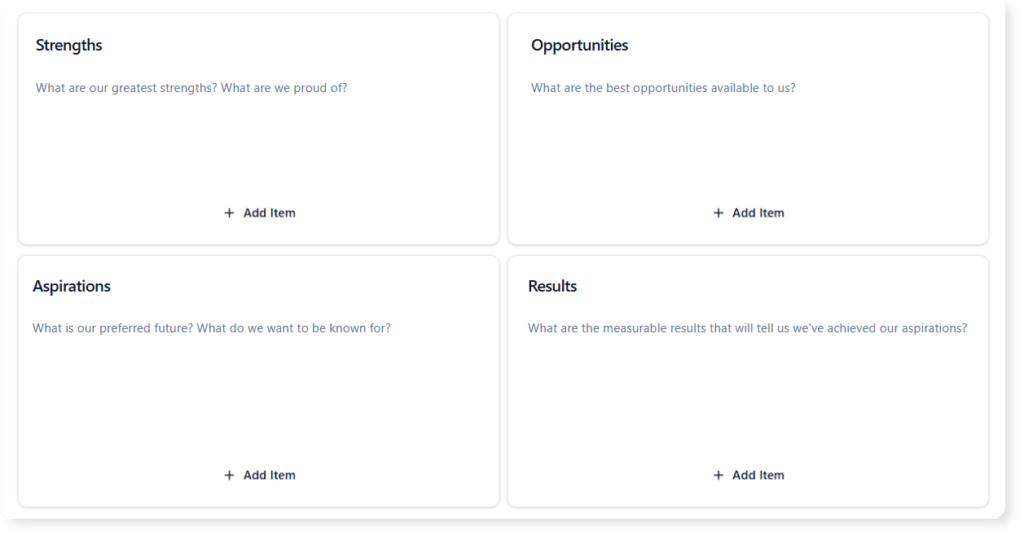
This comprehensive guide explores the mechanics of the SOAR framework, provides actionable guidelines for implementation, and demonstrates how Visual Paradigm’s AI-powered Business Canvas Toolkit can revolutionize your strategic planning sessions.
Before diving into execution, it is critical to understand the four pillars that constitute a SOAR analysis. Unlike SWOT, which balances positive and negative factors, SOAR is an Appreciative Inquiry tool that focuses almost exclusively on positive attributes and future potential.
While both frameworks are essential for strategic planning, they serve different psychological and tactical purposes.
| Feature | SWOT Analysis | SOAR Analysis |
|---|---|---|
| Focus | Analysis of current state (Good & Bad) | Possibilities for the future (Strengths & Vision) |
| mindset | Risk mitigation and competition | Innovation and collaboration |
| Starting Point | Internal and External Audit | Appreciative Inquiry |
| Outcome | Strategic Defense & Improvement | Strategic Growth & Alignment |
Strategic planning often stalls during the ideation phase or when trying to format complex ideas into a presentable document. Visual Paradigm’s AI-powered Canvas tool acts as a force multiplier for strategy teams, moving you from a blank page to a comprehensive plan in seconds.

The most significant hurdle in strategic planning is the “cold start.” With VP AI, you can generate an entire SOAR canvas from a single prompt. For example, by inputting “SOAR Analysis for a sustainable fashion brand,” the AI instantly populates the canvas with:
Beyond initial generation, the AI helps overcome writer’s block during the refinement phase. If your team struggles to articulate a specific “Opportunity,” the AI can review current market signals and industry transitions to spark new directions. Furthermore, the tool allows for deep dives; you can switch from a holistic canvas view to a focused view on a single section (e.g., Aspirations) to add categories, attach insights, and structure the narrative without distractions.
VP AI moves beyond simple list-making. It evaluates the logic of your canvas, checking if your opportunities realistically support your aspirations. Once finalized, the tool facilitates professional exports. You can transform your visual canvas and AI-generated insights into polished Word, Markdown, or PDF documents, ready for stakeholder presentations.
To conduct a successful SOAR analysis, follow this structured approach to ensure alignment and actionable outcomes.
Gather a diverse group of stakeholders. Because SOAR is based on strengths and aspirations, it benefits from a mix of leadership, frontline employees, and even customers. Set a positive tone by framing the session as an exploration of potential rather than a critique of performance.
Begin by mapping what exists today. Focus on tangible assets (capital, proprietary technology) and intangible assets (brand reputation, company culture). Use the VP AI tool to categorize these strengths to see which areas of the business are most robust.
Look outward. Analyze the external environment to find matches for your internal strengths. This step requires bridging the gap between what you are good at and what the market needs. Ensure these opportunities are realistic and actionable.
This is the creative phase. Encourage stakeholders to dream big. What should the organization be known for in 5 or 10 years? This section should be emotive and inspiring, driving the passion of the workforce.
Translate the aspirations into data. If the aspiration is “Market Leadership,” the result might be “40% market share.” Ensure every aspiration has a corresponding metric. This converts the strategic vision into a tactical roadmap.
Optimizing your strategic analysis requires more than just filling out boxes. Use these tips to enhance the effectiveness of your SOAR sessions.
What Is the Business Model Canvas? Why Use Visual Paradigms & AI Tools: This comprehensive guide explains the Business Model Canvas, its core components, and how visual paradigms and AI-powered tools enhance strategic planning and business innovation.
AI-Powered Business Model Canvas Builder – Instant Strategy Design: An AI-driven tool that automates the creation of business model canvases, offering intelligent suggestions and real-time insights to accelerate business planning.
AI Canvas Tool – Intelligent Design for Business Frameworks: An AI-powered canvas application that helps users generate and refine business models, value propositions, and strategy frameworks with smart suggestions and automation.
AI Business Model Canvas Tool – Smart Strategy Development: A comprehensive AI-enhanced solution for building and refining business models with intelligent insights, real-time feedback, and collaborative features.
AI Canvas Editor Release Update: Introduces an AI-powered canvas editor that enhances diagram creation through intelligent suggestions and automated layout optimization.
AI-Powered Business Model Canvas Tool Guide: A step-by-step guide on using an AI-enhanced tool to generate and refine business model canvases with intelligent input and real-time recommendations.
Mission Model Canvas | AI-Powered Strategy Tool by VP: October 28, 2025 – Coordinate live sessions with your team using the built-in timer and export your final canvas or reports into professional formats such as Word, Markdown, or CSV. … The Mission Model Canvas is specifically designed for non-profits, government agencies, social enterprises, and any organization where the primary goal is mission achievement rather than profit.
Comprehensive Tutorial: AI-Powered Business Canvas Toolkit with Visual Paradigm: This page provides a detailed guide on using an AI-enhanced Business Model Canvas toolkit integrated with Visual Paradigm for automated business strategy development.
AI Canvas Tool – Visual Paradigm: An AI-driven tool within Visual Paradigm that enables users to generate and refine business canvases through intelligent automation and natural language input.
Mastering the Business Model Canvas with AI: Step-by-Step Guide Using Visual Paradigm: This blog post offers a structured walkthrough of leveraging AI capabilities in Visual Paradigm to create, customize, and optimize Business Model Canvases efficiently.
How the AI Business Model Canvas Builder Works – Visual Paradigm: This page explains the functionality of the AI-powered Business Model Canvas Builder, highlighting how machine intelligence automates canvas creation and strategic insight generation.
Deep Learning AI Canvas | Strategy Tools Analysis Canvas Template: Edit Localized Version: 深度學習 AI 畫布(TW) | 深度学习 AI 画布(CN) View this page in: EN TW CN · Visual Paradigm Online (VP Online) is an online diagram software that supports analysis canvases, various charts, UML, flowchart, rack diagram, org chart, family tree, ERD, floor plan, etc .
Product Canvas | AI-Powered Strategy Tool by VP: Build products people love. Combine strategy, design, and feedback into one visual space with our AI-powered Product Canvas to bring ideas to market faster.
Lean UX Canvas | AI-Powered Strategy Tool by VP: October 28, 2025 – Create a complete strategy framework in moments. Simply describe your vision, and the AI canvas generator transforms it into a structured, insight-rich canvas that helps you visualize, plan, and refine your next big idea.
Lean Canvas – Visual Paradigm: October 28, 2025 – Our application is designed to be your strategic partner, providing intelligent tools to enhance every step of your planning process for the Business Model Canvas. … Have a startup idea? Just enter ‘a mobile app for local home-cooked meal delivery’ and let our AI generate a complete Lean Canvas, outlining the problem, solution, and key metrics.