 Visual Paradigm Desktop |
  Visual Paradigm Online
In the rapidly evolving landscape of software architecture and business analysis, the transition from manual diagramming to automated, intelligent modeling represents a significant paradigm shift. The Visual Paradigm (VP) AI Visual Modeling Platform stands at the forefront of this evolution. Unlike generic generative tools, VP AI integrates strict modeling standards with advanced artificial intelligence. This guide provides a deep dive into the platform’s architecture, its unique market position, and the strategic value it offers to modern enterprises.
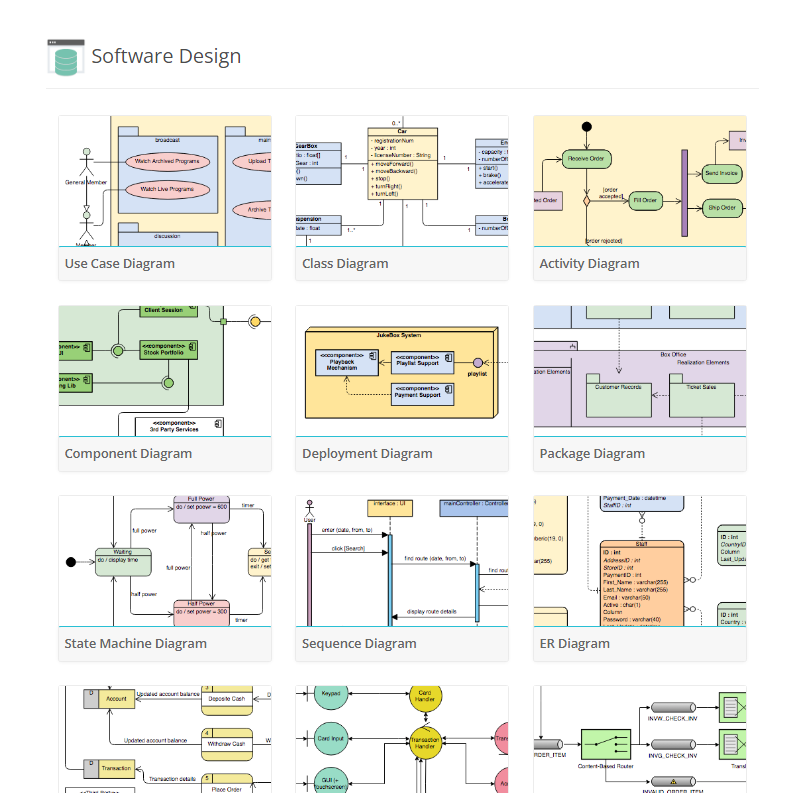
To fully appreciate the capabilities of the Visual Paradigm AI platform, it is beneficial to view it through the lens of the ArchiMate standard—a framework the platform itself rigorously supports. By dissecting the platform into Business, Application, and Technology layers, we can understand how it bridges the gap between high-level strategy and low-level implementation.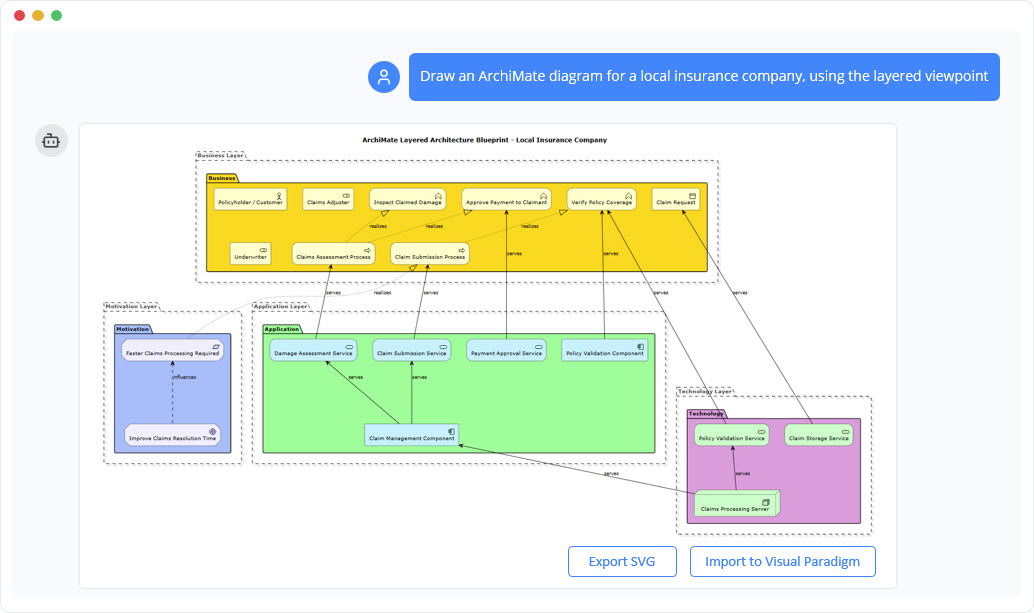
1. The Business Layer: Strategic Alignment
At the highest level, the platform is designed to serve business analysts, enterprise architects, and project managers. Its primary function in this layer is to align broad business goals with specific technical capabilities. Visual Paradigm AI supports this by integrating strategic frameworks directly into the modeling workflow. Users can leverage tools to generate SWOT analyses, PESTLE assessments, and BCG Matrices. This capability allows teams to rigorously assess market conditions and potential risks during the critical initiation phases of a project, ensuring that subsequent technical designs are rooted in sound business logic.
The core functionality of the platform resides within the Application Layer, where a suite of intelligent assistance tools operates. This suite includes an AI Chatbot, a 10-Step AI-Assisted Wizard, and AI-Powered Textual Analysis engines. These applications are engineered to facilitate the immediate generation of implementation-ready artifacts. Users can transform natural language descriptions directly into professional diagrams, including UML, BPMN, C4, and ArchiMate models. This layer effectively automates the translation of requirements into visual specifications.
Supporting the upper layers is a robust Technology Layer focused on infrastructure and code. The platform enables Cloud Application Architecture by allowing architects to map artifacts to physical or virtual nodes across major providers like AWS, Azure, and GCP via UML Deployment Diagrams. Furthermore, this layer bridges the gap between design and execution through Code Engineering capabilities. This includes database generation, schema reversal, and Hibernate ORM integration, ensuring that the visual models are not merely static pictures but active blueprints for development.
Visual Paradigm AI distinguishes itself by transforming modeling from a labor-intensive drawing chore into an automated, conversational workflow. While general Large Language Models (LLMs) can generate visual content, they often lack the technical rigor required for systems engineering. VP AI addresses this through several key differentiators:
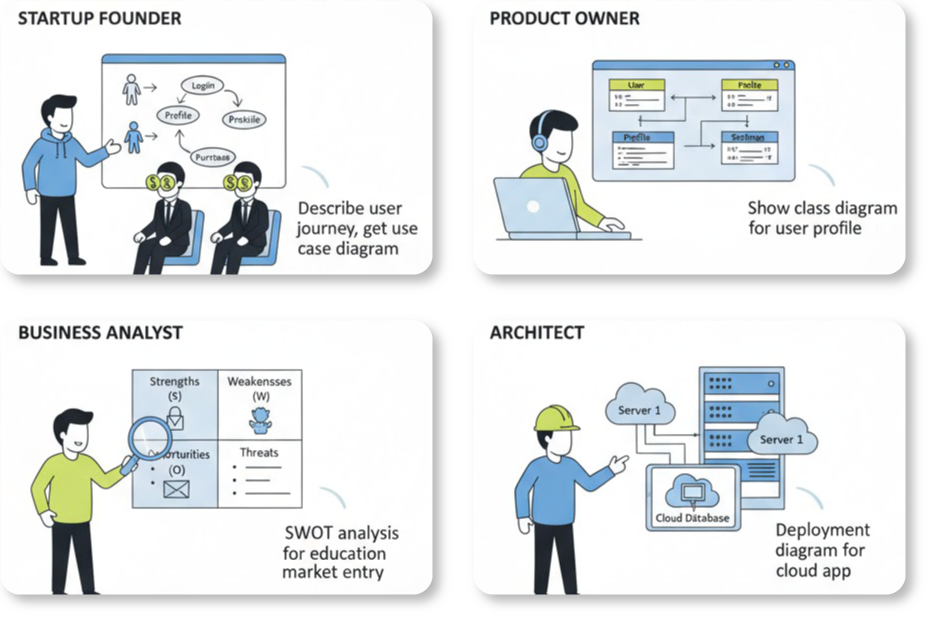
Adopting Visual Paradigm AI offers a “transformative power” that extends beyond simple diagram creation. It impacts the velocity and quality of the entire development lifecycle.
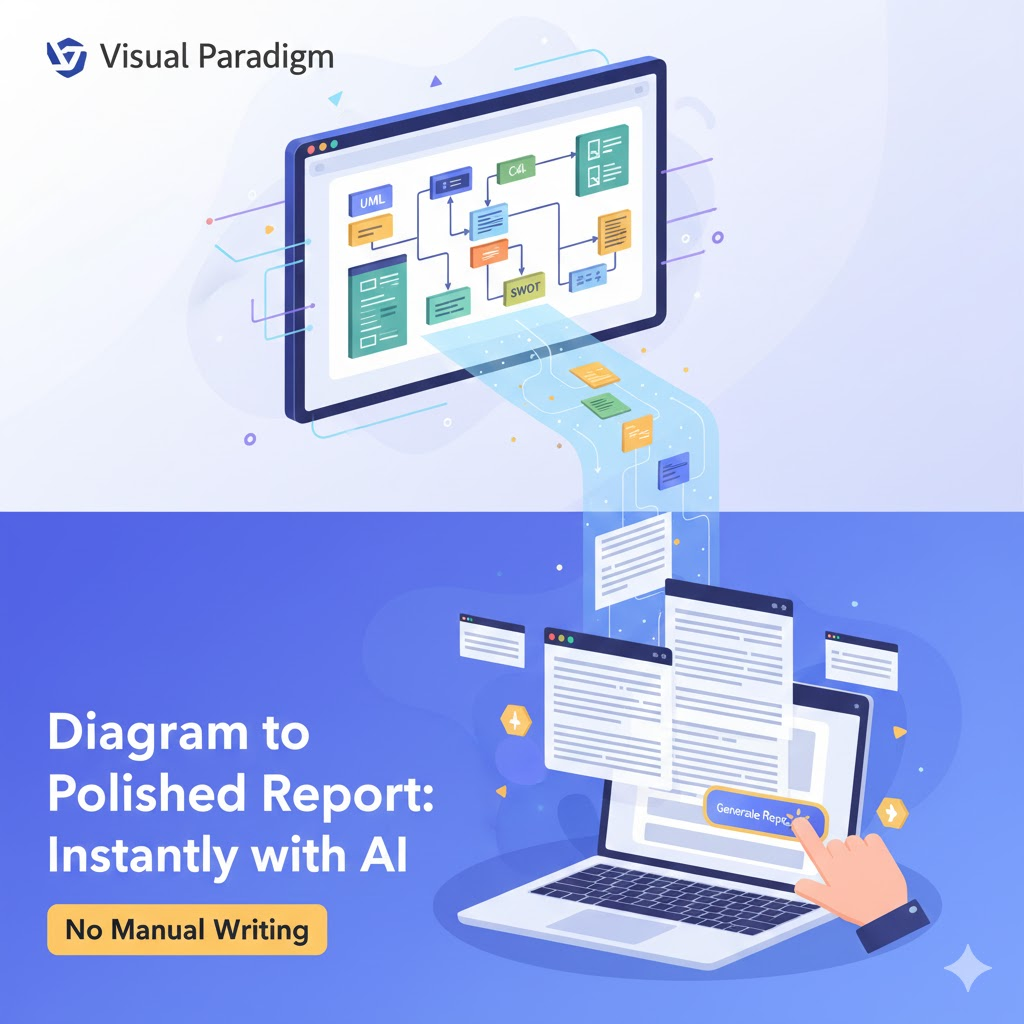
The platform eliminates the “blank canvas” paralysis that often stalls early-stage planning. By transforming abstract ideas into actionable, standardized models in seconds, teams can transition immediately from vague meetings to precise blueprints.
acting as a systematic design assistant, the AI provides architectural critiques. It can identify single points of failure, suggest robust design patterns like MVC, and highlight missing multiplicities, significantly reducing the technical debt caused by early design oversights.
Unlike standalone AI tools, diagrams generated here are not isolated. They can be imported directly into Visual Paradigm Desktop or Online. This allows for advanced operations such as version control, team collaboration, and simulation, integrating the AI output into the broader corporate environment.
With support for over 50 languages in both the UI and chat, the platform democratizes modeling for international teams. Furthermore, the 10-step guided wizard allows stakeholders with limited technical knowledge to contribute to complex system designs without needing to master the intricacies of modeling syntax.
To visualize the fundamental difference between generic AI tools and Visual Paradigm AI, consider the following analogy: A general LLM is like a talented sketch artist who can draw whatever you describe but may neglect structural necessities like load-bearing walls. Visual Paradigm AI is like an architect equipped with a CAD system who understands building codes and ensures the blueprint is viable for construction.
| Feature | General LLM / Sketch Tools | Visual Paradigm AI |
|---|---|---|
| Output Nature | Static Image / Approximation | Editable, Standard-Compliant Model |
| Standards Adherence | Low (often hallucinates syntax) | High (UML 2.5, ArchiMate 3, C4) |
| Refinement Workflow | Regenerates full image (loses layout) | Conversational updates (maintains layout) |
| Technical Depth | Surface level | Deep semantic understanding (Code Engineering, ORM) |
Streamlining Class Diagrams with Visual Paradigm’s AI: This article explains how Visual Paradigm’s AI-powered tools reduce the complexity and time required to create accurate class diagrams for software projects.
Mastering Sequence Diagrams with Visual Paradigm: AI Chatbot Tutorial: A beginner-friendly tutorial using Visual Paradigm to create sequence diagrams, illustrated through a real-world e-commerce chatbot use case.
Visual Paradigm AI: Streamlining Diagram Creation with AI: A YouTube tutorial demonstrating how Visual Paradigm’s AI features simplify the process of generating and refining software diagrams in real time.
Integrating AI Activity Diagrams into Your Visual Paradigm …: Sep 12, 2025 · Learn how to use AI -powered modeling software to generate and refine activity diagrams with natural language. Discover the benefits of AI chatbot diagram generation in UML workflows.
AI-Powered UML Class Diagram Generator by Visual Paradigm: An advanced AI-assisted tool that automatically generates UML class diagrams from natural language descriptions, streamlining software design and modeling.
Real-Life Case Study: Generating UML Class Diagrams with Visual Paradigm AI: A detailed case study showcasing how Visual Paradigm’s AI assistant successfully transformed textual requirements into accurate UML class diagrams in a real-world project.
Comprehensive Tutorial: Generate UML Class Diagrams with Visual Paradigm’s AI Assistant: Step-by-step guide demonstrating how to use Visual Paradigm Online’s AI assistant to create precise UML class diagrams from plain text input.
Creating a UML Class Diagram for a Library System Using AI and Visual Paradigm: A practical blog post that walks through building a UML class diagram for a library management system using Visual Paradigm’s AI assistant.
Interactive AI Chat for UML Class Diagram Generation: A conversational AI interface that allows users to generate UML class diagrams through natural language interaction directly in the browser.
AI-Assisted UML Class Diagram Generator – Visual Paradigm AI Toolbox: A dedicated AI-powered application that enables developers to generate UML class diagrams from text descriptions with minimal manual input.
Building a Hotel Reservation System Class Diagram with Visual Paradigm AI: A hands-on tutorial guiding users through the creation of a comprehensive UML class diagram for a hotel reservation system using Visual Paradigm’s AI capabilities.
Visual Paradigm – AI-Powered UML Sequence Diagrams: Learn how to generate UML sequence diagrams instantly using AI within Visual Paradigm’s advanced modeling suite.
AI-Powered Use Case Diagram Example for Smart Home System: A community-shared AI-generated use case diagram illustrating interactions between users and a smart home system, demonstrating real-world application of AI in UML modeling.