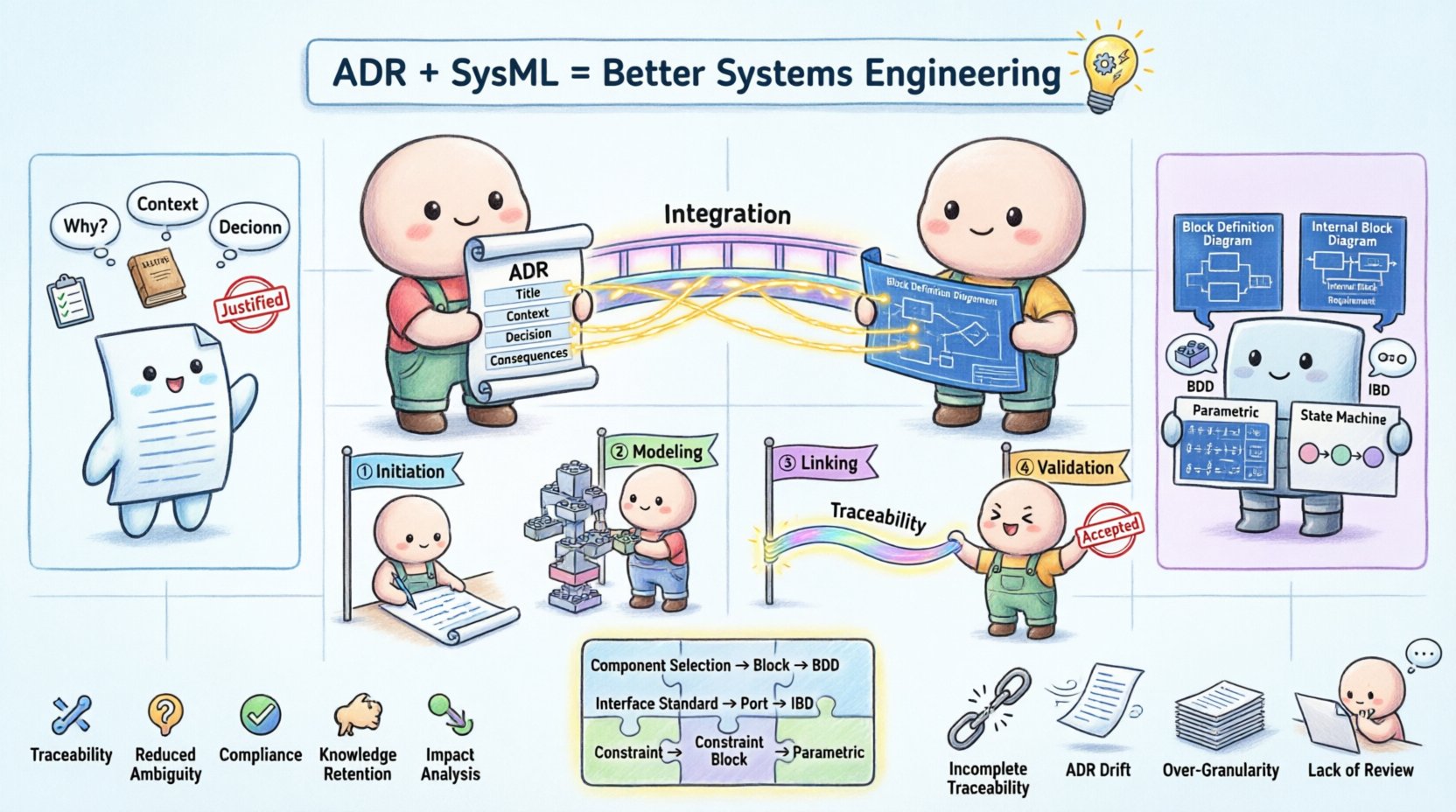
Systems engineering demands precision. When complex systems are built, the reasoning behind structural choices must be as documented as the structures themselves. This guide explores the integration of Architecture Decision Records (ADRs) with Systems Modeling Language (SysML) models. By linking textual justification with visual modeling, engineers create a robust traceability matrix that supports governance and maintenance.
Engineering decisions impact performance, cost, and safety. Without a clear record, future iterations of a system may lose context. Integrating ADRs directly into the modeling environment ensures that every block, requirement, and interface has a documented rationale. This approach bridges the gap between abstract reasoning and concrete design.
📚 Understanding the Core Components
Before establishing integration, it is necessary to define the two primary artifacts involved. Understanding their individual purposes clarifies how they complement each other.
📝 Architecture Decision Records (ADRs)
An ADR is a short text document that captures a significant architectural decision along with the context and consequences. It is not merely a log of changes; it is a justification for a specific path taken.
- Purpose: To document why a specific technology, standard, or structure was chosen.
- Format: Typically includes Title, Status, Context, Decision, and Consequences.
- Benefit: Provides historical context for future engineers reviewing the system.
- Scope: Covers high-level strategic choices and specific technical implementations.
📊 Systems Modeling Language (SysML)
SysML is a general-purpose modeling language used to specify, analyze, design, and verify complex systems. It provides a graphical syntax for capturing system requirements and structures.
- Purpose: To visualize system behavior, structure, and requirements.
- Format: Uses specific diagrams like Block Definition, Internal Block, and Requirement diagrams.
- Benefit: Enables simulation and analysis of system dynamics.
- Scope: Covers the entire system lifecycle from concept to retirement.
🔗 Why Integrate ADRs with SysML?
Separating documentation from modeling creates silos. Engineers often read the model to understand the design, then consult external documents for the “why”. Integration eliminates this friction.
✅ Benefits of Integration
- Enhanced Traceability: Decisions link directly to the elements they influence.
- Reduced Ambiguity: The rationale is visible next to the implementation details.
- Compliance Support: Auditors can verify that decisions meet regulatory standards.
- Knowledge Retention: Institutional knowledge remains with the model, not in individual memories.
- Impact Analysis: Changing a decision becomes easier when the affected model elements are visible.
🛠️ Mapping Strategies for Integration
Connecting a text-based record to a graphical model requires a consistent method. The following strategies outline how to map specific ADRs to SysML elements.
📌 Mapping ADRs to Requirements
Many decisions stem from requirements. An ADR often validates that a requirement is feasible or defines the solution path.
- Link Type: Traceability Link.
- Direction: Requirement to ADR.
- Usage: When a requirement is decomposed, the ADR explains the solution selected to satisfy it.
🧱 Mapping ADRs to Blocks
Blocks represent system components. Decisions regarding component selection, interface standards, or physical constraints belong here.
- Link Type: Specification Link.
- Direction: Block to ADR.
- Usage: A Block Definition Diagram (BDD) element specifies which ADR governs its configuration.
🔌 Mapping ADRs to Interfaces
Interfaces define how systems interact. Decisions on communication protocols or data formats are critical here.
- Link Type: Association Link.
- Direction: Interface to ADR.
- Usage: An Internal Block Diagram (IBD) interface references the ADR detailing the protocol standard.
📋 Integration Mapping Table
The table below summarizes how different ADR types correspond to specific SysML diagram elements.
| ADR Topic |
SysML Element |
Diagram Type |
Traceability Goal |
| Component Selection |
Block |
Block Definition Diagram (BDD) |
Ensure component specs match decision |
| Interface Standard |
Port/Proxy |
Internal Block Diagram (IBD) |
Verify communication protocol |
| Constraint Setting |
Constraint Block |
Parametric Diagram |
Validate performance limits |
| Requirement Solution |
Requirement |
Requirement Diagram |
Trace solution to origin |
| State Transition Logic |
State Machine |
State Machine Diagram |
Justify state logic |
⚙️ The Integration Workflow
Implementing this integration requires a defined workflow. The process ensures that decisions are recorded before or during modeling, not after.
🚀 Step 1: Initiation
- Identify a significant decision point.
- Create a new ADR document with a unique identifier.
- Define the status as “Draft” or “Proposed”.
📐 Step 2: Modeling
- Create or update the SysML model based on the proposed decision.
- Apply the ADR identifier as a custom property or attribute to the relevant model element.
- Ensure the model reflects the consequences described in the ADR.
🔗 Step 3: Linking
- Establish a traceability link between the ADR and the model element.
- Label the link clearly (e.g., “Satisfies”, “Justifies”, “Refines”).
- Verify the link exists in the traceability matrix.
✅ Step 4: Validation
- Review the ADR with stakeholders.
- Confirm the model accurately represents the decision.
- Update ADR status to “Accepted”.
📝 ADR Structure for SysML Context
Standard ADR templates often need adjustment when used in systems engineering. The following structure includes fields specific to model integration.
- Decision ID: Unique identifier (e.g., ADR-001).
- Title: Brief summary of the decision.
- Status: Proposed, Accepted, Superseded, or Rejected.
- Context: What problem does this solve?
- Options Considered: What alternatives were evaluated?
- Decision: The chosen path.
- Consequences: Positive and negative outcomes.
- SysML Link: ID of the model element (e.g., Block ID, Requirement ID).
- Diagram Reference: Specific diagram where the decision is visible.
🔄 Managing Lifecycle Changes
Systems evolve. A decision that was valid at the concept phase may change during detailed design. Managing this drift is critical for maintaining integrity.
📉 Handling Superseded Decisions
- Do not delete old ADRs. Archive them.
- Create a new ADR that references the old one.
- Update the SysML model to reflect the new decision.
- Link the new model element to the new ADR.
- Mark the old ADR as “Superseded”.
📈 Version Control
- Version the ADR documents alongside the model files.
- Ensure the model version tag matches the ADR version tag.
- Use change logs to document the reason for version increments.
🧩 Example Scenario: Communication Protocol
To illustrate the integration, consider a decision regarding the communication protocol for a control system.
📄 ADR Content
- Title: Selection of Communication Protocol.
- Context: The system requires real-time data exchange between sensors and controllers.
- Options: Ethernet, CAN Bus, Wireless.
- Decision: CAN Bus selected due to noise immunity and determinism.
- Consequence: Higher latency than Ethernet, but robust in electromagnetic environments.
📊 SysML Representation
- Block: “SensorController”.
- Interface: “DataPort”.
- Traceability: The “DataPort” specification links to ADR-001.
- Constraint: A constraint block defines the “MaxLatency” parameter, derived from the ADR consequences.
🛑 Common Pitfalls to Avoid
Even with a good process, errors can occur. Awareness of common mistakes helps maintain quality.
❌ Incomplete Traceability
Creating the link but not updating it when the model changes. This leads to broken references and lost context.
❌ ADR Drift
Updating the model to match the decision, but not updating the ADR text. This creates a false record of what was decided.
❌ Over-Granularity
Creating ADRs for every minor change. Focus on decisions that impact the architecture significantly.
❌ Lack of Review
Writing ADRs in isolation without stakeholder sign-off. This reduces the authority of the record.
📏 Best Practices for Governance
Governance ensures the process is followed consistently across the engineering team.
- Standardized Naming: Use a consistent naming convention for ADRs and model elements.
- Access Control: Restrict who can modify ADRs and model links.
- Regular Audits: Periodically check for orphaned links (model elements without ADRs).
- Training: Ensure all engineers understand how to link and maintain these artifacts.
- Automation: Where possible, use scripts to validate that every critical block has an associated ADR.
🔍 Deep Dive: Parametric Diagrams and Decisions
Parametric diagrams define the mathematical relationships within a system. Decisions regarding constraints and equations are vital here.
- Equation Selection: The ADR specifies which physical model equations are used.
- Unit Systems: The ADR defines the unit system (SI vs Imperial) for the model.
- Solver Configuration: The ADR records the numerical methods chosen for simulation.
- Validation: The ADR notes how the model was validated against physical tests.
When a decision changes a parametric constraint, the traceability link ensures the solver does not run with outdated assumptions. This prevents simulation errors that could lead to costly redesigns.
🔍 Deep Dive: State Machine Diagrams
Behavioral decisions often reside in state machines. The transition logic is governed by architectural decisions.
- State Logic: The ADR justifies why a specific state is entered.
- Event Handling: The ADR defines how the system responds to specific triggers.
- Failure Modes: The ADR documents how the system handles errors within the state machine.
- Timeouts: The ADR sets the timing constraints for state transitions.
Integrating ADRs here ensures that the logic is not just functional but also safe and compliant with safety standards.
📈 Measuring Success
How do you know the integration is working? Use metrics to track the health of the system.
- Traceability Coverage: Percentage of critical blocks with linked ADRs.
- Link Validity: Percentage of links that are active and not broken.
- ADR Age: Average age of ADRs to ensure they are reviewed periodically.
- Change Frequency: How often ADRs are superseded (high frequency may indicate instability).
- Review Time: Time taken to review and approve new decisions.
🤝 Collaboration Across Disciplines
Systems engineering involves multiple disciplines. ADRs and SysML must serve all of them.
- Software Engineers: Use ADRs to understand hardware constraints modeled in SysML.
- Mechanical Engineers: Use ADRs to understand thermal and structural limits.
- Test Engineers: Use ADRs to understand the rationale behind test coverage requirements.
- Project Managers: Use ADRs to understand risk factors in the schedule.
When the model is the single source of truth, communication becomes more efficient. Everyone references the same decision ID.
🚧 Handling Legacy Models
Many organizations have existing SysML models without ADRs. Integrating retroactively is possible but requires effort.
- Audit Phase: Review existing models to identify critical decisions.
- Gap Analysis: Identify elements without documented rationale.
- Backlog Creation: Create a list of ADRs to be written.
- Priority: Focus on high-risk or high-cost decisions first.
- Documentation: Write the ADRs based on interviews and historical records.
- Linking: Establish the traceability links in the model.
This process turns a passive model into an active knowledge base.
📌 Summary of Key Points
- ADRs provide the “why” while SysML provides the “what” and “how”.
- Integration requires a defined workflow and consistent mapping strategies.
- Traceability links must be maintained throughout the system lifecycle.
- Version control is essential for managing changes and superseded decisions.
- Specific diagrams (Parametric, State Machine, BDD) require tailored ADR content.
- Governance and audits ensure the process remains effective over time.
By combining these two disciplines, engineering teams build systems that are not only technically sound but also well-understood and maintainable. The effort invested in documentation pays dividends in reduced risk and smoother lifecycle management.
 Visual Paradigm Desktop |
  Visual Paradigm Online