 Visual Paradigm Desktop |
  Visual Paradigm Online


Complex programs require stability amidst change. Leaders need to make decisions based on a single source of truth. Architecture Baseline Management provides the framework for this stability. When combined with Systems Modeling Language (SysML), the process becomes more rigorous and traceable. Program leadership relies on clear definitions of what is approved, what is proposed, and what is in progress.
This guide outlines the methodology for managing architecture baselines using SysML. It focuses on the structural, behavioral, and requirement aspects that drive program success. The objective is to establish control without stifling innovation. We explore the mechanisms for versioning, change control, and governance.
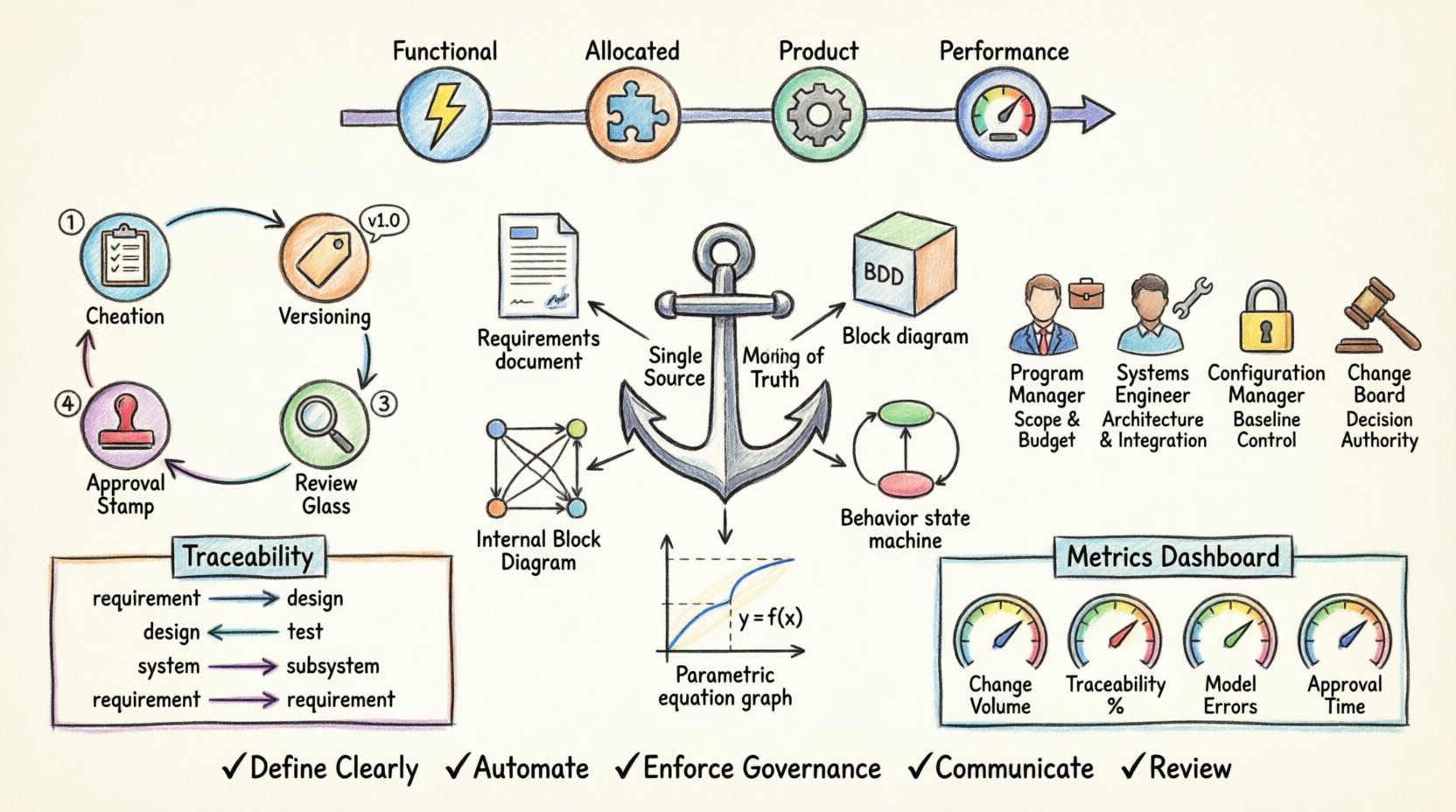
An architecture baseline is a snapshot of the system design at a specific point in time. It represents an agreed-upon state of the system. This snapshot serves as a reference for future development and verification. Without a baseline, changes accumulate without oversight. The result is a system that diverges from its intended purpose.
In the context of SysML, a baseline is not just a document set. It is a structured model. This model includes:
Leadership must understand that a baseline is a management tool. It is not merely a deliverable. It is the contract between the design team and the program office. It defines the scope of work for the next phase.
Traditional document-based approaches often suffer from fragmentation. A requirement in a Word file may not match a diagram in Visio. SysML unifies these artifacts into a single repository. This integration is critical for effective baseline management.
When managing baselines in SysML, the model acts as the central nervous system. Changes in requirements automatically highlight impacts on the design. This capability allows leaders to assess risk before approval.
Program leadership gains visibility into the system health. You can see where the system is drifting from the baseline without manual audits.
Different stages of the program require different types of baselines. Understanding these distinctions helps in governance. The following table outlines the common states.
| Baseline Type | Description | Usage Context |
|---|---|---|
| Functional Baseline | Defines what the system must do. | Early design and requirement allocation. |
| Allocated Baseline | Defines how requirements are assigned to blocks. | Subsystem definition and interface control. |
| Product Baseline | Defines the final physical design. | Manufacturing and deployment phases. |
| Performance Baseline | Defines parametric constraints and metrics. | Verification and validation testing. |
Each baseline represents a milestone. Progression from one to the next requires formal approval. In SysML, this is often managed through model versioning and tag values.
Establishing a baseline is a structured process. It involves creation, review, approval, and release. Each step must be documented within the model to ensure auditability.
Before a baseline is set, the model must be stable. This means all active requirements are linked to design elements. Unresolved issues should be flagged. The model should be in a consistent state.
Every baseline needs a unique identifier. In SysML, this is often achieved through model properties or version tags. This allows the team to revert to a previous state if necessary.
Leadership must review the proposed baseline. This is not just a signature exercise. It involves validating that the model reflects reality.
Once validated, the baseline is officially released. This status change is critical. It locks the scope for the current phase. Any changes after this point require a formal change request.
Successful baseline management requires clear roles. Ambiguity leads to unauthorized changes. The following table defines standard responsibilities.
| Role | Responsibility |
|---|---|
| Program Manager | Approves the baseline release and budget impact. |
| Systems Engineer | Ensures technical integrity and traceability. |
| Configuration Manager | Manages version control and model access. |
| Change Board | Evaluates the impact of proposed modifications. |
Leadership must enforce these roles. The Systems Engineer cannot approve a baseline without Program Manager sign-off. The Configuration Manager protects the model from accidental overwrites.
Change is inevitable. A program baseline must accommodate change without losing control. When a stakeholder requests a modification, a formal process is triggered.
SysML facilitates the Impact Analysis step. You can trace a requirement change through the blocks to the verification tests. This visibility prevents unintended consequences.
For example, changing a mass constraint on a block might affect the power budget. The parametric diagram shows this dependency immediately. Without this model, the impact might only be discovered during testing.
Traceability is the backbone of baseline management. It links requirements to design and verification. In a baseline state, this traceability must be complete.
When managing a baseline, leaders should audit these links. Broken links indicate gaps in the design. They signal areas where the baseline is fragile.
SysML provides native support for these links. The refine and satisfy relationships make these connections explicit. Tools can generate reports showing the coverage percentage. A baseline with low coverage is a risk.
How do you know if the baseline management is working? Metrics provide the answer. Program leadership should track these indicators regularly.
Tracking these metrics helps identify process bottlenecks. If approval cycle time is too long, the governance process may be too heavy. If traceability is low, the engineering effort needs more focus.
Several common mistakes undermine baseline management. Awareness of these pitfalls helps leadership avoid them.
Diagrams are for communication. The model is for data. If the model is not structured correctly, the baseline is weak. Ensure requirements are text-based and linked, not just labels on a diagram.
Drift occurs when changes are made without updating the baseline status. The model diverges from the approved version. Strict configuration management prevents this.
Not every detail needs to be baselined. Focus on the critical elements. Baseline everything can slow down progress. Identify the critical-to-quality attributes.
Tools do not manage baselines. People do. Training is essential. Engineers must understand the value of the baseline process. Resistance to change is a common barrier.
Programs involve multiple teams. Suppliers, internal departments, and contractors all contribute to the architecture. A unified baseline ensures everyone works from the same information.
In SysML, this is managed through model federation or shared repositories. Each team maintains their section of the model. The master baseline integrates these sections.
This collaboration reduces integration risk. When teams align on the baseline, the final assembly of the system goes more smoothly.
Programs span years. Technology evolves. The baseline must be adaptable. While the baseline provides stability, it should not lock the program into obsolete solutions.
Consider modularity in the architecture. Design blocks that can be swapped if technology changes. This allows the baseline to remain valid even if components are updated. The interface remains the same, even if the internal implementation changes.
This approach supports long-term sustainment. The program can evolve without breaking the core architecture. SysML supports this through extension mechanisms and profile usage.
To ensure success, follow these core principles.
Program leadership plays a pivotal role in this ecosystem. By demanding rigor and clarity, you set the tone for the entire program. The baseline is the anchor that keeps the project on course.
Managing architecture baselines is a discipline. It requires patience and attention to detail. The investment in a robust SysML-based process pays off in reduced risk and clearer decision-making. Leaders who embrace this structure gain a competitive advantage in program execution.
The goal is not perfection. The goal is control. With a well-managed baseline, uncertainty is reduced. The path forward becomes visible. This clarity is the foundation of successful program leadership.
Start by assessing your current state. Identify gaps in your traceability and versioning. Implement the processes step by step. Over time, the model becomes the true source of truth for your program.