 Visual Paradigm Desktop |
  Visual Paradigm Online


Product development does not happen in a vacuum. Every feature launched, every user experience tweak, and every strategic pivot exists within a broader ecosystem of forces. Among these, social dynamics play a pivotal role. When you integrate the Social component of the PEST analysis framework into your product roadmap, you gain a clearer view of human behavior shifts that dictate market success. This guide explores how to align your strategic planning with these evolving social currents without relying on hype or guesswork.
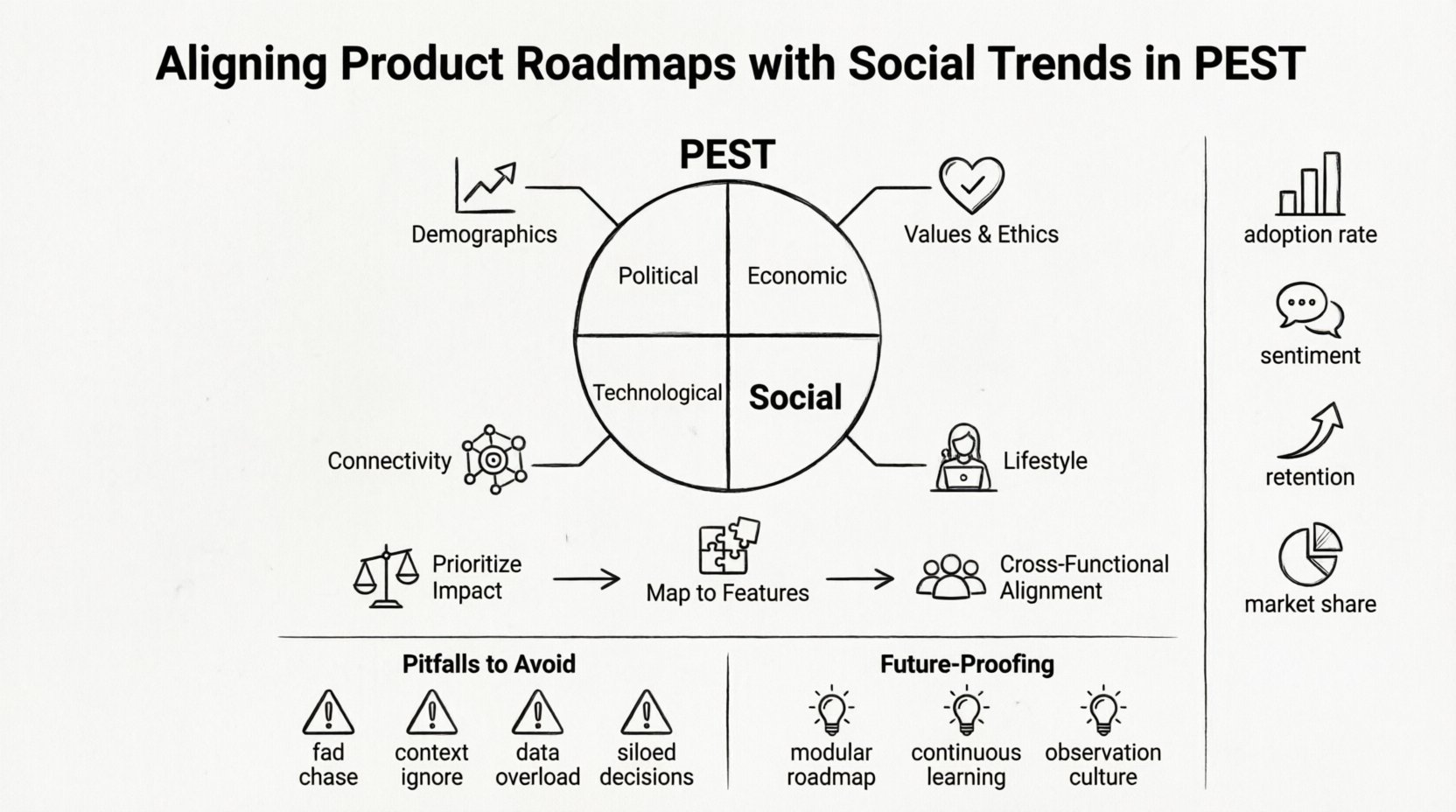
PEST analysis stands for Political, Economic, Social, and Technological. While often used for high-level market entry strategies, its application in product roadmap planning offers granular insights. Each letter represents a category of external factors that influence the viability and direction of a product.
While all four pillars are important, the Social element is increasingly becoming the primary driver of product adoption. Users do not just buy functionality; they buy alignment with their values, lifestyles, and identities. Ignoring this shift can lead to a roadmap that is technically sound but culturally irrelevant.
The speed at which social norms evolve has accelerated. A feature that resonates today might feel outdated in a year. By monitoring social trends, product teams can anticipate demand rather than react to it. This proactive stance reduces the risk of building solutions for problems that no longer exist.
Consider the shift towards remote work. Years ago, collaboration tools were niche. Today, they are essential infrastructure. Product roadmaps that anticipated this social shift captured significant market share. Conversely, products that ignored the move towards digital-first lifestyles faced obsolescence.
To effectively align your roadmap, you must first identify which social trends are relevant. Not every trend warrants a strategic pivot. Some are fleeting fads, while others represent fundamental shifts in how people live and work.
Here are key areas to monitor within the Social pillar:
Collecting data on these topics requires a mix of quantitative research and qualitative observation. You should look at census data, social media sentiment, and industry reports to build a comprehensive picture.
| Trend Category | Key Indicators | Impact on Product |
|---|---|---|
| Demographics | Age, location, income level | UI complexity, pricing tiers |
| Values & Ethics | Privacy, sustainability, fairness | Feature prioritization, data handling |
| Connectivity | Device usage, social platforms | Integration points, platform support |
| Lifestyle | Work patterns, leisure time | Accessibility, offline capabilities |
Once you have identified the relevant social trends, the next step is translation. How do abstract social shifts become concrete roadmap items? This process requires mapping insights to product capabilities.
Not all trends are equal. You need a framework to decide which ones to address. Use a scoring system that considers the size of the affected audience and the urgency of the need. A trend affecting 50% of your user base with high urgency should rank higher than a niche preference.
Ask yourself:
Once prioritized, map the trend to specific product requirements. For example, if the trend is increased privacy consciousness, the roadmap might include:
This ensures that the social insight directly influences the technical deliverables. It moves the conversation from “we want a privacy feature” to “we need a privacy feature to align with user values.”
Product roadmaps are not owned by the product team alone. Marketing, sales, and customer support must understand the social rationale behind the roadmap. When everyone understands the “why,” execution becomes smoother. Marketing can craft narratives that resonate with the trend, and support can prepare for new user inquiries related to it.
While this guide focuses on the Social aspect of PEST, it is crucial to recognize that these factors do not operate in isolation. The Social component interacts dynamically with Economic, Political, and Technological factors.
Economic pressures often dictate social behaviors. For instance, during periods of high inflation, consumers may shift towards value-oriented products or second-hand markets. A product roadmap that ignores economic reality might over-index on premium features that the market cannot afford.
Conversely, rising disposable income in certain demographics can unlock demand for luxury or convenience-based features. Understanding the economic backdrop helps contextualize the social trend.
Government policies shape social norms. Regulations around data privacy (like GDPR or CCPA) force changes in how users interact with products. Political stability also affects consumer confidence. If a region is politically volatile, users may prioritize security and reliability over new features.
Aligning your roadmap with political shifts ensures compliance and builds trust. It prevents the development of features that might become illegal or restricted in the near future.
Technology enables social change, and social demand drives technological adoption. The rise of mobile technology changed how people socialize. Now, the demand for seamless mobile experiences is a social expectation.
If your product relies on a technology that conflicts with a social value (e.g., high energy consumption when sustainability is trending), you face friction. Balancing technological capability with social expectation is key.
Implementing a trend-aligned roadmap is not a one-time event. You must measure the impact of your decisions to ensure you are moving in the right direction. Establishing clear KPIs allows you to validate whether the social trend integration is working.
Regular retrospectives are essential. Set intervals to review the roadmap against current social data. If a trend has peaked and is fading, adjust your strategy accordingly. Flexibility is a core component of successful planning.
Create direct channels for user feedback. Surveys, interviews, and community forums provide real-time data. This information helps validate your assumptions about social trends. Do not rely solely on third-party reports; your own users are the best source of truth regarding their own behaviors.
Even with a solid framework, mistakes can happen. Recognizing common traps helps you steer clear of them.
There is a difference between a trend and a fad. Fads are short-lived spikes in interest. Investing significant roadmap resources into a fad often results in wasted effort once the hype dies down. Look for longevity and structural change when selecting trends.
A trend in one region may not apply in another. A social shift in North America might be irrelevant in Asia. Global products must localize their social analysis. A one-size-fits-all approach to PEST analysis often fails in diverse markets.
There is too much data available. Trying to analyze every single data point leads to paralysis. Focus on high-signal indicators. Filter out noise. Quality of insight matters more than quantity of data.
When product teams work in isolation from market research, the connection to social trends is lost. Ensure that strategic planning involves input from various departments. Broad perspectives prevent blind spots.
The landscape of social trends is constantly shifting. What is relevant today may not be tomorrow. To stay ahead, build adaptability into your planning process.
Adopt a modular approach to your roadmap. Instead of rigid long-term plans, create flexible blocks that can be rearranged as social conditions change. This allows you to pivot without derailing the entire vision.
Invest in continuous learning. Encourage your team to stay informed about sociology, anthropology, and cultural studies. Understanding human behavior is just as important as understanding code or algorithms.
Make trend monitoring a routine part of your workflow. Dedicate time in sprint planning to discuss external factors. Ask: “How is the world changing?” and “How does that affect our users?” This keeps the social context alive in daily operations.
Aligning product roadmaps with social trends within a PEST analysis framework is a disciplined process. It requires patience, data, and a willingness to adapt. By focusing on the Social pillar, you ensure your product remains relevant to the people who use it.
Success comes from understanding the human behind the data. When you build for values, behaviors, and lifestyles, you create products that stand the test of time. The goal is not to predict the future perfectly, but to prepare for it intelligently.
Start by auditing your current roadmap against the current social landscape. Identify gaps. Prioritize the most significant shifts. Execute with clarity. This approach builds resilience and drives sustainable growth.