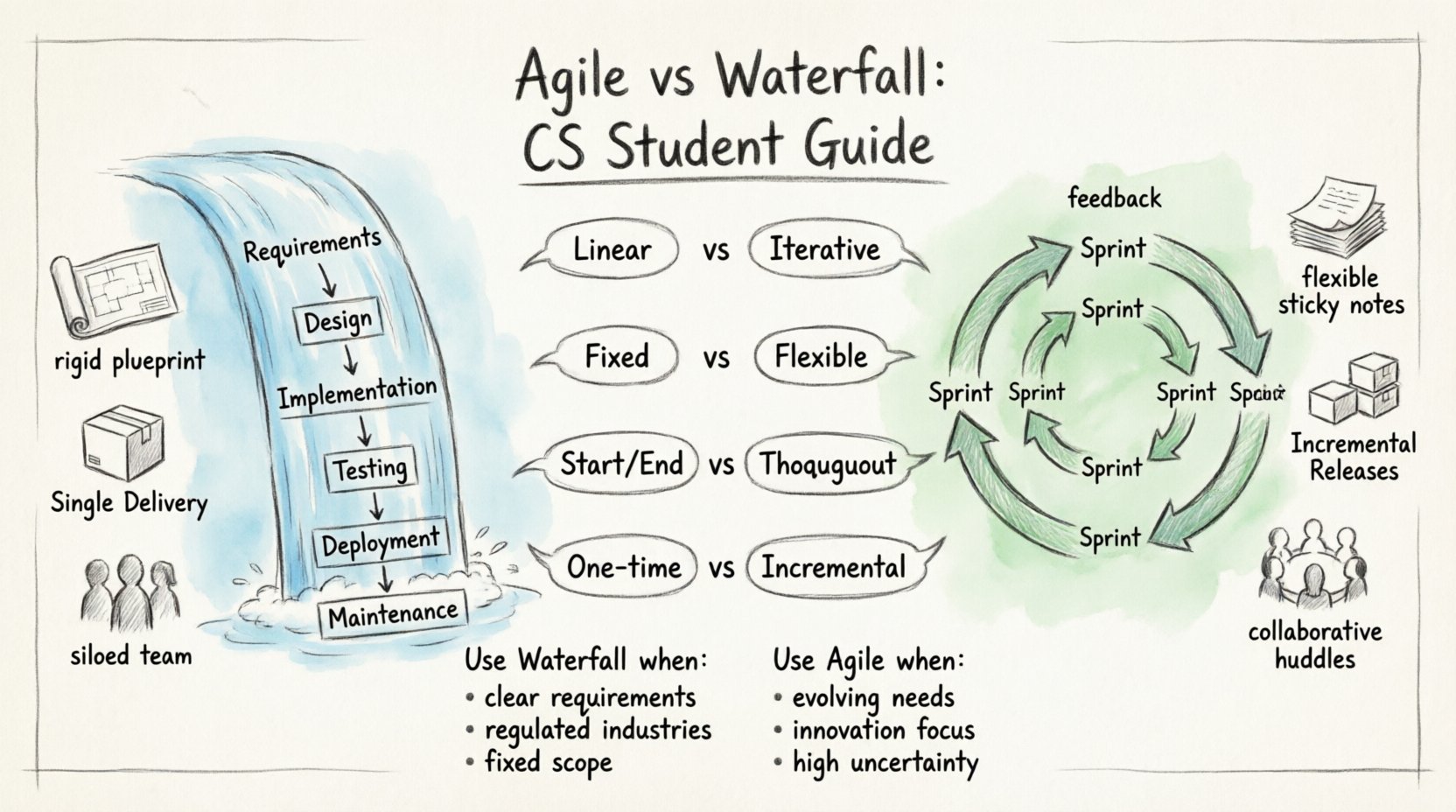
As a computer science student, you will encounter various frameworks and methodologies during your academic career and early professional life. Two of the most dominant approaches to software development are Agile and Waterfall. Understanding the distinctions between these models is crucial for managing projects, communicating with stakeholders, and delivering high-quality code. This guide provides a deep dive into both methodologies, helping you navigate the complexities of the software development lifecycle (SDLC) without relying on specific tools or sales pitches.
Understanding the Waterfall Model 🌊
The Waterfall model is one of the earliest approaches to software development. It follows a linear, sequential design process. Think of it like a waterfall where water flows down in one direction; once a stage is complete, the project moves to the next. There is no going back to previous stages without significant cost or effort.
Core Characteristics
- Sequential Phases: The process is divided into distinct stages. You cannot start the next stage until the current one is finished and approved.
- Heavy Documentation: Every phase requires detailed documentation before moving forward. This ensures clarity and a record of decisions.
- Rigid Planning: Requirements are defined upfront. Changes are difficult to accommodate once the project has started.
- Testing at the End: Quality assurance and testing typically occur after the development phase is complete.
The Phases of Waterfall
While variations exist, the standard Waterfall lifecycle generally includes these steps:
- Requirements Analysis: Gathering all necessary information about what the software needs to do. Stakeholders define the scope completely.
- System Design: Architects and engineers create a blueprint. This includes database design, hardware specifications, and interface layouts.
- Implementation: Developers write the actual code based on the design specifications.
- Testing: The system is tested for bugs, errors, and compliance with requirements. If issues are found, they are fixed, but scope changes are rare.
- Deployment: The software is released to the end-users.
- Maintenance: Ongoing support is provided after launch to fix issues or update the system.
Understanding Agile Methodology 🔄
Agile is a modern approach that contrasts sharply with Waterfall. It emphasizes flexibility, collaboration, and customer feedback. Instead of a long timeline with a single delivery at the end, Agile breaks the project into small, manageable chunks called iterations or sprints.
Core Characteristics
- Iterative Development: Work is done in cycles. Each cycle produces a potentially shippable product increment.
- Collaboration: Developers, testers, and business stakeholders work closely together daily.
- Adaptability: Requirements can change at any time. The team adapts to feedback rather than sticking rigidly to an initial plan.
- Continuous Testing: Testing happens throughout the development process, not just at the end.
The Agile Manifesto Principles
The foundation of Agile is built on four core values and twelve principles. Key takeaways for students include:
- Individuals and interactions over processes and tools.
- Working software over comprehensive documentation.
- Customer collaboration over contract negotiation.
- Responding to change over following a plan.
Within Agile, there are various frameworks like Scrum and Kanban. Scrum focuses on time-boxed iterations, while Kanban focuses on visualizing workflow and limiting work in progress.
Agile vs. Waterfall: A Detailed Comparison 📊
To truly grasp the differences, it helps to look at specific dimensions of project management. The following table outlines the primary distinctions.
| Feature |
Waterfall |
Agile |
| Structure |
Linear and Sequential |
Iterative and Incremental |
| Requirements |
Fixed at the beginning |
Flexible and evolving |
| Testing |
Post-development |
Continuous throughout |
| Client Involvement |
High at start and end |
High throughout |
| Risk Management |
Identified late |
Identified early and often |
| Documentation |
Heavy and detailed upfront |
Just enough, often just-in-time |
| Delivery |
One final delivery |
Multiple partial deliveries |
| Team Dynamics |
Specialized silos |
Cross-functional collaboration |
When to Use Waterfall 🏛️
Waterfall is not obsolete. It remains the best choice for specific types of projects where requirements are clear and stability is paramount.
- Clear and Fixed Requirements: If you know exactly what needs to be built and it is unlikely to change, Waterfall is efficient.
- Regulated Industries: Sectors like healthcare, finance, or aerospace often require strict documentation and traceability that fits the Waterfall model well.
- Short Projects: For small projects with a fixed deadline and scope, the overhead of Agile might not be necessary.
- Contractual Obligations: Some fixed-price contracts require a complete definition of scope before work begins, making Waterfall safer for legal and financial reasons.
- Technology Stability: When using established technology where risks are well-understood, the linear approach minimizes uncertainty.
When to Use Agile 🚀
Agile shines in environments where uncertainty is high and innovation is the goal. Most modern software startups and tech companies prefer this approach.
- Unclear Requirements: If the end-user needs are vague or evolving, Agile allows you to explore and refine them as you build.
- Complex Projects: Large-scale systems where features are interdependent benefit from iterative testing and integration.
- Need for Speed: If you need to get a product to market quickly to test an idea, Agile allows for early releases of core features.
- High Stakeholder Engagement: When clients want to be involved in the process and provide feedback regularly.
- High Risk: When the technology is new or the market is volatile, Agile reduces risk by validating assumptions early.
Implications for Computer Science Students 🎓
As a student, your choice of methodology affects how you structure your capstone projects, group work, and internships. Here is how these methodologies impact your daily workflow.
Project Management Skills
- Waterfall: You will practice detailed planning. You must learn to write comprehensive specifications before coding. This teaches discipline and foresight.
- Agile: You will practice prioritization. You must learn to decide what features are essential for the next iteration versus what can wait. This teaches adaptability and negotiation.
Code Quality and Testing
- Waterfall: You might write all code first, then test. This can lead to a “big bang” integration where many bugs appear at once.
- Agile: You will likely write unit tests alongside code. You will integrate frequently. This promotes cleaner code and fewer integration headaches.
Team Communication
- Waterfall: Communication is often formal. Hand-offs between design, coding, and testing are distinct events.
- Agile: Communication is constant. Daily check-ins ensure everyone knows what others are working on and if there are blockers.
Common Misconceptions ❌
There is a lot of noise in the industry regarding these methodologies. Let’s clear up some common misunderstandings.
1. Agile Means No Planning
Agile requires planning, but the planning is different. You plan the immediate future in detail while keeping the long-term vision flexible. You do not abandon planning; you just change the cadence.
2. Waterfall is Just Old and Bad
Waterfall is not inherently bad. It is a tool for specific jobs. In construction, for example, you cannot build the roof before the walls. Similarly, some software dependencies require a fixed sequence.
3. Agile is Only for Small Teams
Agile scales to large organizations. While it requires coordination, large enterprises use scaled frameworks to manage hundreds of developers working on the same product.
4. Agile is Faster Than Waterfall
Agile is not always faster. It is more predictable. Waterfall might deliver faster if requirements never change, but if they do, Agile saves time by preventing work on the wrong features.
Interview Preparation for CS Graduates 🎤
When applying for software engineering roles, you may be asked about your experience with development methodologies. Here are some points to consider when answering.
- Know the Basics: Be able to define both terms clearly without jargon.
- Provide Examples: If you used a specific method in a university project, explain why it was chosen. Did you know the requirements? Did they change?
- Discuss Testing: Mention how testing fits into your preferred workflow. Does it happen at the end or continuously?
- Show Flexibility: Employers value candidates who understand that one size does not fit all. Express willingness to adapt to the team’s needs.
Hybrid Approaches 🧩
In the real world, many teams do not stick strictly to one model. They create a hybrid approach.
- Water-Scrum-Fall: Planning and requirements are defined in a Waterfall style, development happens in Scrum sprints, and testing/release follows a Waterfall gate.
- Agile with Documentation: Teams use Agile for development but maintain the heavy documentation required by compliance regulations.
Understanding that these models exist on a spectrum allows you to tailor your approach to the specific constraints of your project. This nuance is often what separates a junior developer from a senior engineer.
Technical Decision Making 🛠️
When choosing a methodology for your own projects, consider the following technical factors:
- Architecture: Monolithic architectures often fit Waterfall better. Microservices often fit Agile better due to independent deployability.
- Database: If the schema is fixed and unlikely to change, Waterfall is easier. If the schema needs to evolve based on usage data, Agile is better.
- Dependencies: If your code relies heavily on external APIs that are not ready, Agile allows you to mock them and continue. Waterfall requires waiting.
- Security: Security requirements must be integrated. In Waterfall, they are checked at the end. In Agile, security reviews can happen in every sprint.
Building a Professional Portfolio 📁
As you build your portfolio, document which methodology you used for each project. Recruiters appreciate transparency regarding your process.
- For Waterfall Projects: Highlight your documentation skills. Show your requirements documents and design diagrams.
- For Agile Projects: Highlight your collaboration. Show how you handled changes and how you tested incrementally.
- For Both: Focus on the outcome. Did the software work? Was it delivered on time? Did it meet user needs?
Final Thoughts on Methodology Selection 🤔
The choice between Agile and Waterfall is not about picking the “best” method. It is about picking the right tool for the job. As a computer science student, you will face projects with different constraints. Some will be academic assignments with fixed deadlines and rigid grading rubrics. Others will be startup prototypes needing rapid iteration.
Developing the ability to assess a situation and recommend a workflow is a valuable skill. It demonstrates maturity and an understanding of the broader context of software engineering. Whether you are managing a team of five or working alone, the principles of structure and adaptability will guide your success.
Remember that methodologies are frameworks, not laws. They are meant to help you work better. As you progress in your career, you will likely find yourself using elements of both. The goal is to deliver value to the user efficiently and effectively. Keep learning, stay flexible, and focus on the code quality and user experience above all else.
 Visual Paradigm Desktop |
  Visual Paradigm Online