 Visual Paradigm Desktop |
  Visual Paradigm Online


The business landscape shifts with increasing velocity. Markets evolve, customer expectations change, and technological disruptions occur daily. In this environment, the traditional approach to project management often struggles to keep pace. Organizations are increasingly seeking a shift from rigid planning to adaptive execution. This transition is not merely a process change; it is a fundamental rethinking of how value is delivered. This guide explores the mechanics of agile transformation, focusing on practical steps to build a resilient, responsive organization.
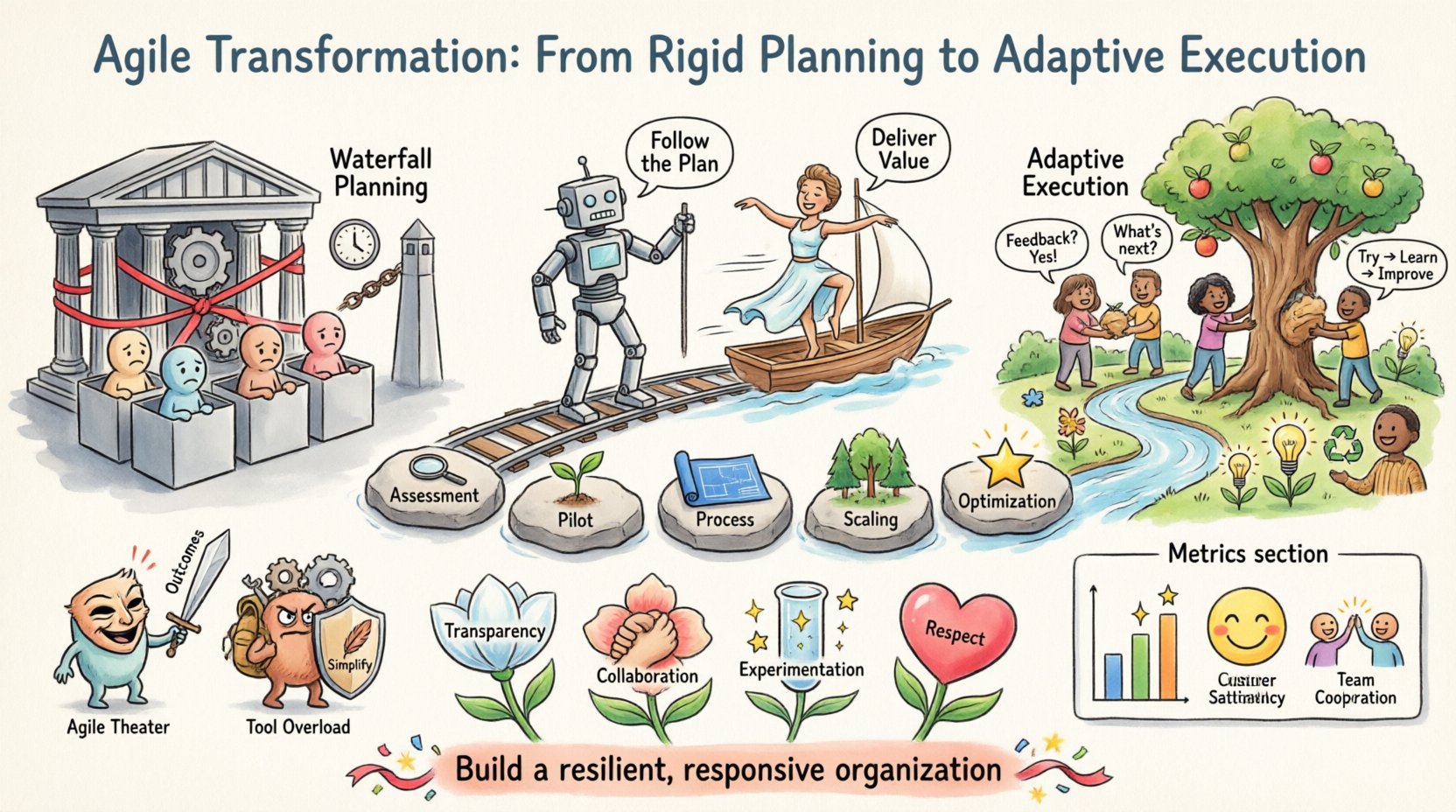
For decades, the industry relied on sequential planning models. These models assume that requirements can be fully understood and documented at the start of a project. While this works for construction or manufacturing where physical constraints are fixed, it often fails in knowledge work and software development. The reliance on fixed plans creates several systemic issues.
When planning is rigid, the organization loses the ability to pivot. The cost of change increases exponentially over time. Teams become focused on adhering to the plan rather than delivering value. This mindset creates friction between management and execution.
Adaptive execution prioritizes responsiveness over predictability. It acknowledges that uncertainty is inherent in complex work. Instead of trying to predict the future, teams focus on creating feedback mechanisms to learn quickly. The goal is to minimize the time between an idea and its realization.
This approach does not mean abandoning planning. It means planning in small increments. It involves setting a strategic direction while leaving the tactical details flexible until the last responsible moment. This allows teams to incorporate new information into their workflow continuously.
Key characteristics include:
| Feature | Rigid Planning | Adaptive Execution |
|---|---|---|
| Focus | Following the plan | Delivering value |
| Change Management | Resistant, costly | Embraced, low cost |
| Feedback Frequency | End of project | Continuous |
| Risk Mitigation | Upfront analysis | Ongoing testing |
| Success Metric | On time, on budget | Customer satisfaction, business value |
Technology and processes are easy to change. Culture is difficult. A transformation fails if the mindset of the people does not align with the new way of working. Trust must be built between leadership and teams. Blame must be replaced with accountability.
Leadership plays a critical role in this shift. Managers must transition from command-and-control to servant leadership. Their job is to remove obstacles, provide context, and protect the team from external noise. This requires letting go of the need to micromanage every detail.
Teams must also embrace ownership. This means accepting responsibility for outcomes rather than just outputs. It involves admitting mistakes early and treating them as learning opportunities. Psychological safety is essential here. If people fear punishment for failure, they will hide problems rather than solve them.
Key cultural pillars include:
Transitioning is a journey, not a flip of a switch. A phased approach reduces risk and allows for adjustment. Rushing often leads to resistance and burnout. Here is a structured path to guide the organization.
Many organizations attempt this transformation and struggle. Recognizing common traps helps avoid them. Below is a breakdown of frequent issues and how to address them.
| Pitfall | Impact | Solution |
|---|---|---|
| Agile Theater | Teams adopt rituals without changing behavior. | Focus on outcomes, not ceremonies. Ask “Why are we doing this?” |
| Hybrid Confusion | Halfway adoption leads to friction. | Choose one approach. Do not mix rigid and adaptive rules. |
| Leadership Resistance | Managers revert to old controls. | Train leaders on their new role as enablers. |
| Tool Overload | Teams spend more time managing software than working. | Keep tools simple. Use them to support work, not dictate it. |
Another common issue is the belief that agile means no planning. This is incorrect. Planning happens more frequently but at a smaller scale. It is about managing uncertainty, not eliminating it. Teams need clear goals but flexible paths to reach them.
How do you know if the transformation is working? Traditional metrics like “percent complete” are often misleading. They encourage teams to lie about progress to meet dates. New metrics should reflect flow and value.
It is important to track these metrics over time. One-off numbers do not tell the whole story. Trends reveal whether the organization is improving. Dashboards should be visible to the whole team. This promotes shared ownership of the data.
Transformation is not a one-time event. It requires constant maintenance. Markets change, and the way we work must evolve to match. Regular retrospectives are vital. These meetings allow teams to reflect on their process and make adjustments.
Training must be ongoing. New hires need to understand the culture from day one. Experienced staff need refreshers on new techniques. Knowledge retention is key to avoiding regression.
Leadership must remain committed. If leaders revert to old habits, the culture will erode. They must model the behavior they expect. Celebrating small wins keeps momentum going. Recognition should be tied to value delivered, not hours worked.
Building an adaptive organization is about creating a system that learns. It is about creating a safe environment where innovation can thrive. The goal is not to be agile for the sake of it. The goal is to be effective in a complex world. By moving from rigid planning to adaptive execution, organizations can navigate uncertainty with confidence. They become resilient, capable of withstanding shocks and seizing opportunities. This shift is the difference between surviving and thriving in the modern economy.
The path forward requires patience and commitment. It is not always smooth. There will be setbacks. However, the long-term benefits of flexibility and responsiveness far outweigh the short-term discomfort of change. Organizations that embrace this shift position themselves for sustainable growth. They build products that customers love and teams that are engaged. The future belongs to those who can adapt.