 Visual Paradigm Desktop |
  Visual Paradigm Online


Welcome to the beginning of your journey into Agile development. The transition from traditional methods to a framework like Scrum can feel overwhelming. It is not just about changing tools; it is about shifting your mindset towards collaboration, adaptability, and continuous improvement. This guide is designed to provide you with a structured path for your first seven days. By the end of this week, you will understand the core mechanics of the Scrum framework and how to integrate them into your daily workflow effectively. 🛠️
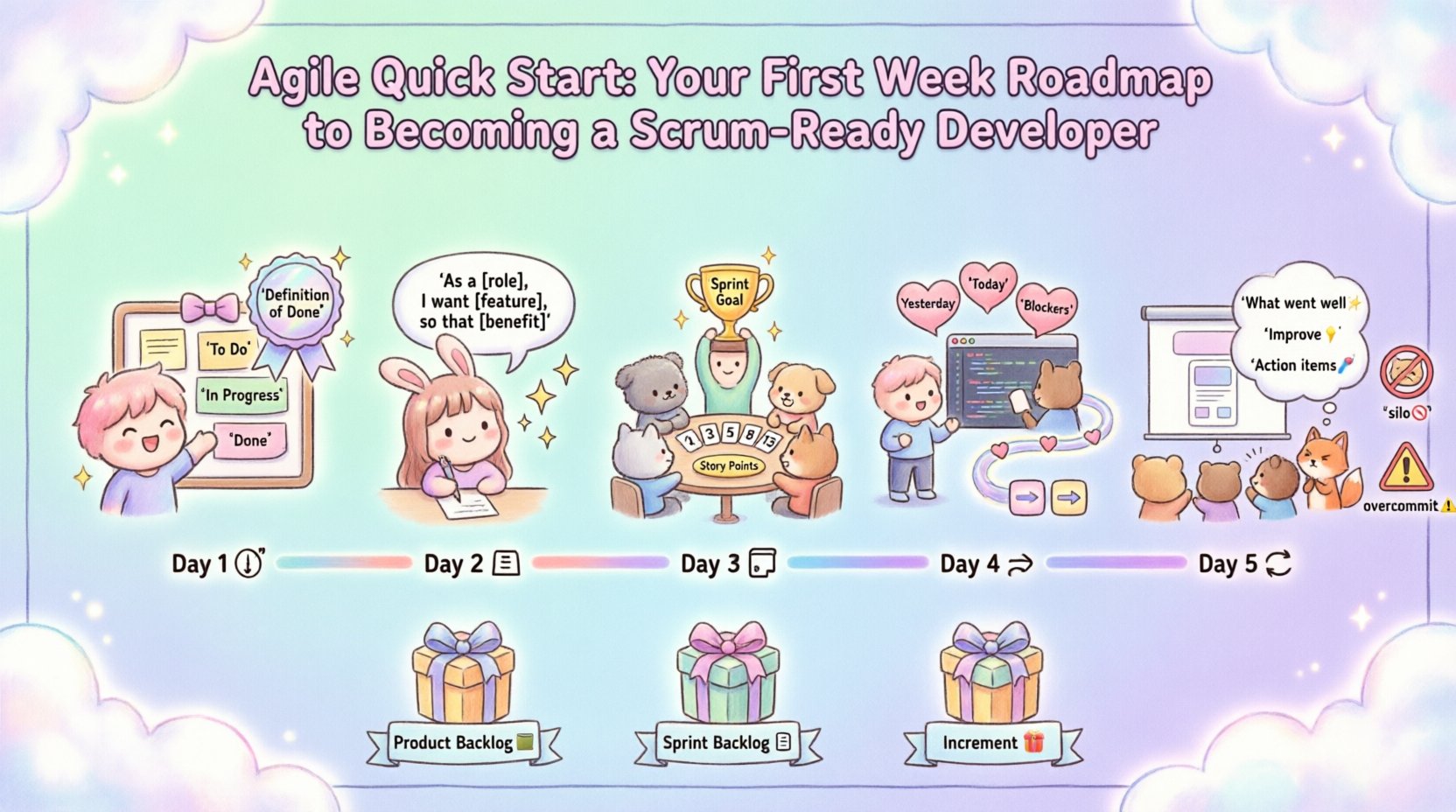
Entering a new development environment requires clarity. Without a clear understanding of how your team operates, progress can stall. Agile methodologies prioritize individuals and interactions over processes and tools. However, to have meaningful interactions, you need a shared language. This roadmap ensures you learn that language. You will move from passive observation to active contribution. The goal is to become a functional member of a Scrum team who understands the why behind every ceremony and artifact.
Throughout this week, we will focus on:
The first day is about setting the foundation. You do not need to write code immediately. Instead, focus on understanding the environment and the rules of engagement. Your primary task is to absorb the context in which you will be working.
Development in Agile is driven by value. We do not build features for the sake of building them; we build them to solve problems for users. This is captured in User Stories. Understanding how to read and write these is essential.
A standard User Story follows a specific structure:
As a [role], I want [feature], so that [benefit].
This format forces you to think about the who, the what, and the why. When you receive a story, your first job is to ask questions. If the benefit is vague, the story is likely incomplete.
Every User Story should have Acceptance Criteria. These are the conditions that must be met for the story to be accepted by the Product Owner. They act as the contract between the developer and the stakeholder. Look for stories that lack these criteria; this is a common sign of a backlog that needs grooming.
The Sprint Planning meeting is where the team decides what work they will tackle for the upcoming cycle. This is a collaborative event, not a top-down assignment. Your participation here sets the tone for the Sprint.
The meeting is typically divided into two parts:
Agile teams rarely use hours for estimation. Instead, they use relative sizing. This accounts for the complexity and effort relative to other stories. Common methods include:
Important: Estimation is an estimate, not a promise. It is a tool for planning, not a target for performance management. Avoid committing to specific deadlines; commit to the scope you believe you can handle within the timebox.
Once the Sprint begins, the focus shifts to execution. The Daily Standup (or Daily Scrum) is the heartbeat of the Sprint. It is a short meeting, usually 15 minutes, where the team synchronizes.
You should not treat this as a status report to the manager. It is a plan for the next 24 hours. When it is your turn to speak, cover three points:
The end of the Sprint is not the end of the work; it is the end of a cycle. Two major events occur to close the loop.
This is a demonstration of the work completed. The team shows the increment to stakeholders. It is not a formal presentation with slides. It is a hands-on walkthrough.
This meeting is for the team only. It is a safe space to discuss how the Sprint went. The goal is continuous improvement.
To help visualize the flow of your first week, refer to the table below.
| Day | Focus Area | Key Event | Outcome |
|---|---|---|---|
| 1 | Orientation | Team Intro & Backlog Review | Understand roles and Definition of Done |
| 2 | Requirements | Backlog Grooming | Learn to write/read User Stories |
| 3 | Planning | Sprint Planning | Commit to Sprint Goal and tasks |
| 4 | Execution | Daily Standup | Begin coding and clear impediments |
| 5 | Review & Reflect | Review & Retrospective | Demonstrate work and plan improvements |
Even experienced developers can stumble when new to Agile. Here are common traps to watch out for.
Agile requires collaboration. If you wait for a ticket to be assigned before you start thinking about it, you are working in a silo. Communicate early. Ask questions. Share your knowledge.
Completing code is not enough. The Definition of Done usually includes testing, documentation, and review. If you skip these steps, you are creating technical debt that will slow the team down later.
It is tempting to say yes to everything. If you overcommit, you will miss the Sprint Goal. It is better to commit to less and deliver consistently. Transparency is better than false promises.
The Retrospective is often the most valuable meeting. If you skip it, you miss the chance to improve your workflow. Treat it with respect. Speak up about what is hindering your productivity.
To be Scrum-Ready, you must understand the three core artifacts that provide transparency and inspection.
This is an ordered list of everything that is known to be needed in the product. It is the single source of requirements. It is never complete. It is dynamic and evolves as the product and environment evolve. As a developer, you may contribute items to this list, such as technical tasks required to support features.
This is the set of Product Backlog items selected for the Sprint, plus a plan for delivering the product Increment. It is a plan created by the Developers. It is visible to everyone. It changes during the Sprint as the team learns more about the work.
An Increment is a concrete stepping stone toward the Product Goal. It is the sum of all the Product Backlog items completed during a Sprint and the value of the increments of all previous Sprints. You must ensure that every Increment is in a usable condition, regardless of whether the Product Owner decides to release it.
Technical skills are vital, but communication is what makes a team function. In an Agile environment, communication is explicit and frequent.
Use the board. Move tickets as you work. If a ticket is stuck, move it to an “Blocked” column. This visual cue signals to the team that help is needed without you having to interrupt someone constantly.
Not everything needs a meeting. Use chat tools to share links, ask quick questions, or announce completion of a task. This reduces meeting fatigue and allows for deep work.
Seek feedback early. Show your code to a peer before you consider it finished. Ask the Product Owner if you are on the right track before you build the whole feature. This prevents wasted effort.
Speed is important, but quality is non-negotiable. Agile does not mean cutting corners.
Technical debt occurs when you choose an easy solution now instead of a better approach that would take longer. Sometimes this is necessary for speed, but it must be acknowledged. If you take on debt, you must create a task to pay it back. Do not let debt accumulate indefinitely.
To move fast without breaking things, you need confidence. Automated tests provide this confidence. Unit tests, integration tests, and end-to-end tests should be part of your Definition of Done. If a test fails, the work is not done.
Agile is not a destination; it is a continuous journey. Your first week is just the start. You will encounter changes in requirements, shifting priorities, and new challenges. The framework provides the structure to handle these changes gracefully.
Remember that the Scrum Guide is the foundation. It is the source of truth for the roles and events. If you find a process that does not align with the values of Agile, discuss it in the Retrospective. The goal is to find what works best for your specific team context while maintaining the core principles.
By following this roadmap, you build a solid foundation for your career in Agile development. You learn to deliver value consistently, collaborate effectively, and improve continuously. Welcome to the team. Let’s build something great. 🏗️