 Visual Paradigm Desktop |
  Visual Paradigm Online


Academic capstone projects represent the culmination of a student’s educational journey. They require planning, execution, and delivery of a significant work product. Traditionally, these projects followed a linear, waterfall approach. However, modern curricula increasingly favor agile methodologies. This shift allows students to adapt to changing requirements and deliver value incrementally.
This guide outlines how to apply agile principles to academic capstones. It covers preparation, execution, and review. The focus remains on process and collaboration rather than specific software tools. Students and educators can use this framework to manage complex tasks effectively.
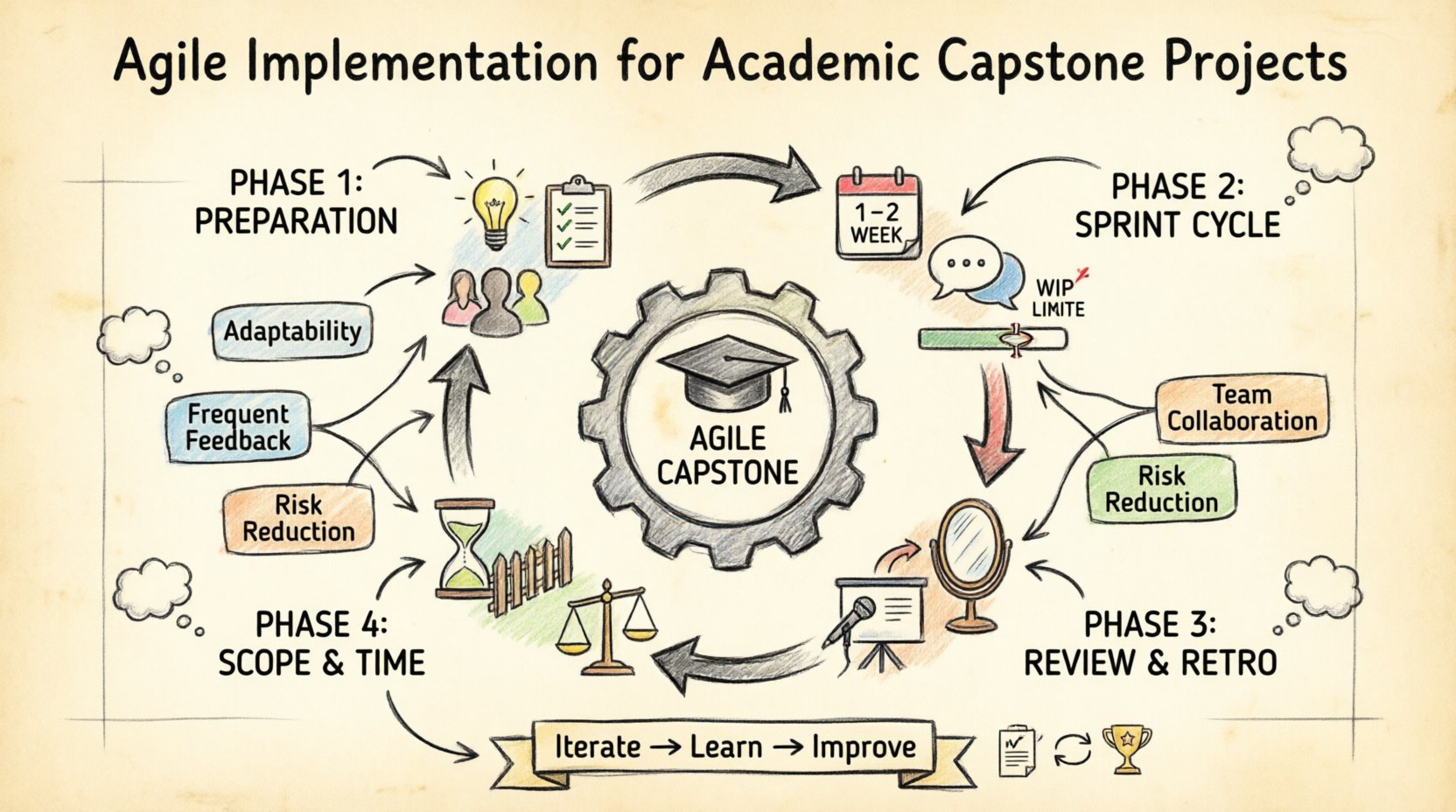
Capstone projects often span several months. During this time, requirements may change. Faculty feedback might alter the scope. Agile methods accommodate these shifts better than rigid plans.
Implementing this methodology does not mean abandoning documentation or structure. It means organizing work into manageable cycles. Each cycle, often called a sprint, produces a tangible outcome.
Before writing code or conducting experiments, the team must establish a foundation. This phase sets the stage for the entire project lifecycle.
Every agile project starts with a clear purpose. Write a statement that describes the core problem being solved. This vision acts as a compass. When the team faces difficult decisions, refer back to this statement.
The backlog is a prioritized list of all tasks required to complete the project. In an academic setting, this includes research, development, testing, and documentation.
Even in a small student team, distinct roles help maintain order. Adapt industry roles to fit an academic context.
Sprints are short, fixed-length periods of work. In a semester context, a sprint might last one to two weeks. Each sprint ends with a review of completed work.
At the start of each cycle, the team selects items from the backlog. The goal is to commit to a realistic amount of work.
During the sprint, work begins. To maintain momentum, hold brief daily meetings. These should take no more than 15 minutes.
Three Key Questions:
If a blocker exists, the team must address it immediately. This might mean seeking help from a peer or contacting the instructor.
Starting many tasks at once leads to context switching. Focus on finishing one item before starting another. This concept, known as Work In Progress (WIP) limits, improves quality and speed.
At the end of every sprint, two specific meetings occur. The first reviews the work. The second reviews the process.
This meeting demonstrates the work completed to stakeholders. In an academic setting, this might be the professor or a panel of peers.
This meeting is internal to the team. It focuses on improving how the team works together.
Example Action Item: “Schedule meetings earlier in the week to avoid Friday fatigue.”
Academic deadlines are fixed. Unlike commercial projects, you cannot push back the delivery date indefinitely. Managing scope is critical.
Scope creep occurs when new features are added without adjusting the timeline. In capstones, this often happens when students discover interesting ideas during research.
Assign a fixed amount of time to specific tasks. If a task is not finished within the timebox, it is paused or moved to the backlog.
Transitioning to this methodology introduces specific challenges. The table below outlines common issues and practical solutions.
| Challenge | Impact | Solution |
|---|---|---|
| Uneven Workload | Some members do more work than others | Use visible task boards to track contributions. Rotate roles to balance effort. |
| Communication Gaps | Members miss updates or meetings | Set a standard communication channel. Send meeting summaries immediately. |
| Technical Debt | Quick fixes lead to future problems | Schedule specific sprints for refactoring and documentation. |
| Conflicting Priorities | Team members have different goals | Align on the “Sprint Goal” during planning. Revisit the project vision. |
| Academic Conflicts | Exams or other classes interrupt flow | Plan sprints around the academic calendar. Adjust capacity during exam weeks. |
A common misconception is that agile means no documentation. In academic projects, documentation is often a grading requirement. Agile documentation focuses on value and necessity.
Use a central repository to store all documents. Ensure version control is used for all text and code files. This ensures that the history of changes is preserved for assessment.
Working in a team is difficult. Academic pressure adds stress. Healthy dynamics are essential for success.
Team members must feel safe to admit mistakes. If a member hides a bug or delay, the whole project suffers.
Disagreements will happen. Address them early using a structured approach.
Academic projects are graded. The agile process must align with how the project is evaluated.
Review the grading rubric before starting. Identify which criteria correspond to agile artifacts.
Keep evidence of every sprint. This helps during the final defense or presentation.
The project concludes with a final presentation. This is the culmination of all iterative work.
Show the full functionality. Highlight how the product evolved over time. Explain the decisions made during the process.
After the final grade, the team should reflect on the entire term. What would they do differently?
This reflection helps improve future projects. It solidifies the skills gained during the process.
Applying agile methods to academic capstone projects offers a structured way to manage complexity. It emphasizes adaptability, collaboration, and continuous improvement. By breaking work into smaller cycles, teams can maintain momentum and respond to feedback.
The process requires discipline. Students must commit to regular meetings and honest reporting. However, the benefits outweigh the effort. The skills learned in project management, communication, and iterative development prepare students for professional environments.
Start small. Focus on the core goals. Iterate often. This approach ensures a successful completion of your academic journey.