 Visual Paradigm Desktop |
  Visual Paradigm Online


Welcome to the professional world of software development. As you step out of the classroom and into the industry, you will quickly realize that the methodologies you learned in theory often differ from the reality of shipping products. One of the most pervasive frameworks you will encounter is Agile. It is not just a buzzword; it is a way of thinking that prioritizes adaptability, customer feedback, and continuous improvement.
This guide is designed to walk you through the core concepts, practices, and mindset required to succeed in an Agile environment. We will avoid specific software tools and focus on the principles that drive value. By the end of this text, you will have a solid foundation to navigate your early career with confidence and competence.
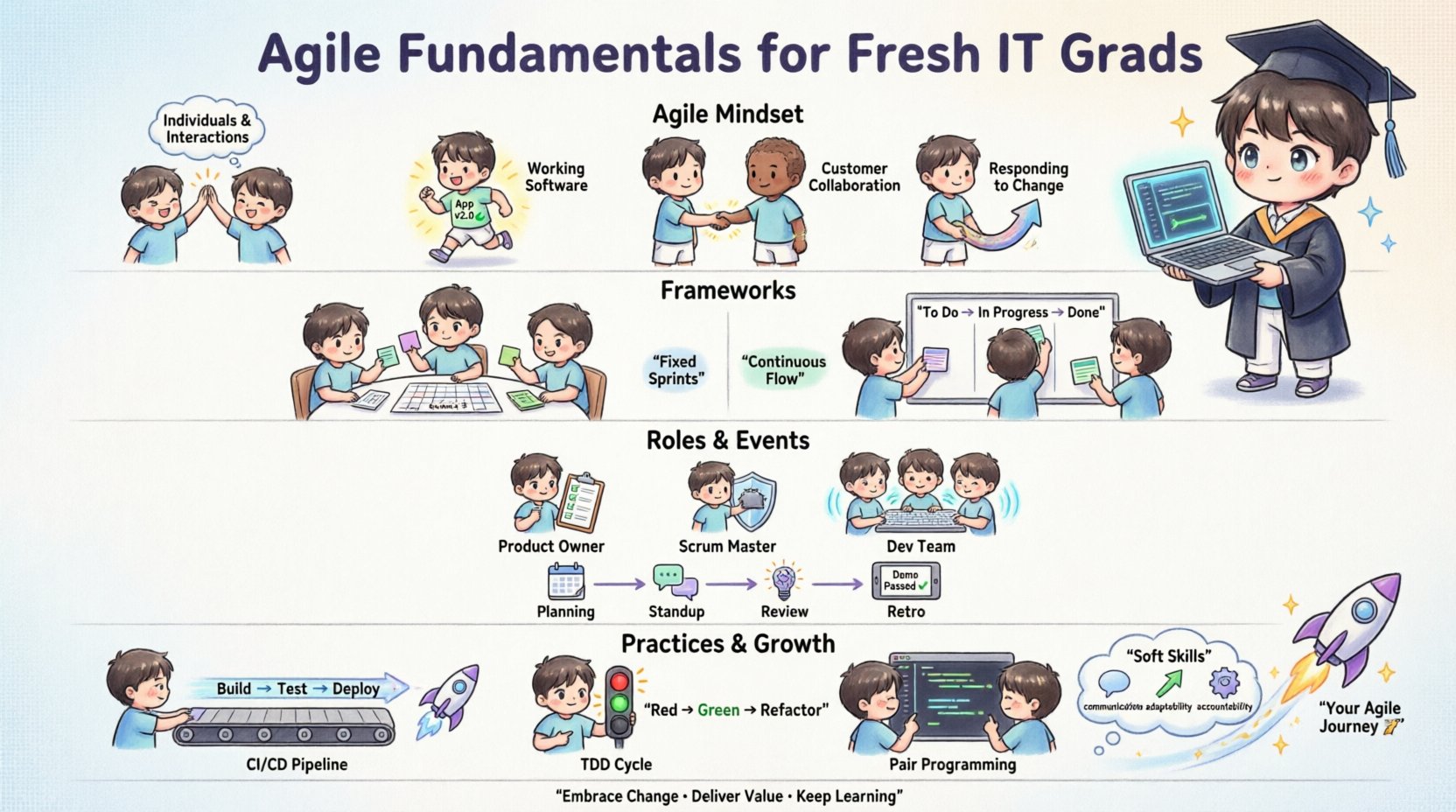
Before diving into specific frameworks, it is crucial to understand what Agile represents. At its heart, Agile is a response to the rigidity of traditional project management. In the past, projects were often planned in extensive detail at the start, with little room for change. If requirements shifted, the whole plan could collapse.
Agile flips this approach. It embraces change. It accepts that requirements will evolve as you learn more about the problem you are solving. Here are the core values that define this approach:
These values are supported by twelve principles that guide decision-making. For a fresh graduate, understanding these principles helps you make better technical and project decisions daily.
While Agile is a mindset, teams often adopt specific frameworks to implement it. Two of the most common are Scrum and Kanban. Knowing the difference will help you understand team dynamics.
Scrum is a lightweight framework that helps people, teams, and organizations generate value through adaptive solutions for complex problems. It is structured around time-boxed iterations known as Sprints.
Kanban focuses on visualizing work, maximizing efficiency, and limiting work in progress. It is less prescriptive than Scrum and does not require fixed iterations.
Use the following table to understand the structural differences at a glance.
| Feature | Scrum | Kanban |
|---|---|---|
| Iterations | Fixed Sprints (2-4 weeks) | Continuous Flow |
| Roles | Defined (PO, SM, Team) | No specific roles required |
| Changes | Not allowed during Sprint | Allowed anytime |
| Metrics | Velocity, Burndown | Lead Time, Cycle Time |
| Best For | Projects with clear goals | Support teams, variable demand |
Even in a small team, everyone has responsibilities. Understanding these roles helps you know who to approach for specific information.
The Product Owner represents the voice of the customer and stakeholders. They are responsible for maximizing the value of the product.
The Scrum Master serves the team and the organization. They are not a manager in the traditional sense but a facilitator.
This is the group of professionals who do the actual work. They are cross-functional, meaning they possess all the skills necessary to create the product increment.
Agile teams use specific meetings to synchronize, plan, and improve. These are not just administrative tasks; they are communication hubs.
This meeting happens at the start of every Sprint. The team discusses what they can commit to completing within the timebox.
A short, 15-minute meeting held every day. The goal is to synchronize activities and create a plan for the next 24 hours.
Held at the end of the Sprint. The team demonstrates the work completed to stakeholders.
The most important meeting for team growth. The team reflects on the process, not the product.
Artifacts represent work or value. They provide transparency and opportunities for inspection.
A prioritized list of everything that might be needed in the product. It is never complete and evolves as the product and environment evolve.
The set of Product Backlog items selected for the Sprint, plus a plan for delivering the Sprint Goal.
The sum of all Product Backlog items completed during a Sprint and the value of the increments of all previous Sprints.
Requirements are often written as User Stories. This format keeps the focus on the user’s needs rather than technical specifications.
The standard format is:
As a [type of user], I want [some goal], so that [some reason].
Each story needs Acceptance Criteria. These are conditions that must be met for the story to be considered complete. They act as a contract between the team and the stakeholder.
To ensure stories are well-formed, use the INVEST model:
Agile is not just about management; it relies heavily on engineering excellence to deliver quality software frequently.
Developers frequently merge their code changes into a central repository. Automated builds and tests run to detect errors early.
A practice where tests are written before the actual code.
Two developers work together at one workstation. One writes code (Driver), while the other reviews each line (Navigator).
Technical skills get you hired, but soft skills help you survive and thrive in an Agile team.
Agile relies on face-to-face conversation. Be clear, concise, and honest. If you do not know something, say so.
Plans will change. Requirements will shift. Your attitude towards change determines your success.
Even experienced teams make mistakes. As a new member, be aware of these common traps.
This happens when a team follows the ceremonies but ignores the values. They have standups but do not collaborate. They have retrospectives but do not implement changes.
Measuring success solely by the number of features shipped. This ignores quality, technical debt, and user satisfaction.
Shutting down code quality to ship faster leads to slower development over time.
Starting your journey in an Agile environment can be daunting. Here are practical steps to integrate smoothly.
Identify a senior developer who can guide you. Ask them about their experience and how they handle challenges.
Watch how meetings are conducted. Notice how conflicts are resolved. Learn the team’s rhythm.
Do not be afraid to say “I don’t understand.” It is better to ask than to make assumptions.
Share your perspective on what is working and what is not. Your fresh eyes might spot issues veterans miss.
The industry changes rapidly. What you learn today might be outdated in a few years. Maintain a habit of learning.
Entering the IT industry as a fresh graduate is an exciting time. Agile provides a structure that supports growth, adaptability, and collaboration. By understanding the fundamentals outlined in this guide, you are better equipped to navigate your career.
Remember that Agile is not a destination but a journey. It requires constant reflection and improvement. Embrace the challenges, learn from your mistakes, and contribute to your team’s success. Your career will be defined not just by the code you write, but by the value you deliver and the people you work with.
Stay curious. Stay adaptable. And enjoy the process of building software that makes a difference.