Visual Paradigm Desktop | Visual Paradigm Online
Read this post in: de_DEes_ESfr_FRhi_INid_IDjapl_PLpt_PTru_RUvizh_CNzh_TW

Agile Career Prep: Skills Every Computer Science Student Needs to Master

AgileYesterday

The transition from academic study to professional software development is rarely a straight line. It involves shifting from theoretical constructs to practical, iterative delivery. In the modern technology landscape, the ability to adapt quickly, collaborate effectively, and deliver value incrementally is just as critical as writing efficient code. This guide outlines the essential competencies a computer science student must develop to thrive in an agile environment.

Agile is not merely a set of meetings or a specific toolset; it is a philosophy of work. It prioritizes individuals and interactions over processes and tools, working software over comprehensive documentation, customer collaboration over contract negotiation, and responding to change over following a plan. For a student, understanding this shift is the first step toward a sustainable career.
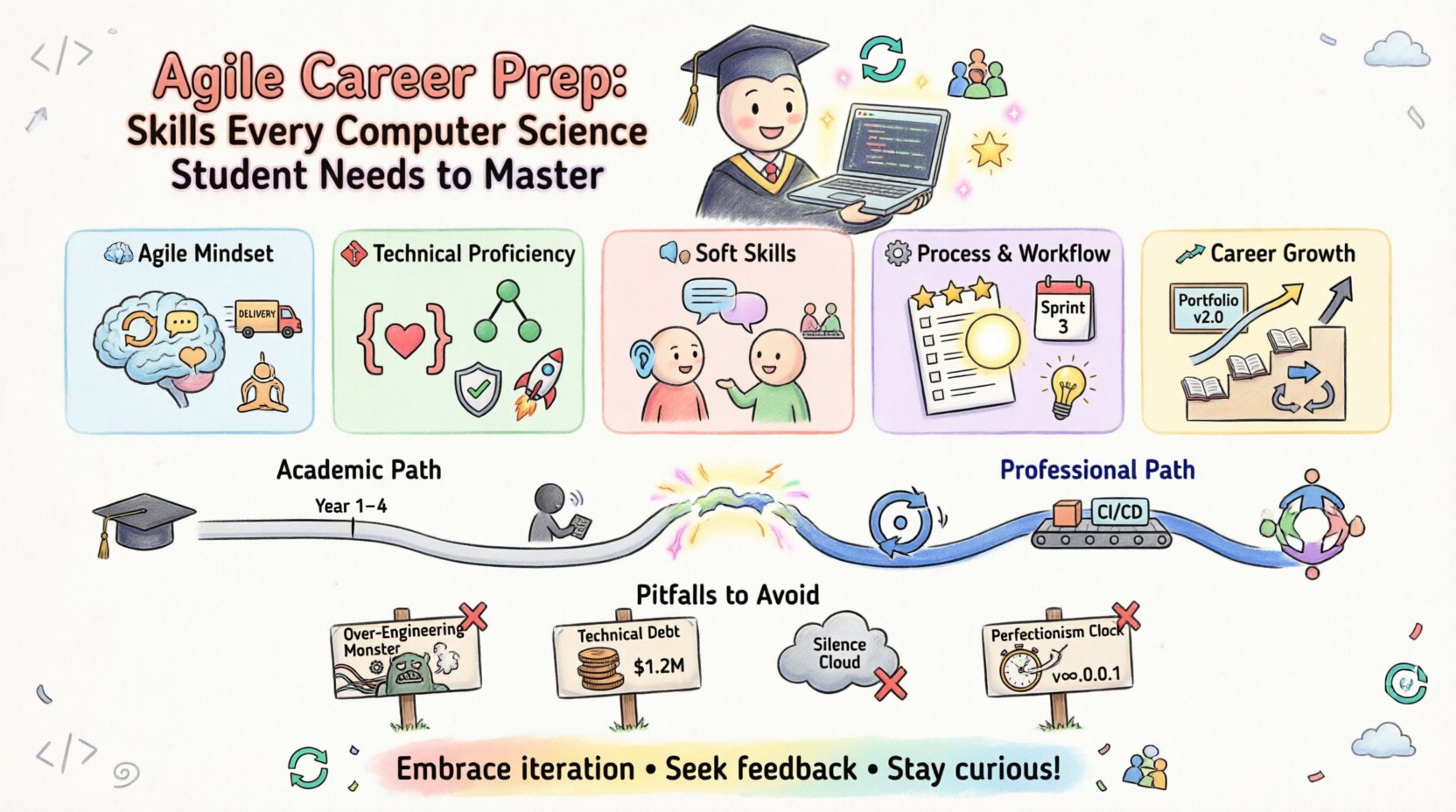
Whimsical infographic illustrating essential agile skills for computer science students: agile mindset (iteration, feedback, adaptability), technical proficiency (clean code, version control, CI/CD), soft skills (communication, collaboration), workflow management (backlog, sprints, retrospectives), and career growth strategies, plus academic vs professional comparison and common pitfalls to avoid, designed in playful hand-drawn style with pastel colors and friendly icons

1. Cultivating the Agile Mindset 🧠

Before diving into specific methodologies, one must internalize the values that drive agile success. This mindset permeates every aspect of professional life, from how code is written to how conflicts are resolved.

  • Embrace Iteration: Accept that perfection is rarely achieved in the first attempt. Build small, test often, and refine continuously. This reduces risk and allows for course correction before significant resources are wasted.
  • Value Feedback: Feedback loops are the heartbeat of agile development. Whether it comes from a peer code review or a stakeholder demo, treat feedback as data to improve the product, not as personal criticism.
  • Focus on Delivery: Academic projects often prioritize the final grade. Professional work prioritizes the value delivered to the user. Understanding the difference between “finished” and “done” is crucial.
  • Adaptability: Requirements change. Plans evolve. The ability to pivot without losing momentum is a hallmark of a resilient developer.

Students often struggle with the ambiguity of agile tasks compared to the rigid specifications of university assignments. Learning to navigate this ambiguity is a skill in itself.

2. Technical Proficiency in a Collaborative Setting 💻

While the agile philosophy focuses on people, the foundation remains technical. However, the way technical skills are applied changes when working in a team environment.

Code Quality and Maintainability

In a solo project, you might write code that works for you. In a team, code must be readable by others. This requires adherence to clean code principles.

  • Readability: Use clear naming conventions and consistent formatting. Future maintainers should not need to guess your intent.
  • Refactoring: Continuous improvement of the codebase without changing its external behavior is essential. Do not let technical debt accumulate.
  • Testing: Automated tests provide confidence. When you change code, tests should tell you immediately if something broke. This enables rapid iteration.

Version Control Systems

Collaboration requires a shared history of changes. Proficiency with version control is non-negotiable.

  • Branching Strategies: Understand how to isolate work without disrupting the main line of development.
  • Merge Conflicts: Learn how to resolve conflicts when multiple people edit the same files. This is a common friction point that slows down teams.
  • Commit Hygiene: Write meaningful commit messages that explain the “why” behind the change, not just the “what”.

Integration and Deployment

The ability to take code from a local machine to a live environment is a vital skill. This process, often called continuous integration and deployment, ensures that software is always in a deployable state.

  • Build Automation: Automate the compilation and packaging process to reduce human error.
  • Environment Parity: Ensure that the development environment matches the production environment as closely as possible to avoid “it works on my machine” issues.

3. Soft Skills and Communication 🗣️

Technical skills get you hired, but soft skills get you promoted. In agile teams, communication is the glue that holds the process together.

Transparency and Honesty

Agile relies on trust. Hiding problems delays their resolution. Be open about progress, blockers, and challenges.

  • Reporting Status: Clearly communicate what is done, what is in progress, and what is blocked.
  • Admitting Mistakes: When a bug is introduced, own it. Focus on fixing the root cause rather than assigning blame.

Active Listening

Understanding requirements requires listening to stakeholders, not just reading tickets. Paraphrase what you hear to ensure alignment.

  • Clarifying Questions: Ask questions early. Ambiguity in requirements is a primary cause of rework.
  • Empathy: Understand the user’s perspective. Why is this feature needed? What problem does it solve?

Collaboration over Competition

The goal is team success, not individual heroics. Share knowledge and help teammates succeed.

  • Pair Programming: Working together on a single terminal improves code quality and spreads knowledge.
  • Mentorship: Help onboard new members. A rising tide lifts all boats.

4. Process and Workflow Management ⚙️

Understanding the mechanics of agile frameworks helps you navigate daily work. You do not need to be a Scrum Master to understand the flow.

Backlog Management

The backlog is the single source of truth for work. It contains everything that might be needed.

  • Prioritization: Learn to distinguish between what is urgent and what is important. Work on high-value items first.
  • Refinement: Ensure items in the backlog are clear enough to be worked on. Vague tickets lead to wasted time.

Sprint Planning and Execution

Work is often organized into short cycles called sprints. This creates a rhythm for the team.

  • Commitment: Agree on a realistic amount of work for the cycle. Overcommitting leads to burnout.
  • Focus: Minimize context switching. Try to complete tasks within the cycle rather than starting new ones.

Retrospectives

Regular reflection allows the team to improve its process. This is not about finding faults, but about finding improvements.

  • Safe Environment: Create a space where team members feel safe to speak up.
  • Actionable Items: Identify one or two changes to implement in the next cycle. Do not just talk; act.

5. Career Growth and Continuous Learning 📈

The technology landscape changes rapidly. Skills that are relevant today may be obsolete in a few years. A commitment to learning is necessary for longevity.

Self-Directed Learning

Formal education ends, but learning never stops. Use available resources to fill knowledge gaps.

  • Documentation: Read the official documentation of the technologies you use. It is the most accurate source.
  • Community: Engage with the developer community. Contribute to open source or write technical blogs.

Building a Portfolio

Projects demonstrate capability better than resumes. Show, don’t just tell.

  • Real-World Scenarios: Build applications that solve actual problems, even if they are small.
  • Documentation: Include a README that explains how to run the project and why it was built.

Skills Matrix: Academic vs. Professional

To visualize the shift in expectations, compare the typical academic environment with the professional agile environment.

Aspect Academic Environment Professional Agile Environment
Goal Grade / Correctness User Value / Business Impact
Timeline Semester / Fixed Deadline Iterative Cycles / Continuous Delivery
Feedback Grader / End of Term Peers / Stakeholders / Automated Tests
Code Ownership Individual Collective / Shared Ownership
Requirements Fixed at Start Dynamic / Evolving
Success Metric Passing Tests Deployable Software / Customer Satisfaction

Common Pitfalls to Avoid 🚫

Even with the right skills, new professionals often stumble. Being aware of common traps helps you navigate your early career.

  • Over-Engineering: Building complex solutions for simple problems. Keep it simple until complexity is required.
  • Ignoring Technical Debt: Taking shortcuts now will cost more later. Balance speed with quality.
  • Silence: Staying quiet when you don’t understand something. Ask for help early.
  • Perfectionism: Waiting for the perfect solution before delivering. Done is better than perfect.

Final Thoughts on Your Path Forward

Preparing for a career in software development requires more than just syntax knowledge. It demands a shift in how you approach problems, collaborate with others, and view your own growth. By focusing on iterative delivery, clear communication, and continuous improvement, you position yourself for long-term success.

The journey from student to professional is about building habits that serve you well beyond the first job. Embrace the uncertainty, seek feedback, and remain curious. The industry values those who can adapt and learn as much as those who already know the answers. Start applying these principles in your current projects, and you will find yourself better prepared for the realities of the workplace.

Remember, every line of code you write and every conversation you have is an opportunity to practice these skills. Treat your education as the beginning of your professional practice, not a separate phase of life.

Loading

Signing-in 3 seconds...

Signing-up 3 seconds...