 Visual Paradigm Desktop |
  Visual Paradigm Online


The landscape of international commerce is no longer a static map to be followed. It is a living, breathing ecosystem that changes with geopolitical currents, economic cycles, social movements, and technological breakthroughs. For businesses operating across borders, the margin between success and stagnation often lies in the ability to anticipate these shifts before they impact the bottom line. This is where the PEST analysis methodology becomes an indispensable tool for strategic planning.
Adapting to global trade shifts requires more than just reacting to news headlines. It demands a structured approach to understanding the macro-environmental factors that influence markets. By utilizing the PEST framework—Political, Economic, Social, and Technological—organizations can navigate volatility with precision. This guide explores how to deploy this methodology effectively to secure supply chains, optimize market entry, and maintain competitive advantage in a fluid global economy.
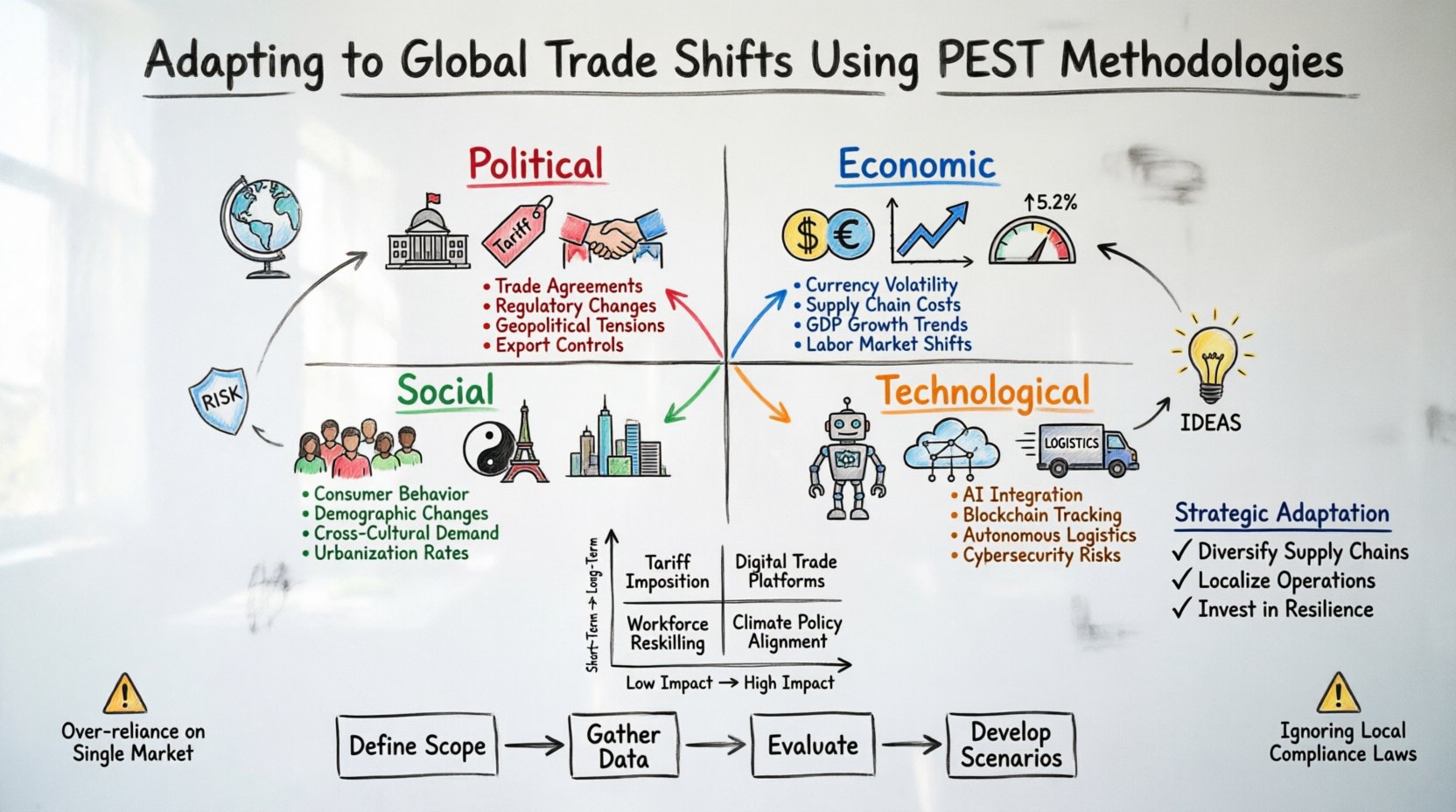
Global trade has undergone significant transformations over the last decade. The era of purely efficiency-driven supply chains is giving way to resilience-focused networks. Disruptions such as pandemics, regional conflicts, and protectionist policies have highlighted the fragility of interconnected systems. Companies must now look beyond internal operations to the external forces shaping their environment.
Without a clear view of the macro-environment, strategic decisions become guesses. A company might expand into a market that appears profitable on paper, only to find political instability or currency devaluation eroding profits within months. The PEST analysis provides the necessary lens to see these hidden variables.
PEST is an acronym that stands for the four key categories of external factors. Each category represents a distinct set of forces that can impact business operations and trade flows. Understanding these categories allows for a holistic view of the market.
Political stability and government policy are the bedrock of international trade. Changes in administration or legislation can alter the rules of engagement overnight. When conducting a PEST analysis for global trade, political factors require deep scrutiny.
For example, a change in import duties by a major trading partner can increase the cost of raw materials by 20% in a single quarter. Strategic planners must monitor legislative sessions and diplomatic relations closely to forecast these risks.
Economic conditions dictate purchasing power and operational costs. Even in stable political environments, economic volatility can disrupt trade flows. This section of the analysis focuses on the financial health of the target markets.
Economic analysis also involves looking at trade balances. A country with a significant trade surplus might impose restrictions to protect local industries, whereas a deficit country might encourage imports to stabilize its currency.
People are the engine of the global economy. Social trends shape consumer behavior, workforce availability, and brand perception. Ignoring the human element can lead to cultural missteps that damage reputation or reduce sales.
For instance, a shift toward ethical consumption in Western markets may require suppliers in developing nations to certify their sourcing practices. Failure to adapt to these social expectations can result in boycotts or brand damage.
Technology is the accelerant of modern trade. It enables new channels of commerce, improves logistics efficiency, and creates entirely new industries. The technological landscape is perhaps the fastest-moving component of the PEST analysis.
Companies that fail to integrate digital tools into their supply chain management may find themselves outpaced by competitors using predictive analytics and automated warehousing. The technological divide between nations can also create disparities in production capabilities.
To make the data actionable, it helps to visualize how these factors interact. The following table outlines potential impacts across different sectors when trade shifts occur.
| Factor | High Impact Scenario | Low Impact Scenario | Strategic Response |
|---|---|---|---|
| Political | New tariffs imposed on imports | Renewal of free trade agreement | Re-evaluate pricing and sourcing locations |
| Economic | Currency devaluation by 15% | Stable exchange rates | Hedge currency risk or adjust payment terms |
| Social | Shift to remote work culture | Return to traditional office | Adjust office lease strategies and digital tools |
| Technological | Widespread blockchain adoption | Legacy systems remain standard | Invest in interoperability and integration |
Conducting a PEST analysis is not a one-time event. It is a continuous process of gathering intelligence and interpreting it. The following steps outline how to integrate this methodology into your strategic planning workflow.
Before analyzing, determine the boundaries of your study. Are you looking at a specific region, a product line, or the entire organization? A focused scope yields more accurate data. For example, analyzing the trade implications for electronics manufacturing differs significantly from analyzing the textile industry.
Reliable data is the foundation of any analysis. Rely on primary and secondary sources to build a comprehensive picture.
Not all factors carry the same weight. Use a scoring system to rank factors based on their likelihood of occurring and the severity of their impact. This helps prioritize resources toward the most critical risks and opportunities.
Create multiple scenarios based on your findings. For instance, a “Best Case” scenario might assume favorable trade agreements, while a “Worst Case” scenario assumes increased tariffs and supply chain disruptions. Plan strategies for each outcome.
Data is useless without action. Once the PEST analysis is complete, the focus shifts to adaptation. How do you adjust your business model to align with the identified external forces?
Reliance on a single source country creates vulnerability. If political instability or economic sanctions affect one region, having backup suppliers in different jurisdictions ensures continuity. Diversification reduces the risk of total operational halt.
Adapting to social and economic factors often requires localization. This means hiring local talent, sourcing materials locally, and tailoring products to cultural preferences. Localization builds goodwill and reduces exposure to trade barriers.
Technological investments should focus on resilience. Inventory management systems that offer real-time visibility allow companies to pivot quickly when disruptions occur. Building buffer stock or flexible logistics contracts can also mitigate economic shocks.
The macro-environment is dynamic. What is true today may change in six months. Establishing a monitoring system ensures that your strategy remains relevant.
Identify specific metrics that signal change. These could be interest rate thresholds, election dates, or infrastructure project completions. Tracking these indicators provides early warning signals.
Conduct formal PEST reviews quarterly or biannually. During these reviews, compare current data against previous findings. Identify trends that are emerging and factors that have become obsolete.
Create channels for feedback from local teams. Employees on the ground often notice shifts in customer sentiment or regulatory enforcement before they appear in high-level reports. Incorporating their insights adds depth to the analysis.
Even with the best intentions, organizations can make mistakes during the PEST analysis process. Being aware of these common errors can help ensure the integrity of your strategic planning.
As global trade continues to evolve, the tools used to analyze it must also mature. The integration of artificial intelligence and big data is changing how companies process macro-environmental information. While the PEST framework provides the structure, the speed and depth of analysis are increasing.
Organizations that embed these methodologies into their core culture will find themselves better positioned to weather storms. Adaptability is no longer a nice-to-have; it is a requirement for survival. By systematically evaluating Political, Economic, Social, and Technological factors, businesses can turn uncertainty into a strategic advantage.
The path forward requires vigilance and discipline. It requires looking beyond the immediate horizon and understanding the forces that shape it. With a robust PEST analysis, you are not just reacting to the future; you are preparing for it.