 Visual Paradigm Desktop |
  Visual Paradigm Online


“The future of enterprise architecture isn’t just about structure—it’s about speed, adaptability, and execution. TOGAF 10 delivers the vision. Visual Paradigm delivers the engine.”
The TOGAF Standard, 10th Edition—released in 2022 and continuously enhanced through Series Guides up to 2025 and beyond—marks a pivotal shift in how enterprise architecture (EA) is practiced. No longer a rigid, monolithic framework, TOGAF 10 embraces the realities of modern business: agility, digital transformation, ecosystem collaboration, and iterative delivery.
For EA teams navigating complex, fast-moving environments, the framework’s depth and comprehensive scope can be overwhelming. While TOGAF 10 offers powerful guidance, the real challenge lies in execution: turning principles into actionable steps, ensuring consistency across deliverables, and onboarding teams quickly without sacrificing quality.
This is where Visual Paradigm’s TOGAF ADM tool emerges as a game-changer—not just a diagramming tool, but a fully integrated, AI-powered execution engine for TOGAF 10.
In this article, we’ll explore:
The key advancements in TOGAF 10 that redefine enterprise architecture,
The common pain points teams face when starting TOGAF initiatives,
How Visual Paradigm solves these challenges with intelligent, guided workflows,
Why it stands out in the 2025–2026 landscape as the best-in-class solution for practical TOGAF adoption.
TOGAF 10 is not an incremental update—it’s a paradigm shift toward practicality, flexibility, and real-world applicability. Here’s what sets it apart from earlier versions like TOGAF 9.2:
Instead of a single, dense document, TOGAF 10 is now structured into two core components:
TOGAF Fundamental Content: The universal core—principles, concepts, and best practices.
TOGAF Series Guides: Topic-specific, extensible documents covering areas like:
Business Capability Planning (2023)
Information Architecture (metadata, BI, analytics)
Digital Transformation
Ecosystem & Partnership Architecture
Agile Integration
🔍 Why it matters: Organizations can adopt only the guides relevant to their goals—no more sifting through irrelevant content.
The ADM is no longer a linear, waterfall-style process. TOGAF 10 introduces:
Flexible ADM modes (e.g., “Agile Mode,” “Incremental Mode,” “Strategic Mode”) to match project context.
Removal of arrowheads in ADM diagrams to emphasize non-linear, iterative flow.
Support for continuous feedback loops, sprint-like cycles, and incremental validation.
🔄 Why it matters: Aligns seamlessly with agile, DevOps, and hybrid delivery models—critical for digital transformation.
TOGAF 10 includes practical techniques, templates, and use cases across all phases. It answers questions like:
How do I define a compelling Architecture Vision?
What’s the best way to conduct a capability gap analysis?
How do I model a digital ecosystem using ArchiMate?
📚 Why it matters: Reduces ambiguity and accelerates team productivity.
TOGAF 10 explicitly addresses modern challenges:
Digital transformation through architecture-driven innovation.
Ecosystem and partner architecture beyond organizational boundaries.
Business capability planning as a strategic foundation.
Information architecture with focus on metadata, data governance, and analytics.
🌐 Why it matters: The framework now reflects how enterprises actually operate—not how they wished they did.
New content is being released regularly:
Business Capability Planning Guide (2023)
Information Architecture Guide (2024)
AI & Machine Learning in Enterprise Architecture (2025)
Sustainability & Green IT Architecture (2025–2026)
📈 Why it matters: TOGAF is not static—it evolves with technology and business needs.
Despite its strengths, TOGAF 10 adoption remains difficult for many teams. Based on hands-on experience with enterprise architecture teams across financial services, healthcare, government, and tech, the most common challenges include:
| Challenge | Impact |
|---|---|
| Overwhelm from framework depth | Teams don’t know where to start. |
| Inconsistent modeling standards | ArchiMate diagrams vary in quality and alignment. |
| Missing or delayed deliverables | Critical artifacts (e.g., Gap Analysis, Migration Roadmap) fall through the cracks. |
| ADM navigation confusion | Unclear when to loop back, iterate, or move forward. |
| Slow onboarding | Junior architects take weeks to become productive. |
⚠️ Result: Projects stall. Momentum fades. EA is seen as “bureaucratic” rather than “strategic.”
Visual Paradigm isn’t just another modeling tool. It’s a purpose-built, process-driven platform designed to demystify TOGAF 10 and supercharge its execution.
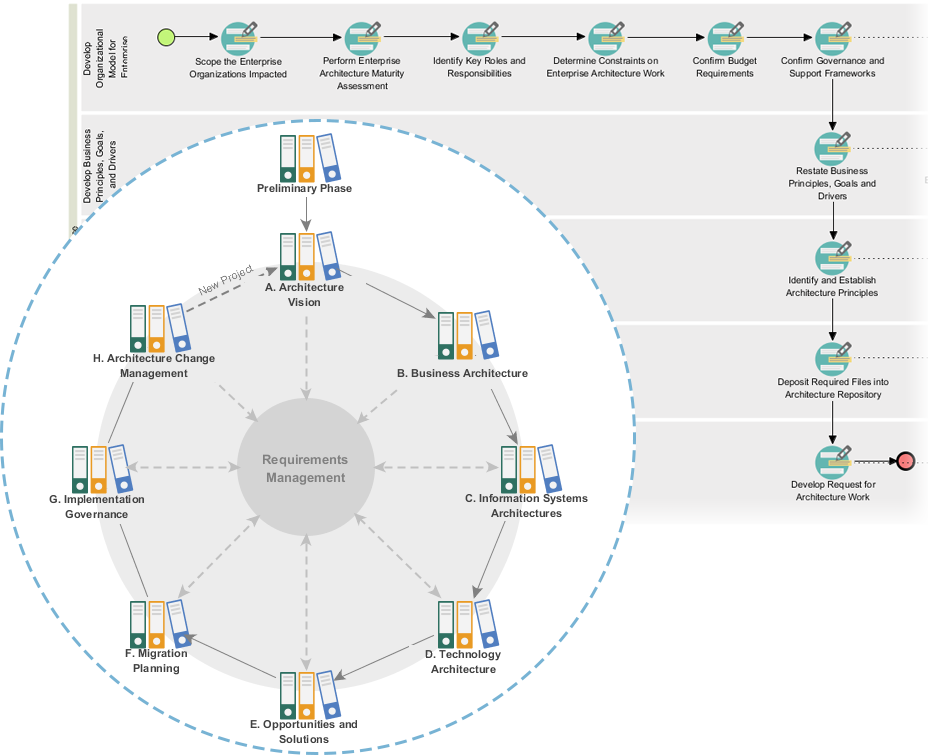
At the heart of Visual Paradigm is the ADM Process Navigator—an interactive, guided journey through the TOGAF 10 ADM.
Visual, step-by-step navigation of all 8 phases (Preliminary to Phase H).
Context-aware guidance: Shows only relevant activities based on your project type (e.g., Agile Mode vs. Strategic Mode).
Just-in-time help: Click any activity to access:
Purpose & objectives
Inputs and outputs
Best practices & examples
Related ArchiMate diagrams and matrices
💡 Example: In Phase A (Architecture Vision), you’ll see a step-by-step guide to:
Define the business context
Identify key stakeholders
Draft the Vision Statement
Create a High-Level Capability Map
Double-click any step → jump directly into the right modeling tool.
Let’s break down how Visual Paradigm addresses the top challenges teams face.
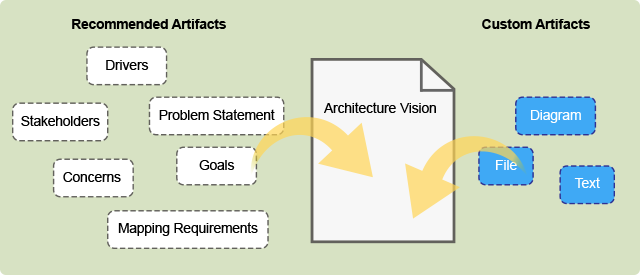
As you progress through the ADM, Visual Paradigm automatically generates and archives TOGAF-compliant deliverables into a centralized Architecture Repository.
Deliverables include:
Architecture Vision (Phase A)
Business Architecture (Phase B)
Gap Analysis (Phase D)
Consolidated Gaps / Solutions / Dependencies Matrix (Phase E)
Migration Roadmap (Phase F)
Implementation & Migration Plan (Phase G)
Governance & Compliance Plans (Phase H)
📦 No more manual consolidation. No more lost artifacts. Everything is version-controlled and traceable.
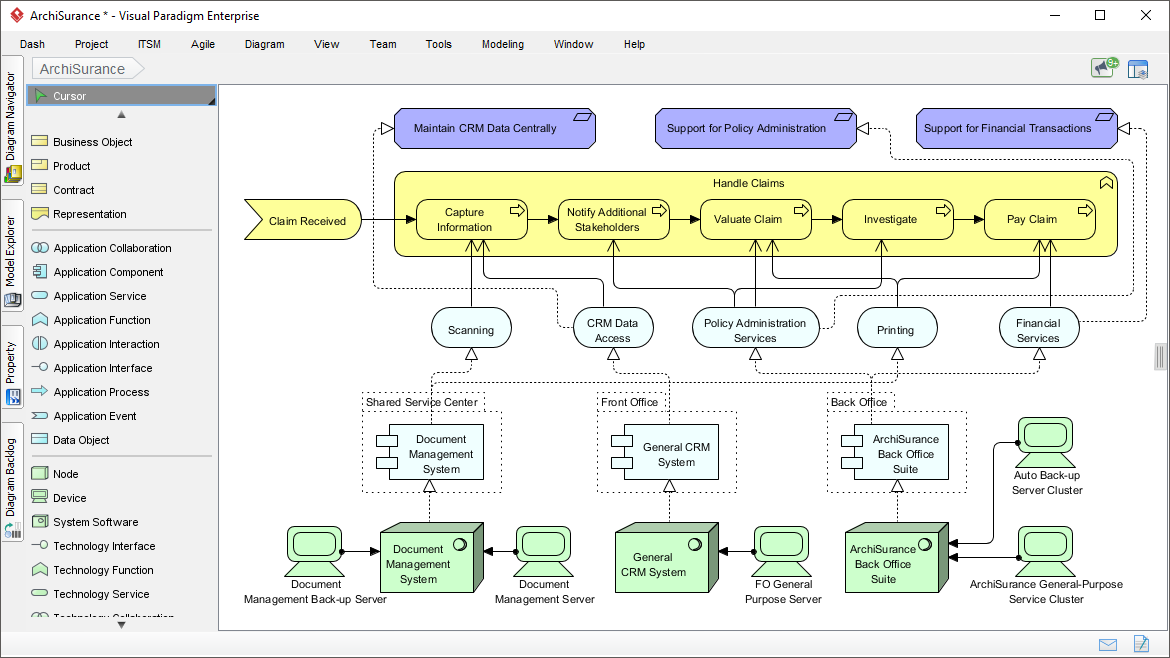
Visual Paradigm offers a full-stack, enterprise-grade modeling environment:
ArchiMate 3.2 Certified (by The Open Group)
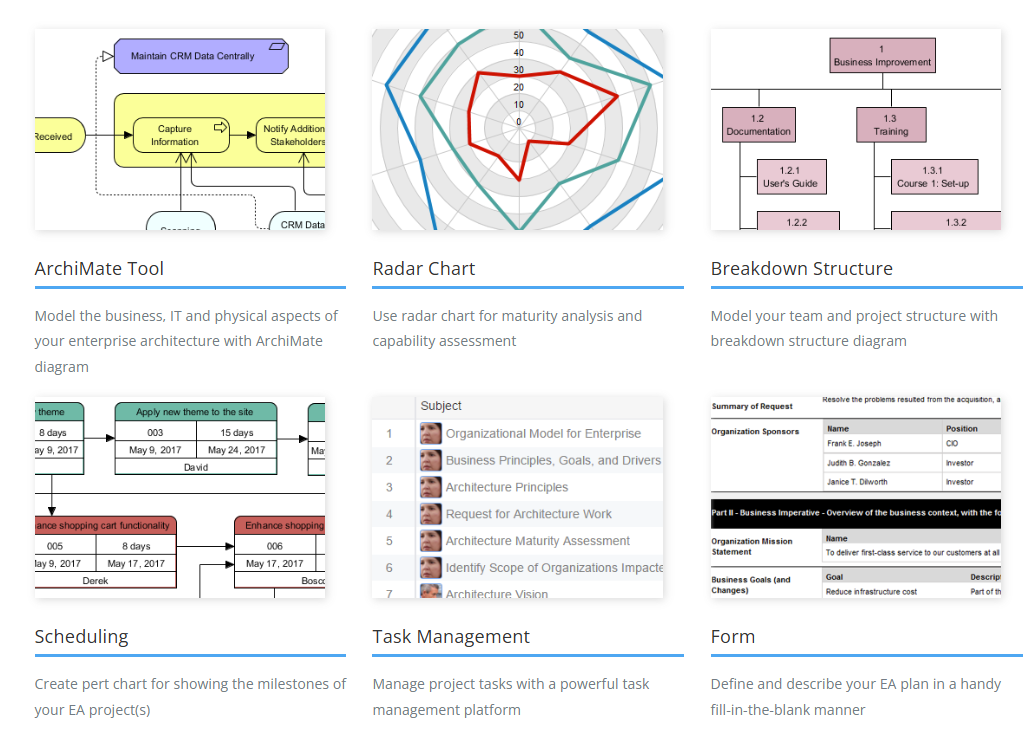
Capability Analysis Tools: Build capability maps, maturity assessments, and radar charts.
RACI Matrices: Assign roles and responsibilities per architecture component.
PERT & Gantt Charts: Model project timelines and dependencies.
Roadmap Visualizer: Create interactive, time-based migration plans.
Data & Information Modeling: Support for metadata, data flows, and analytics architecture.
🔗 All linked to ADM phases—no context switching. No disconnected tools.
The most transformative addition: AI-enhanced guidance.
The AI Guide-Through feature lets you:
Describe a problem in plain English (e.g., “We need to integrate our CRM with a third-party logistics partner”).
Instantly generate:
A high-quality ArchiMate diagram (with correct notation and structure)
A gap analysis between current and target states
A migration plan with phased initiatives
A dependency matrix and RACI assignment
🚀 Teams report up to 70–80% reduction in manual diagramming and documentation effort.
✅ Ideal for: Rapid prototyping, scaling across multiple projects, onboarding new architects, or kickstarting agile architecture sprints.
Visual Paradigm supports enterprise-scale collaboration:
Shared Architecture Repository (cloud or on-premise)
Role-based access control
Built-in templates & samples for common scenarios (e.g., digital transformation, cloud migration)
Guided onboarding workflows for new team members
Customizable TOGAF tailoring (e.g., define your own ADM mode, naming conventions, deliverable formats)
👥 Junior architects can become productive in days—not weeks.
While other tools offer modeling capabilities, Visual Paradigm is the only one that combines:
| Feature | Visual Paradigm | Competitors (e.g., Sparx EA, Archi) |
|---|---|---|
| Guided, process-driven ADM navigation | ✅ Yes | ❌ Limited or absent |
| Auto-generates & archives TOGAF deliverables | ✅ Yes | ❌ Manual or partial |
| AI-powered artifact generation | ✅ Yes (2024–2025) | ❌ No (or basic) |
| All-in-one affordability & ease of use | ✅ Yes | ❌ High cost or steep learning curve |
| ArchiMate 3.2 Certified + Full Toolset | ✅ Yes | ⚠️ Varies (e.g., Archi = free but basic) |
💎 Bottom line: For teams seeking quick value, agile-friendly TOGAF application, and minimal overhead, Visual Paradigm is unmatched.
In multiple client engagements, we’ve seen teams go from:
Day 1: “We’ve read TOGAF 10, but we don’t know how to begin.”
Day 3–5: Delivering a complete Architecture Vision, capability map, and initial gap analysis.
Day 7–10: Publishing a migration roadmap and implementation plan with stakeholder buy-in.
🏆 Case Study (Financial Services Firm, 2024):
A mid-sized bank was launching a digital transformation initiative. Their EA team had been using fragmented tools—spreadsheets, PowerPoint, and basic diagramming software—and struggled to align across departments. After adopting Visual Paradigm with TOGAF 10 guidance, they achieved the following in just 12 days:
Completed Phase A (Architecture Vision) with a compelling, stakeholder-approved vision statement.
Built a cross-functional capability map identifying 18 core business capabilities and their maturity levels.
Conducted a gap analysis using AI-generated insights, revealing 7 critical technology and process gaps.
Created a 6-month migration roadmap with prioritized initiatives, dependencies, and resource estimates.
Onboarded 5 new architects via guided workflows—no formal training needed.
📊 Result: The initiative gained executive sponsorship within weeks. The EA team shifted from being “documentation gatekeepers” to trusted strategic partners.
To maximize success, follow these proven steps:
Define your ADM mode (Agile, Incremental, Strategic).
Select relevant Series Guides (e.g., Business Capability Planning, Digital Transformation).
Customize templates and naming conventions in Visual Paradigm.
Focus on Phase A (Architecture Vision) and Phase B (Business Architecture).
Use AI Guide-Through to generate initial diagrams and gap analysis.
Validate with key stakeholders using the built-in presentation mode.
Enable automatic deliverable archiving.
Use version control to track changes across iterations.
Share artifacts securely with IT, business, and governance teams.
Create reusable project templates for common initiatives (e.g., cloud migration, M&A integration).
Share best practices across teams via the centralized repository.
Use the Governance Dashboard to track compliance with TOGAF principles.
Schedule regular architecture reviews using Visual Paradigm’s built-in meeting tools.
Update models as the business evolves—no need to start from scratch.
TOGAF 10 is the most modern, flexible, and practical version of the framework yet. It’s designed for real-world complexity, not theoretical perfection.
But frameworks don’t deliver value—execution does.
Visual Paradigm bridges the gap between vision and reality. It transforms TOGAF 10 from a complex standard into a streamlined, intelligent execution engine—complete with:
Guided ADM navigation
Auto-generated deliverables
AI-powered acceleration
Team-friendly collaboration
🏁 In 2025–2026, if your EA team is adopting or refreshing with TOGAF 10, Visual Paradigm isn’t just an option—it’s the fastest path to impact.
👉 Try Visual Paradigm for Free
No credit card required. Full access to:
TOGAF 10 ADM Process Navigator
AI Guide-Through
ArchiMate 3.2 modeling
Architecture Repository & collaboration
100+ templates and samples
💬 “We went from ‘TOGAF is too complicated’ to ‘We’re actually building something real’ in under a week. Visual Paradigm changed everything.”
— Senior Enterprise Architect, Global Insurance Provider
The best enterprise architecture isn’t the one with the most diagrams—it’s the one that enables business outcomes.
With TOGAF 10 and Visual Paradigm, you get both:
✅ A future-proof, principles-driven framework
✅ A tool that makes it easy, fast, and collaborative to execute
Stop wrestling with the framework. Start delivering value with it.
Visual Paradigm – Empowering Enterprise Architecture in the Age of Agility