 Visual Paradigm Desktop |
  Visual Paradigm Online


In the complex landscape of modern business strategy, understanding your external environment is only half the battle. The true driver of long-term success often lies within. To bridge the gap between internal potential and market dominance, organizations turn to the VRIO Framework. This strategic tool allows businesses to evaluate their resources and capabilities to determine if they hold a sustained competitive advantage.
Whether you are a startup founder utilizing a Business Model Canvas or a corporate strategist conducting a SWOT analysis, integrating VRIO into your planning process is essential for distinguishing between temporary wins and enduring success. This guide explores the depths of VRIO analysis, offering practical guidelines and demonstrating how Visual Paradigm’s AI-powered tools can revolutionize your strategic planning.
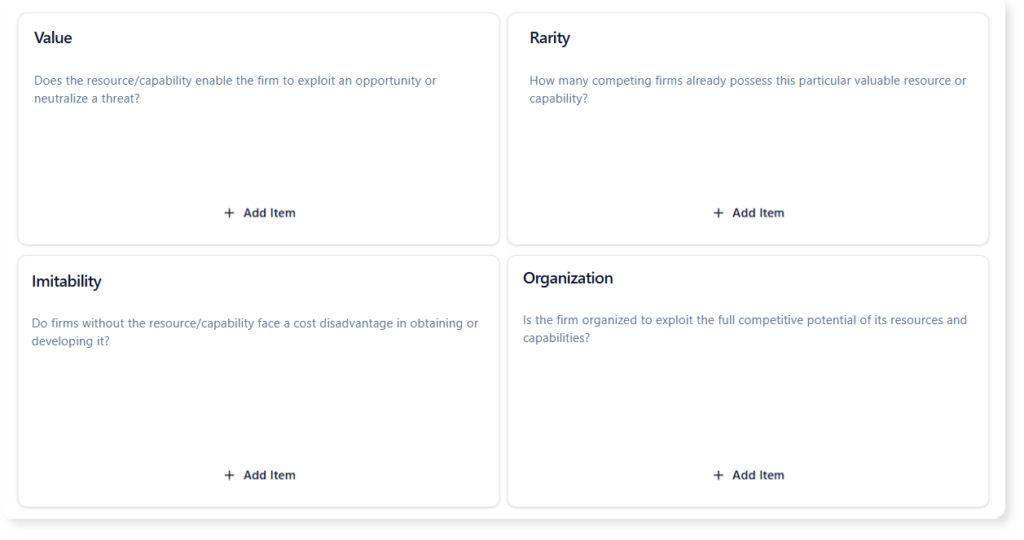
The VRIO framework is an acronym that stands for four dimensions used to evaluate a firm’s resources: Value, Rarity, Imitability, and Organization. Understanding these concepts is foundational to accurate analysis.
Conducting a thorough VRIO analysis requires a systematic approach. Follow these step-by-step guidelines to ensure your assessment results in actionable strategic insights.
Begin by listing all tangible and intangible assets. This includes physical assets (machinery, location), human resources (skilled staff, leadership), and organizational capabilities (culture, brand reputation, proprietary technology).
Move through the VRIO framework in order. Stop at the step where the answer is “No” to determine the competitive implication.
| Test | Question | If No… | If Yes… |
|---|---|---|---|
| Value | Is it valuable? | Competitive Disadvantage | Proceed to Rarity |
| Rarity | Is it rare? | Competitive Parity | Proceed to Imitability |
| Imitability | Is it hard to copy? | Temporary Competitive Advantage | Proceed to Organization |
| Organization | Are we organized to use it? | Unused Competitive Advantage | Sustained Competitive Advantage |
Once your resources are categorized, identify where your weaknesses lie. Resources that provide only “Parity” are necessary to stay in business but won’t help you win. Your strategy should focus on protecting and leveraging resources that offer “Sustained Competitive Advantage.”
Traditional strategic analysis can be time-consuming and prone to cognitive bias. Visual Paradigm Online leverages advanced AI to automate and enhance the VRIO analysis process, transforming static diagrams into dynamic strategic engines.

Starting from scratch is often the hardest part. With Visual Paradigm, you can simply enter a prompt such as “VRIO Analysis for a SaaS Logistics Company.” The AI instantly maps out key resources, categorizing them based on their likely value, rarity, and imitability. This provides an immediate structural foundation, saving hours of brainstorming.
One of the biggest challenges is objectivity—overestimating the uniqueness of your own resources. Visual Paradigm’s AI helps evaluate market benchmarks and competitor signals. It can suggest whether an asset truly offers a real advantage or if it merely maintains parity with industry standards, ensuring your strategy is built on reality rather than assumption.
Beyond simple categorization, the tool offers deep analysis. It identifies resources that have the potential to become long-term advantages if investment is increased. It also highlights areas where “Organization” is lacking—pointing out where you have a goldmine of a resource but lack the internal structure to monetize it effectively.
Once the analysis is complete, the tool allows you to export your canvas and AI-generated insights into professional formats like PDF, Word, or Markdown. This facilitates easy sharing with stakeholders, ensuring that strategic decisions are backed by clear, data-driven visualizations.
To visualize how this works effectively, consider these scenarios derived from common industry benchmarks:
Maximize the effectiveness of your VRIO analysis with these practical tips:
What Is the Business Model Canvas? Why Use Visual Paradigms & AI Tools: This comprehensive guide explains the Business Model Canvas, its core components, and how visual paradigms and AI-powered tools enhance strategic planning and business innovation.
AI-Powered Business Model Canvas Builder – Instant Strategy Design: An AI-driven tool that automates the creation of business model canvases, offering intelligent suggestions and real-time insights to accelerate business planning.
AI Canvas Tool – Intelligent Design for Business Frameworks: An AI-powered canvas application that helps users generate and refine business models, value propositions, and strategy frameworks with smart suggestions and automation.
AI Business Model Canvas Tool – Smart Strategy Development: A comprehensive AI-enhanced solution for building and refining business models with intelligent insights, real-time feedback, and collaborative features.
AI Canvas Editor Release Update: Introduces an AI-powered canvas editor that enhances diagram creation through intelligent suggestions and automated layout optimization.
AI-Powered Business Model Canvas Tool Guide: A step-by-step guide on using an AI-enhanced tool to generate and refine business model canvases with intelligent input and real-time recommendations.
Mission Model Canvas | AI-Powered Strategy Tool by VP: October 28, 2025 – Coordinate live sessions with your team using the built-in timer and export your final canvas or reports into professional formats such as Word, Markdown, or CSV. … The Mission Model Canvas is specifically designed for non-profits, government agencies, social enterprises, and any organization where the primary goal is mission achievement rather than profit.
Comprehensive Tutorial: AI-Powered Business Canvas Toolkit with Visual Paradigm: This page provides a detailed guide on using an AI-enhanced Business Model Canvas toolkit integrated with Visual Paradigm for automated business strategy development.
AI Canvas Tool – Visual Paradigm: An AI-driven tool within Visual Paradigm that enables users to generate and refine business canvases through intelligent automation and natural language input.
Mastering the Business Model Canvas with AI: Step-by-Step Guide Using Visual Paradigm: This blog post offers a structured walkthrough of leveraging AI capabilities in Visual Paradigm to create, customize, and optimize Business Model Canvases efficiently.
How the AI Business Model Canvas Builder Works – Visual Paradigm: This page explains the functionality of the AI-powered Business Model Canvas Builder, highlighting how machine intelligence automates canvas creation and strategic insight generation.
Deep Learning AI Canvas | Strategy Tools Analysis Canvas Template: Edit Localized Version: 深度學習 AI 畫布(TW) | 深度学习 AI 画布(CN) View this page in: EN TW CN · Visual Paradigm Online (VP Online) is an online diagram software that supports analysis canvases, various charts, UML, flowchart, rack diagram, org chart, family tree, ERD, floor plan, etc .
Product Canvas | AI-Powered Strategy Tool by VP: Build products people love. Combine strategy, design, and feedback into one visual space with our AI-powered Product Canvas to bring ideas to market faster.
Lean UX Canvas | AI-Powered Strategy Tool by VP: October 28, 2025 – Create a complete strategy framework in moments. Simply describe your vision, and the AI canvas generator transforms it into a structured, insight-rich canvas that helps you visualize, plan, and refine your next big idea.
Lean Canvas – Visual Paradigm: October 28, 2025 – Our application is designed to be your strategic partner, providing intelligent tools to enhance every step of your planning process for the Business Model Canvas. … Have a startup idea? Just enter ‘a mobile app for local home-cooked meal delivery’ and let our AI generate a complete Lean Canvas, outlining the problem, solution, and key metrics.
 The Ultimate Guide to PESTLE Analysis: Mastering Strategic Planning with AI
Integrating Strategy and Design: The Role of Visual Paradigm AI in Project Initiation
Overcoming Inconsistency: A Comprehensive Guide to Coherent AI-Generated UML
Comprehensive Guide to UML Class Diagrams: From Basics to AI-Powered Design
The Ultimate Guide to PESTLE Analysis: Mastering Strategic Planning with AI
Integrating Strategy and Design: The Role of Visual Paradigm AI in Project Initiation
Overcoming Inconsistency: A Comprehensive Guide to Coherent AI-Generated UML
Comprehensive Guide to UML Class Diagrams: From Basics to AI-Powered Design