 Visual Paradigm Desktop |
  Visual Paradigm Online


In the highly competitive world of modern business, standing out is not just an advantage; it is a necessity for survival. While many organizations exhaust their resources fighting for market share in saturated industries—often referred to as “Red Oceans”—visionary leaders look toward “Blue Oceans.” A Blue Ocean Strategy focuses on creating uncontested market space, making the competition irrelevant. To achieve this, businesses require robust visualization tools to map out their current trajectory and define their future path.
This guide explores the comprehensive frameworks available within the Ultimate Business Canvas Toolkit, with a specific deep dive into the Blue Ocean Strategy Canvas. We will examine how utilizing advanced tools like Visual Paradigm Online can transform abstract strategic concepts into actionable execution plans.
Before using digital tools to map your strategy, it is crucial to understand the foundational concepts that drive these frameworks. A strategic canvas is more than a chart; it is a diagnostic and action framework.
The core philosophy behind this strategy involves two distinct market universes:
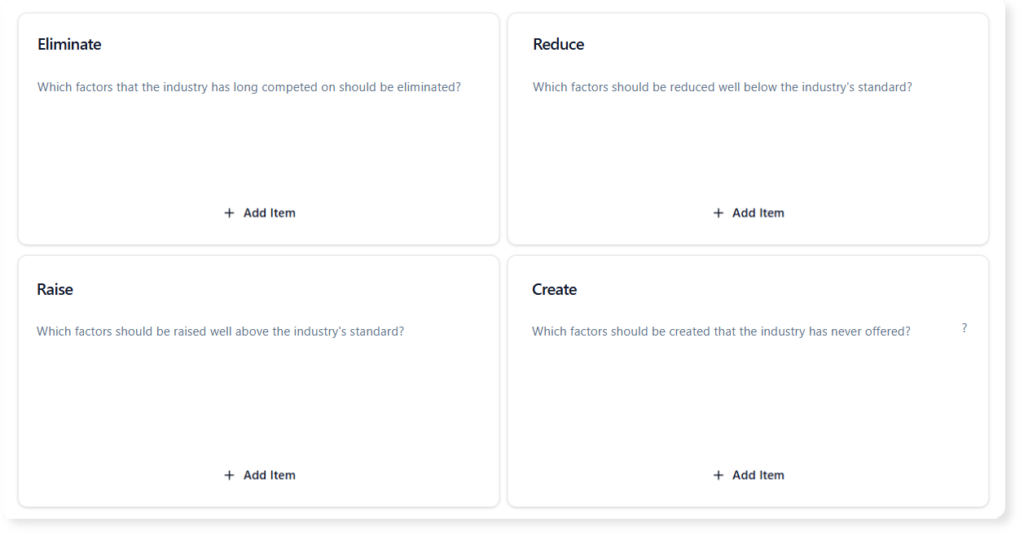
To reconstruct buyer value elements and craft a new value curve, the Blue Ocean Strategy utilizes the ERRC grid. This requires you to answer four critical questions:
This is the cornerstone of the Blue Ocean Strategy. It places equal emphasis on value and innovation. Value without innovation tends to focus on value creation on an incremental scale (e.g., more features for the same price). Innovation without value tends to be technology-driven or futuristic, shooting beyond what buyers are ready to accept and pay for.
Visual Paradigm Online has integrated artificial intelligence directly into the canvas ecosystem, fundamentally changing how strategies are developed. Moving from a blank page to a comprehensive strategy can be daunting; VP AI automates and enhances this process significantly.

One of the biggest hurdles in strategic planning is the “cold start” problem. With Visual Paradigm’s AI Canvas Generation, you can enter a simple prompt—such as “Blue Ocean Strategy for Modern Live Entertainment”—and the system instantly maps out competing factors. It identifies where to eliminate, reduce, raise, and create value, providing a structural foundation in seconds rather than hours.
If you are unsure which elements of your business model need adjustment, the AI-Assisted Ideation feature acts as a strategic consultant. By analyzing industry norms, competitor offerings, and customer expectations, the AI reveals opportunities to shift the strategic landscape. It suggests specific value factors that could be manipulated to create differentiation.
The tool goes beyond simple drafting. You can run deep analyses, such as SWOT or market viability checks, directly on the canvas content. Once the strategy is finalized, the AI helps synthesize these insights into professional reports. You can export a complete Blue Ocean Canvas—enriched with AI-generated narratives—into formats like PDF, Word, or Markdown for stakeholder presentations.
To effectively use the Business Canvas Toolkit for a Blue Ocean Strategy, follow this structured approach to ensure your model is both innovative and viable.
Begin by mapping the “As-Is” strategy canvas. Plot the current value curve of your industry. What are the principal factors the industry competes on? This might include price, speed, luxury, or technical specifications. This step establishes the baseline against which you will innovate.
Use the Four Actions Framework to challenge the industry standards defined in Step 1. Don’t just tweak the numbers; look for radical departures.
Create a new canvas representing your proposed strategy. The resulting value curve should diverge significantly from the industry standard. A good Blue Ocean strategy is characterized by focus, divergence, and a compelling tagline.
Strategy should not be developed in a silo. Use the Collaboration features to invite team members to the canvas. Allow them to comment, adjust value curves, and attach research. Utilize the “Multiple Views” feature to switch between a holistic canvas view and a focused view for deep-diving into specific sections without distraction.
Maximize the impact of your strategic planning sessions with these practical tips tailored for Visual Paradigm’s toolkit.
What Is the Business Model Canvas? Why Use Visual Paradigms & AI Tools: This comprehensive guide explains the Business Model Canvas, its core components, and how visual paradigms and AI-powered tools enhance strategic planning and business innovation.
AI-Powered Business Model Canvas Builder – Instant Strategy Design: An AI-driven tool that automates the creation of business model canvases, offering intelligent suggestions and real-time insights to accelerate business planning.
AI Canvas Tool – Intelligent Design for Business Frameworks: An AI-powered canvas application that helps users generate and refine business models, value propositions, and strategy frameworks with smart suggestions and automation.
AI Business Model Canvas Tool – Smart Strategy Development: A comprehensive AI-enhanced solution for building and refining business models with intelligent insights, real-time feedback, and collaborative features.
AI Canvas Editor Release Update: Introduces an AI-powered canvas editor that enhances diagram creation through intelligent suggestions and automated layout optimization.
AI-Powered Business Model Canvas Tool Guide: A step-by-step guide on using an AI-enhanced tool to generate and refine business model canvases with intelligent input and real-time recommendations.
Mission Model Canvas | AI-Powered Strategy Tool by VP: October 28, 2025 – Coordinate live sessions with your team using the built-in timer and export your final canvas or reports into professional formats such as Word, Markdown, or CSV. … The Mission Model Canvas is specifically designed for non-profits, government agencies, social enterprises, and any organization where the primary goal is mission achievement rather than profit.
Comprehensive Tutorial: AI-Powered Business Canvas Toolkit with Visual Paradigm: This page provides a detailed guide on using an AI-enhanced Business Model Canvas toolkit integrated with Visual Paradigm for automated business strategy development.
AI Canvas Tool – Visual Paradigm: An AI-driven tool within Visual Paradigm that enables users to generate and refine business canvases through intelligent automation and natural language input.
Mastering the Business Model Canvas with AI: Step-by-Step Guide Using Visual Paradigm: This blog post offers a structured walkthrough of leveraging AI capabilities in Visual Paradigm to create, customize, and optimize Business Model Canvases efficiently.
How the AI Business Model Canvas Builder Works – Visual Paradigm: This page explains the functionality of the AI-powered Business Model Canvas Builder, highlighting how machine intelligence automates canvas creation and strategic insight generation.
Deep Learning AI Canvas | Strategy Tools Analysis Canvas Template: Edit Localized Version: 深度學習 AI 畫布(TW) | 深度学习 AI 画布(CN) View this page in: EN TW CN · Visual Paradigm Online (VP Online) is an online diagram software that supports analysis canvases, various charts, UML, flowchart, rack diagram, org chart, family tree, ERD, floor plan, etc .
Product Canvas | AI-Powered Strategy Tool by VP: Build products people love. Combine strategy, design, and feedback into one visual space with our AI-powered Product Canvas to bring ideas to market faster.
Lean UX Canvas | AI-Powered Strategy Tool by VP: October 28, 2025 – Create a complete strategy framework in moments. Simply describe your vision, and the AI canvas generator transforms it into a structured, insight-rich canvas that helps you visualize, plan, and refine your next big idea.
Lean Canvas – Visual Paradigm: October 28, 2025 – Our application is designed to be your strategic partner, providing intelligent tools to enhance every step of your planning process for the Business Model Canvas. … Have a startup idea? Just enter ‘a mobile app for local home-cooked meal delivery’ and let our AI generate a complete Lean Canvas, outlining the problem, solution, and key metrics.