 Visual Paradigm Desktop |
  Visual Paradigm Online
In the landscape of modern software engineering, creating Unified Modeling Language (UML) diagrams has traditionally been a labor-intensive manual task requiring deep expertise in syntax and standards. Engineers often found themselves bogged down by the mechanics of drawing rather than focusing on the architecture itself. Visual Paradigm AI addresses these challenges by transforming the modeling process into an intuitive, conversational, and automated workflow, effectively shifting the focus from manual chores to strategic articulation.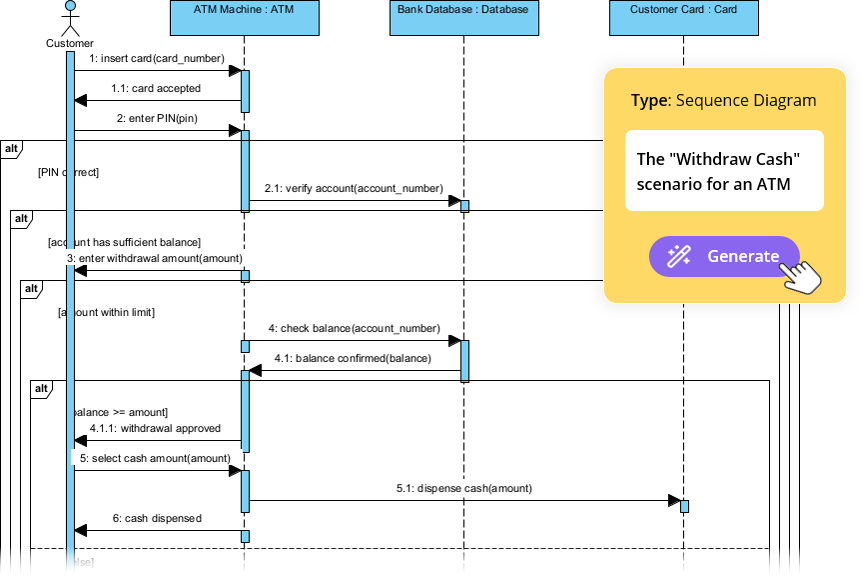
The most significant advancement introduced by Visual Paradigm AI is the capability to generate standardized diagrams directly from natural language descriptions. Instead of manually dragging shapes and connecting lines, users can describe their system in plain English—such as outlining a loan application process or a hospital management system—and the AI synthesizes a professional model in seconds.
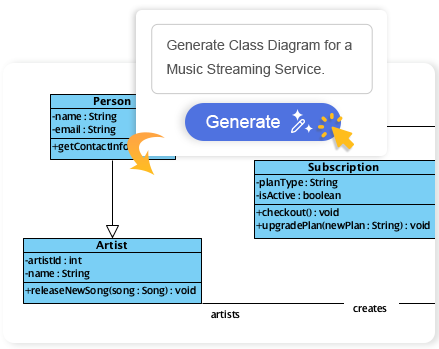
This automated capability spans the core UML suite, covering a wide range of structural and behavioral diagrams:
Visual Paradigm AI operates as more than just a drawing tool; it functions as a systematic design assistant. It offers specialized workflows to ensure that the generated models are not only visually accurate but logically sound.
This feature allows users to input unstructured problem descriptions. The AI parses the text to automatically extract candidate domain classes, attributes, and relationships, forming a structured domain model that serves as a solid foundation for further development.
For users seeking granular control, a guided wizard leads the way through the creation of UML diagrams. At each stage, the system provides educational tips and AI-driven insights to ensure architectural integrity, making it an excellent tool for both seasoned architects and newcomers to UML.
A dedicated tool analyzes existing use case diagrams and intelligently suggests or adds “extend” and “include” relationships. This ensures that the functional requirements adhere to UML best practices and accurately reflect system dependencies.
While general Large Language Models (LLMs) can generate basic diagramming code snippets (such as Mermaid.js or PlantUML), they often produce output that is visually approximating but technically flawed. Visual Paradigm AI is uniquely trained on established modeling standards, specifically UML 2.5.
| Feature | General LLMs | Visual Paradigm AI |
|---|---|---|
| Standard Adherence | Often produce “pretty sketches” that violate syntax rules. | Strict adherence to UML 2.5 naming conventions and multiplicities. |
| Architectural Insight | Generates what is asked without validation. | Provides architectural critique, identifying single points of failure and logic gaps. |
| Design Patterns | Requires explicit prompting for patterns. | Suggests industry standards like MVC (Model-View-Controller) to improve quality. |
This specialized training ensures that naming conventions, inheritance structures, and multiplicities are technically valid, making the diagrams ready for engineering implementation rather than just conceptual presentations.
To support international collaboration, the platform includes robust localization features designed to break down language barriers in technical teams:
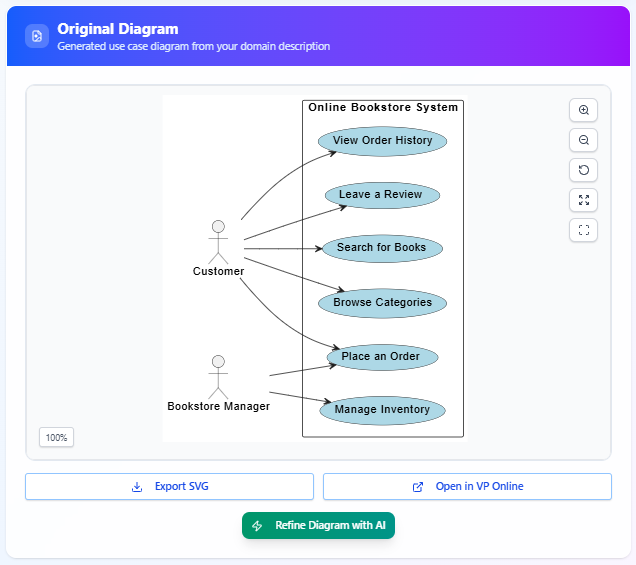
The AI tools serve as a starting point for deeper engineering. Once a diagram is generated, it seamlessly integrates into the broader Visual Paradigm ecosystem:
To understand the magnitude of this transformation, consider that traditional modeling is akin to hand-chiseling a marble statue: every stroke requires intense focus, and a single structural mistake can be costly. In contrast, AI-powered modeling is like using a high-end 3D printer. You provide the specifications, and the system precisely builds the structure. This shift allows engineers to spend their time perfecting the design and logic rather than laboring over the manual production of the artifacts.
Resource
Visual Paradigm – All-in-One Visual Development Platform: A comprehensive platform for visual modeling, software design, business process modeling, and AI-powered development tools.
AI Textual Analysis – Transform Text into Visual Models Automatically: Use AI to analyze text documents and automatically generate diagrams such as UML, BPMN, and ERD for faster modeling and documentation.
Visual Paradigm AI Chatbot Enhances Multi-Language Support …: 7 hours ago · Discover the latest updates to Visual Paradigm ‘s AI -Powered visual modeling software, including multi-language UI and improved chat content localization. Experience seamless AI diagram generation in languages like Spanish, French, Chinese, and more with our AI chatbot for UML and other diagrams.
AI-Powered Use Case Diagram Refinement Tool – Smart Diagram Enhancement: Leverage AI to automatically refine and optimize your use case diagrams for clarity, consistency, and completeness.
Convert Use Case to Activity Diagram – AI-Powered Transformation: Automatically convert use case diagrams into detailed activity diagrams using AI to visualize system workflows.
AI-Assisted UML Class Diagram Generator – Visual Paradigm: An interactive, step-by-step tool to help users create UML class diagrams with AI-powered suggestions, validation, PlantUML export, and design analysis.
Mastering UML Activity Diagrams with AI | Visual Paradigm Blog: A blog post exploring how AI-powered features in Visual Paradigm enhance the creation and optimization of UML activity diagrams for developers and analysts.
AI Diagram Generator Now Supports Package Diagrams in Visual Paradigm: New release enabling AI-generated package diagrams for better software architecture visualization.
How to Translate Text in Images for UML, BPMN, and Flowcharts: Step-by-step guide on using AI-powered tools to extract and translate text in technical diagrams for global collaboration and localization.
Comprehensive Guide to Translating Text in Technical Diagrams Using AI: Learn how Visual Paradigm’s AI Image Translator enables accurate, automated translation of text within technical diagrams like UML, BPMN, and flowcharts.
AI-Powered Diagram Generation: New Features for UML Timing Diagrams: Announcement of AI-driven enhancements in Visual Paradigm that enable automatic generation of UML timing diagrams, improving speed and accuracy in system modeling.
How AI Enhances Class Diagram Creation in Visual Paradigm: This blog explores how Visual Paradigm leverages AI to automate and improve the creation of class diagrams, making software design faster and more accurate.
AI-Powered Sequence Diagram Refinement in Visual Paradigm: Discover how Visual Paradigm’s AI tool transforms use-case descriptions into precise and professional sequence diagrams with minimal manual effort.