 Visual Paradigm Desktop |
  Visual Paradigm Online
In the fast-paced world of entrepreneurship, traditional business plans—often spanning dozens of pages—are frequently obsolete by the time they are printed. Enter the Lean Canvas, a 1-page business plan template created by Ash Maurya. Adapted from Alex Osterwalder’s Business Model Canvas, the Lean Canvas is designed specifically for early-stage startups and entrepreneurs to deconstruct their ideas into key assumptions. It focuses on identifying problems and solutions quickly, allowing founders to pivot before investing significant resources.
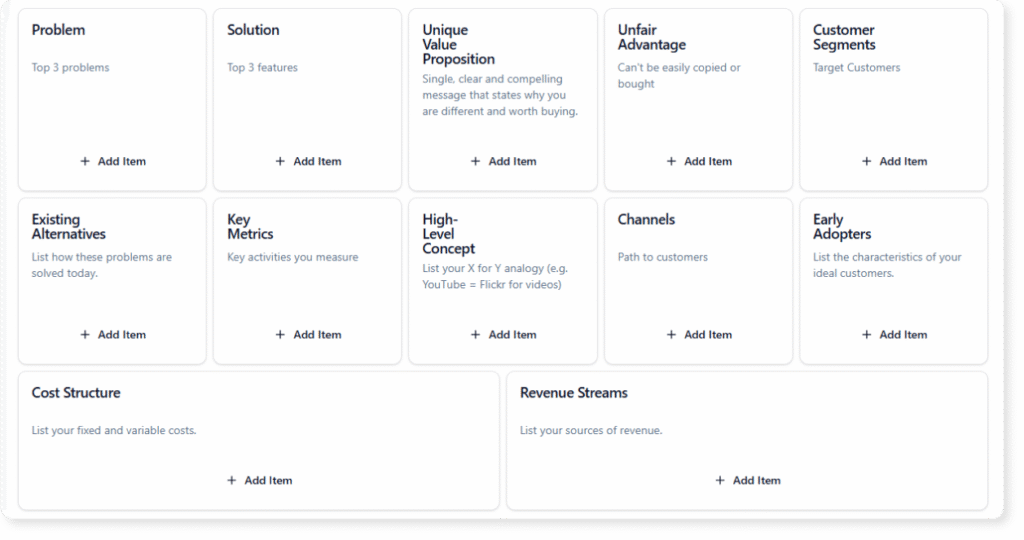
The primary goal of the Lean Canvas is to replace long, boring business plans with a format that is fast, concise, and portable. It forces you to distill the essence of your product, focusing heavily on the problem-solution fit and the inherent risks in your business model.
Before diving into the creation process, it is essential to understand the foundational components that make up the Lean Canvas structure. These nine building blocks provide a holistic view of your business logic.
Completing a Lean Canvas is a strategic exercise, not just a form-filling task. Follow these step-by-step guidelines to maximize its utility.
Do not start with the Solution. Your product is only viable if it solves a real pain point for a specific group of people. Define the specific user (e.g., “Busy urban professionals”) and list their top 3 problems (e.g., “No time to cook healthy meals”). Connect these two blocks first to ensure a Problem-Market fit.
Your UVP is the intersection of the problem and your solution. It should describe the outcome the customer gets. Avoid jargon. A good formula is: Instant clarity headline = End result customer wants + Specific period of time + Address the objections.
List the top three features that directly address the problems you listed. Simultaneously, define how you will measure success. Avoid “vanity metrics” (like total page views) and focus on actionable metrics (like daily active users or cost per acquisition).
Map out the financial viability. What is the customer willing to pay? What are your burn rates? You don’t need exact accounting figures, but you need a solid estimate of your margins to ensure the business model is sustainable.
Visual Paradigm AI offers a suite of intelligent tools designed to be your strategic partner, significantly accelerating the planning process for the Business Model and Lean Canvas. By integrating AI into your workflow, you can move from ideation to validation faster than ever before.
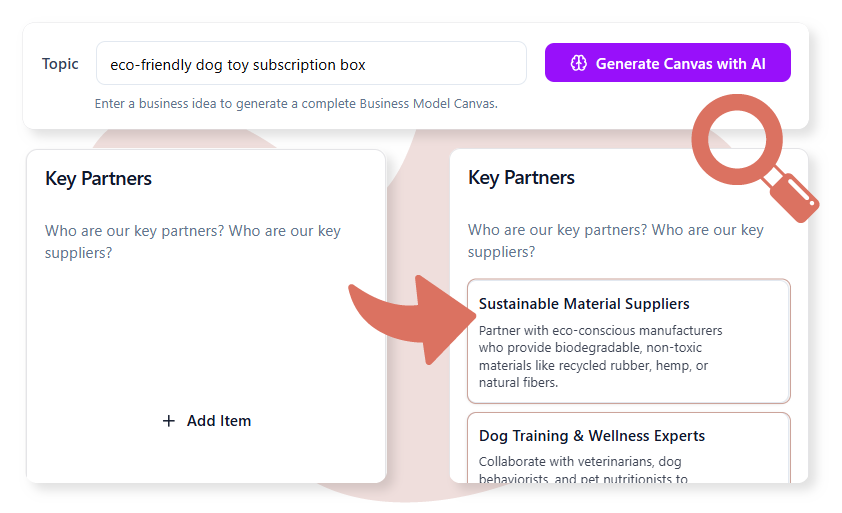
Starting from a blank page is often the hardest part of strategy. With AI Canvas Generation, you can simply input a high-level startup idea—such as “a mobile app for local home-cooked meal delivery”—and the AI will generate a complete, populated Lean Canvas. It outlines the problem, solution, and key metrics automatically, providing a solid foundation to refine rather than building from scratch.
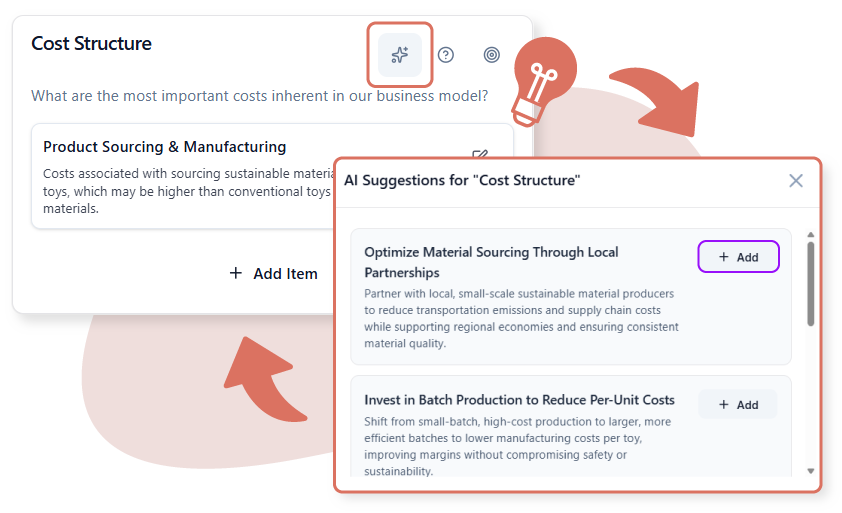
Defining an “Unfair Advantage” is notoriously difficult for new founders. AI-Assisted Ideation analyzes your current canvas entries and suggests potential competitive moats you might have overlooked, such as exclusive data partnerships, community effects, or proprietary algorithms.
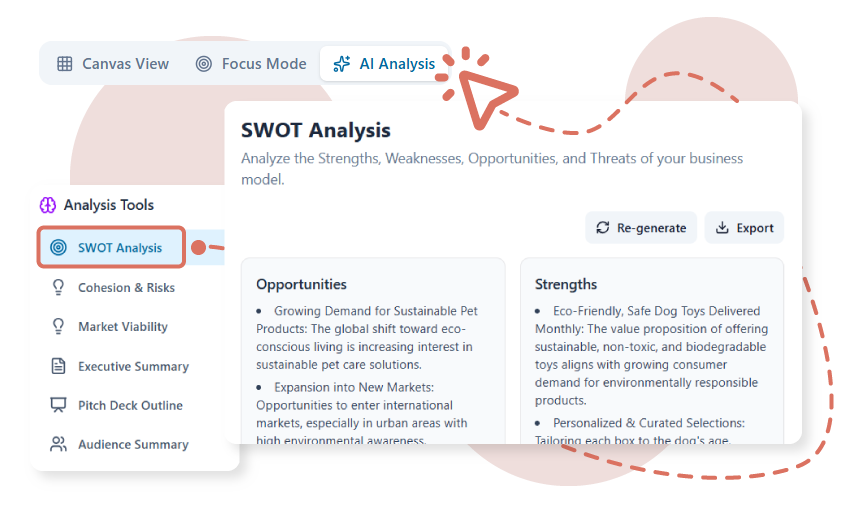
Every Lean Canvas is a collection of assumptions until proven otherwise. The Strategic AI Analysis tool scans your canvas to identify the riskiest assumptions. It acts as a devil’s advocate, highlighting areas that lack evidence and suggesting simple experiments or metrics to test those specific risks, effectively guiding your validation roadmap.
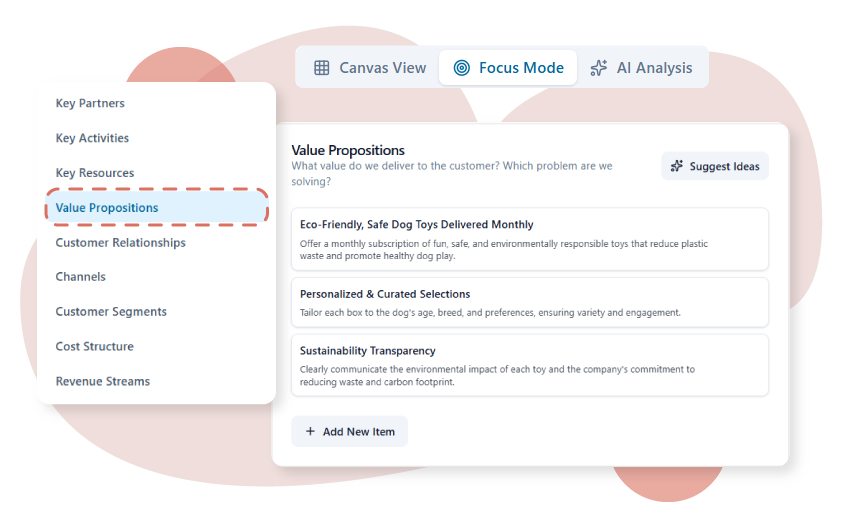
Strategy is rarely a solo endeavor. The platform includes tools to Collaborate & Export, allowing you to run rapid brainstorming sessions with co-founders using built-in timers. Furthermore, the Focus Mode allows you to drill down into specific sections, such as the “Problem” block, to color-code pain points and add detailed notes, ensuring deep understanding before high-level execution.
To better understand how the Lean Canvas applies across industries, consider these scenarios:
Optimize your Lean Canvas experience with these expert tips: