 Visual Paradigm Desktop |
  Visual Paradigm Online


In the rapidly evolving landscape of software architecture and business analysis, the transition from manual drafting to artificial intelligence-driven design is reshaping how professionals work. The Visual Paradigm (VP) AI Visual Modeling Platform represents a significant leap forward, moving beyond simple drawing tools to become a semantic-aware design partner. This guide explores the platform through the lens of the ArchiMate standard, examines its unique market position compared to generic Large Language Models (LLMs), and outlines the strategic advantages of adopting this technology.
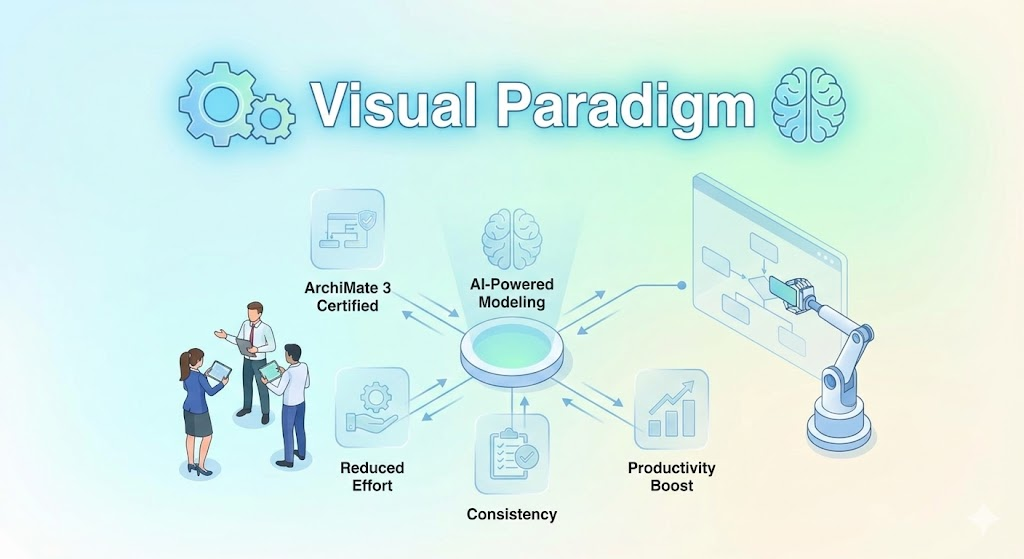
To fully grasp the capabilities of the Visual Paradigm AI platform, it is effective to view it through the ArchiMate standard layers. This approach highlights how the tool bridges the gap between abstract business strategy and concrete technical implementation.
At the highest level, the platform is designed to serve business analysts, enterprise architects, and project managers. It functions as a strategic enabler that aligns organizational goals with technical execution. Within this layer, the platform supports critical strategic frameworks used during the project initiation phase.
The core functionality of Visual Paradigm AI resides in the Application Layer, where intelligent assistance tools transform natural language into structured artifacts. This layer is characterized by a suite of applications designed to automate the heavy lifting of diagramming.
The Technology Layer represents the infrastructure and implementation details. Visual Paradigm AI provides a robust environment for bridging design with code and physical deployment.
While many generative AI tools exist, Visual Paradigm AI differentiates itself by transforming modeling from a “labor-intensive drawing chore” into an automated, conversational workflow. Its value proposition is built on several distinctive technical capabilities that generic LLMs cannot replicate.
A fundamental limitation of general Large Language Models is their tendency to produce “hallucinations” or technically invalid sketches that look appealing but fail structural integrity tests. In contrast, VP AI is uniquely trained on established modeling standards, including UML 2.5, ArchiMate 3, and C4.
This training ensures that the AI understands the semantic rules behind the visuals. For instance, it correctly distinguishes between aggregation and composition relationships in object-oriented design, ensuring the output is not just a drawing, but a technically valid model.
One of the most frustrating aspects of using generic AI for diagrams is the lack of state persistence; requesting a small change often forces the AI to regenerate the entire image, breaking the layout. Visual Paradigm AI maintains the diagram as a persistent object. This allows for conversational refinement, where users can rename actors, add classes, or modify relationships without losing the established layout integrity.
The platform utilizes advanced context recognition to interpret jargon based on the specific domain logic of the diagram type. A prime example is the term “port”. The AI intelligently distinguishes whether this refers to:
Visual Paradigm AI includes a powerful tool for localization and migration. It can analyze existing images (PNG, JPG, SVG) and translate the text within them into over 50 languages. Crucially, it does this while preserving all original connectors, shapes, and complex nested elements, dramatically reducing the time required to localize technical documentation for global teams.
Choosing Visual Paradigm AI offers a “transformative power” that extends beyond simple efficiency gains. It acts as a force multiplier for development and analysis teams.
The platform eliminates the daunting “blank canvas” problem. By transforming abstract ideas and meeting notes into actionable, standardized models in seconds, teams can bypass the initial drafting paralysis and move immediately from vague discussions to precise blueprints.
Functioning as an architectural partner, the AI helps reduce design errors. It provides architectural critiques, identifies single points of failure, suggests established design patterns like MVC (Model-View-Controller), and highlights missing multiplicities in data models. This proactive assistance ensures robust system design before a single line of code is written.
Unlike standalone generative tools, VP AI is integrated into a mature ecosystem. AI-generated diagrams can be imported directly into Visual Paradigm Desktop or Online. This allows for advanced post-processing, including version control, team collaboration, and model simulation.
With features like the 10-step guided wizard and natural language processing, the platform lowers the barrier to entry. Stakeholders and non-experts can contribute to complex system designs without needing to master the intricacies of UML or BPMN syntax.
To visualize the distinction between this platform and general AI tools, consider this analogy: A general LLM is like a talented sketch artist who can draw what you describe but might forget essential structural elements like load-bearing walls. Visual Paradigm AI is like an architect equipped with a CAD system; it understands building codes, semantic rules, and ensures the blueprint is technically sound for construction.
AI-Powered Use Case Diagram Refinement Tool by Visual Paradigm: A smart AI feature that enhances and refines existing use case diagrams by suggesting improvements, identifying missing actors, and optimizing structure.
AI Use Case Description Generator by Visual Paradigm: An AI-powered tool that automatically generates detailed use case descriptions from user inputs, speeding up system analysis and documentation.
Master AI-Driven Use Case Diagrams: A Short Tutorial: A concise tutorial from Visual Paradigm on leveraging AI to create, refine, and automate use case diagram development for faster delivery.
AI-Powered Sequence Diagram Refinement Tool | Visual Paradigm: Discover how Visual Paradigm’s AI Sequence Diagram Refinement Tool enhances UML modeling by automatically improving and optimizing sequence diagrams with intelligent suggestions.
AI Sequence Diagram Refinement Tool | Visual Paradigm: Use AI to automatically refine and optimize your sequence diagrams for better readability, correctness, and consistency.
From Simple to Sophisticated: AI-Powered Sequence Diagram Refinement Tool: Explore how Visual Paradigm’s AI-powered tool evolves simple diagrams into sophisticated, accurate models with minimal effort.
Generate Activity Diagrams from Use Cases Instantly with Visual Paradigm’s AI: Discover how Visual Paradigm’s AI engine enables rapid, accurate conversion of use cases into professional activity diagrams with minimal effort.
Interactive UML Activity Diagram Creator – Visual Paradigm Chat Interface: Use the AI-powered chat interface in Visual Paradigm to generate and edit UML activity diagrams in real time with natural language input.
AI-Powered Editor for Converting Use Cases to Activity Diagrams: An AI-driven online editor that automatically transforms use case descriptions into structured UML activity diagrams with intelligent suggestions.
Automating Use Case Development with AI in Visual Paradigm: Learn how Visual Paradigm’s AI-powered use case description generator streamlines the creation of detailed use cases, reducing manual effort and improving consistency in software development.
How the Scenario Analysis Tool Works in Visual Paradigm: An overview of the inner workings and functionality of the Scenario Analysis Tool in Visual Paradigm for use case validation.
How the Scenario Analysis Tool Works – Official Blog Post: Insightful blog post explaining the mechanics and benefits of Visual Paradigm’s Scenario Analysis Tool for use case modeling.
A Comprehensive Guide to Using the MVC System Architecture Generator | Visual Paradigm: Step-by-step guide on leveraging Visual Paradigm’s AI-powered MVC system architecture generator to accelerate application design.
What is an MVC System Architecture Generator? | Visual Paradigm: Explains the functionality and benefits of AI-driven MVC architecture generators in modern software design workflows.
AI-Powered MVC System Architecture Generator | Visual Paradigm AI Toolbox: A web-based AI tool that automatically generates MVC system architectures from user inputs and requirements.