 Visual Paradigm Desktop |
  Visual Paradigm Online


Your Comprehensive Handbook to the Hub-and-Spoke Ecosystem
The TOGAF® Standard, 10th Edition marks a transformative shift in how enterprise architecture (EA) frameworks are designed, delivered, and used. Moving away from a rigid, monolithic document, TOGAF now embraces a modular, dynamic, and practitioner-focused ecosystem—a hub-and-spoke model that balances timeless principles with real-world adaptability.
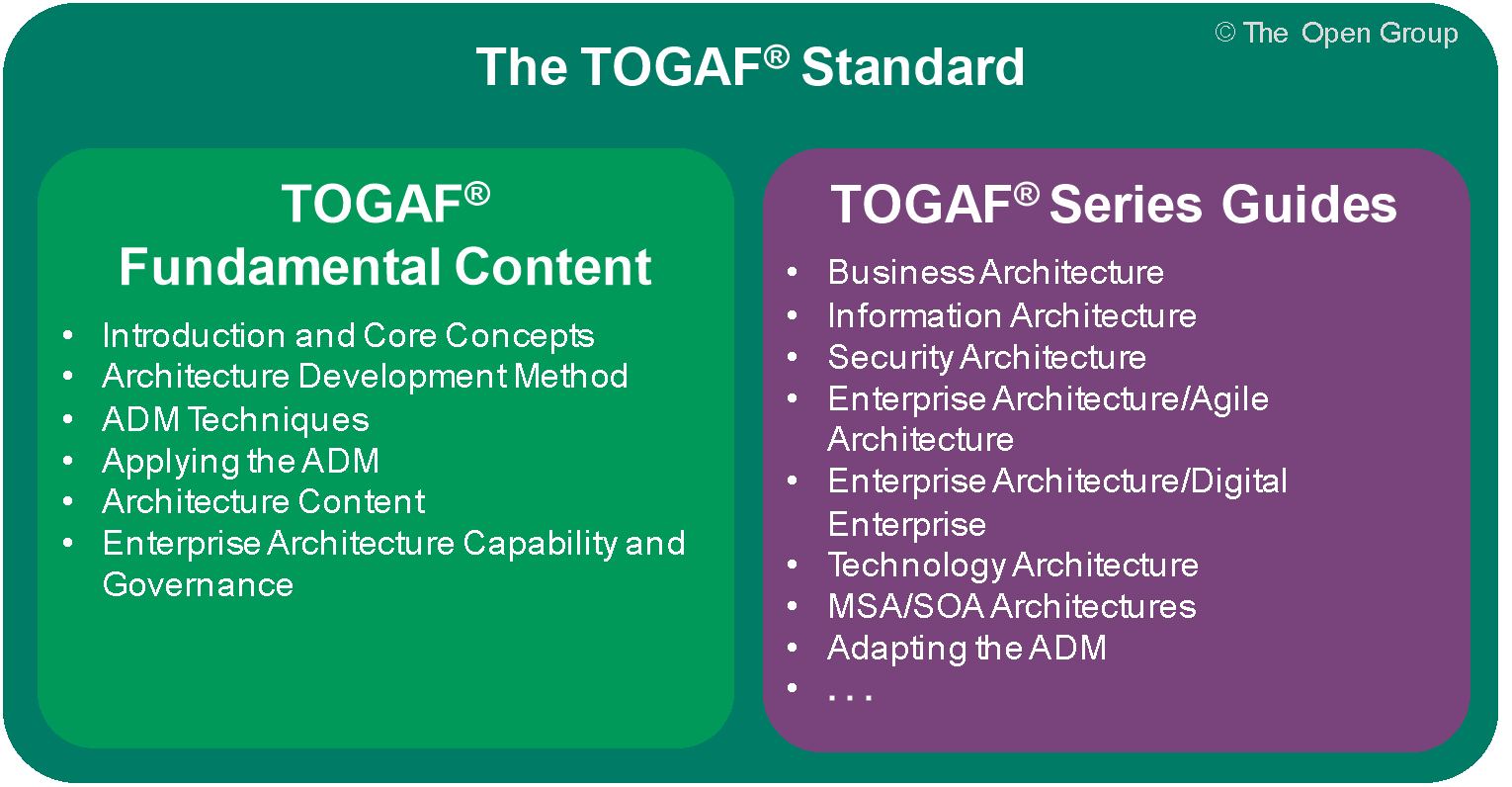
This guide walks you through the core structure, purpose, and practical application of TOGAF 10, with emphasis on how the Fundamental Content and TOGAF Series Guides work together to empower organizations across industries, scales, and digital maturity levels.
At the heart of TOGAF 10 lies a powerful architectural metaphor: the hub-and-spoke model.
| Component | Role | Characteristics |
|---|---|---|
| Hub: Fundamental Content | The stable, universal core of TOGAF | Timeless, foundational, rarely changed |
| Spokes: TOGAF Series Guides | Practical, evolving application guidance | Dynamic, context-specific, rapidly updated |
✅ Key Insight: The hub provides enduring principles; the spokes deliver actionable solutions for today’s challenges.
The Fundamental Content is the bedrock of TOGAF. It defines what enterprise architecture is, and why it matters.
Core Concepts & Terminology
Standardized definitions for architecture, stakeholders, models, and views.
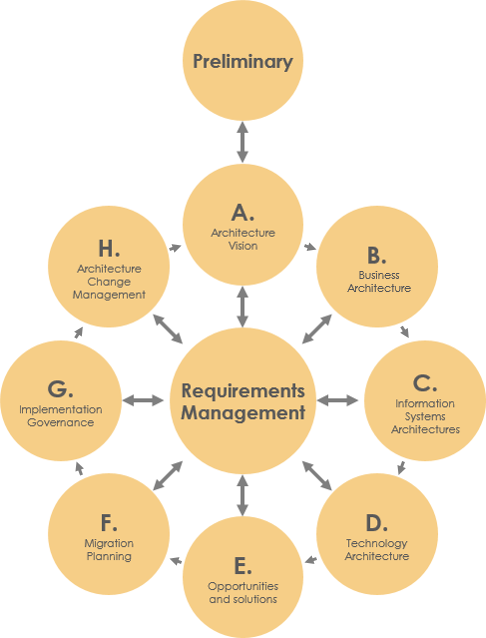
Architecture Development Method (ADM)
The proven, iterative process for developing enterprise architectures—now more flexible than ever.
Enterprise Architecture Principles
High-level, enduring rules that guide decision-making (e.g., “Architecture should be reusable”).
Architecture Framework Scaffolding
The structural backbone: phases, deliverables, governance, and quality assurance.
⚠️ Note: This content changes infrequently—typically only every 5–10 years—ensuring long-term stability and consistency.
The TOGAF Series Guides are the dynamic, evolving extensions of the framework. They answer the critical question: “How do I apply TOGAF in my organization?”
Enable Configuration & Adaptation
Tailor the ADM to fit your organization’s size, industry, culture, and delivery model (e.g., agile, hybrid, waterfall).
Address Modern Use Cases
Provide timely guidance on AI, digital transformation, microservices, sustainability, and cybersecurity—without altering the core standard.
Bridge Theory and Practice
Offer templates, real-world examples, role-based advice, and step-by-step workflows to make TOGAF actionable.
💡 Pro Tip: Think of the Series Guides as “plug-in modules” for your EA practice—select only what you need.
To ensure quality, relevance, and alignment, all Series Guides adhere to three foundational principles:
| Pillar | Description |
|---|---|
| 1. Modular Authority | Official, endorsed best practices. Not part of the broader TOGAF Library (which includes experimental or niche content). |
| 2. Practitioners’ Perspective | Written for real-world use—by practitioners, for practitioners. Focuses on roles: architects, leaders, project teams. |
| 3. Domain & Horizontal Focus | Guides are either: • Domain-specific (deep dives into Business, Security, or Data Architecture) • Horizontal (cross-cutting themes like agility, risk, or integration) |
Below is a curated list of the most impactful and widely used TOGAF Series Guides, grouped by focus area. These are essential reading for both practitioners and certification candidates.
| Guide | Key Focus | Practical Value |
|---|---|---|
| Business Architecture: Value Streams | Maps end-to-end customer value delivery across silos | Eliminates departmental fragmentation; supports lean transformation |
| Business Architecture: Business Capabilities | Defines, analyzes, and plans core organizational abilities | Strategic planning, capability gap analysis, roadmap alignment |
| Business Architecture: Business Models | Guides modeling business structures, revenue models, and ecosystems | Supports innovation, digital business design, and strategy execution |
🎯 Best For: Strategy alignment, organizational redesign, and digital business modeling.
| Guide | Key Focus | Practical Value |
|---|---|---|
| Enabling Enterprise Agility | Adapts the ADM for iterative, incremental delivery (e.g., sprints, continuous delivery) | Enables EA in agile environments without slowing down delivery |
| Enterprise Agility and Digital Transformation | Integrates EA with digital strategy, innovation, and customer-centricity | Supports transformation programs and innovation pipelines |
🎯 Best For: Agile teams, digital transformation leaders, DevOps & product delivery teams.
| Guide | Key Focus | Practical Value |
|---|---|---|
| Integrating Risk and Security | Embeds security and risk considerations into early ADM phases (A & B) | Prevents “security as an afterthought” – proactive threat modeling, compliance alignment |
🎯 Best For: Security architects, risk officers, compliance teams, and governance bodies.
| Guide | Key Focus | Practical Value |
|---|---|---|
| Digital Business Reference Model (DBRM) | Pre-built components for digital enterprises (e.g., customer experience, data platforms) | Accelerates architecture development with proven patterns |
| Information Architecture: BI & Analytics | Guides design of data-driven systems, dashboards, and insights layers | Supports data governance and analytics maturity |
| Information Architecture: Metadata Management | Establishes governance and reuse of metadata across systems | Enhances data quality, interoperability, and AI readiness |
| Architecture Project Management | Best practices for managing EA initiatives (scope, timelines, resources) | Improves success rates of complex architecture projects |
🎯 Best For: Data architects, enterprise architects, project managers, and IT leaders.
| Guide | Focus Area | Why It Matters |
|---|---|---|
| Environmentally Sustainable Information Systems | Green IT, carbon footprint analysis, sustainable tech choices | Supports ESG goals and regulatory compliance |
| Capability Planning & Management | Strategic planning of organizational capabilities over time | Enables long-term agility and future-proofing |
| Metadata Management (Expanded) | Advanced practices for cataloging, lineage, and governance | Critical for AI/ML, data privacy (GDPR), and trust |
🌟 Trend Alert: These guides reflect TOGAF’s commitment to addressing sustainability, ethics, and long-term resilience.
Think of TOGAF 10 as a modern construction project:
| TOGAF Element | Building Analogy |
|---|---|
| Fundamental Content | Universal building codes, load-bearing structures, foundation design — stable, long-lasting, code-compliant |
| Series Guides | Specialized construction manuals: • “How to build a smart home” (Agile) • “How to reinforce against earthquakes” (Security) • “How to install solar panels” (Sustainability) |
✅ Result: The same foundation supports diverse buildings—skyscrapers, homes, eco-villages—each customized for its purpose.
If you’re preparing for the TOGAF Enterprise Architecture Practitioner exam, these Series Guides are especially relevant:
| Guide | Why It Matters for Certification |
|---|---|
| ADM Practitioners’ Approach | Covers real-world ADM application, phase customization, and deliverable management — core to exam scenarios |
| Leader’s Guide | Focuses on EA governance, maturity models, and capability building — essential for leadership and strategic questions |
| Enabling Enterprise Agility | Addresses agile delivery, iterative planning, and fast feedback loops — key for modern EA case studies |
| Integrating Risk and Security | Tests your ability to embed security early — frequently tested in scenario-based questions |
📌 Exam Tip: The Practitioner exam is scenario-driven. Study how these guides apply the ADM in real contexts.
| Guide Title | Focus Area | Key Benefit | Certification Relevance |
|---|---|---|---|
| ADM Practitioners’ Approach | ADM Application | Real-world ADM tailoring | ⭐⭐⭐⭐⭐ |
| Leader’s Guide | EA Governance | Building and evolving EA capability | ⭐⭐⭐⭐⭐ |
| Enabling Enterprise Agility | Agile & Digital | Agile-friendly ADM adaptation | ⭐⭐⭐⭐☆ |
| Integrating Risk and Security | Security & Risk | Proactive security integration | ⭐⭐⭐⭐☆ |
| Business Architecture: Value Streams | Business Architecture | Strategy-to-execution alignment | ⭐⭐⭐⭐ |
| Digital Business Reference Model | Reference Models | Accelerated digital architecture | ⭐⭐⭐☆ |
| Environmentally Sustainable IS | Sustainability | ESG and green IT guidance | ⭐⭐⭐☆ |
Whether you’re:
A new EA practitioner learning the framework,
A senior architect leading transformation,
Or a certification candidate preparing for the exam,
Follow this roadmap:
Start with the Fundamental Content — master the ADM, principles, and core concepts.
Select relevant Series Guides based on your role and context (e.g., Agile, Security, Business Architecture).
Use guides as living documents — update your approach as new guides are released.
Combine guides for tailored solutions — e.g., use Agility + Security + Business Capabilities for a secure, fast-moving digital initiative.
“The best way to start an enterprise architecture journey is not with theory—but with clarity, structure, and speed.”
The Visual Paradigm TOGAF ADM Tool is a game-changing digital companion for Enterprise Architecture (EA) teams. Designed to bring the TOGAF® Standard, 10th Edition to life in a visual, intuitive, and collaborative way, it empowers teams to kickstart any ADM process quickly, consistently, and confidently—even in complex or agile environments.
Enterprise Architecture isn’t just about documents and models—it’s about clarity, alignment, and execution. Yet many EA teams struggle with:
❌ Confusion over which ADM phase to start with
❌ Inconsistent application of the ADM across projects
❌ Time wasted reinventing the wheel for each new initiative
❌ Difficulty communicating the ADM to non-architects (leaders, developers, business stakeholders)
Enter Visual Paradigm’s TOGAF ADM Tool—a purpose-built, visual platform that turns the abstract ADM into a step-by-step, interactive roadmap.
Instead of flipping through the TOGAF 10th Edition manual, teams can:
Launch a new ADM project in seconds with a pre-configured template.
Select a project type (e.g., Digital Transformation, Cloud Migration, Agile Initiative, Security Overhaul).
The tool auto-configures the ADM—highlighting relevant phases, deliverables, and techniques based on context.
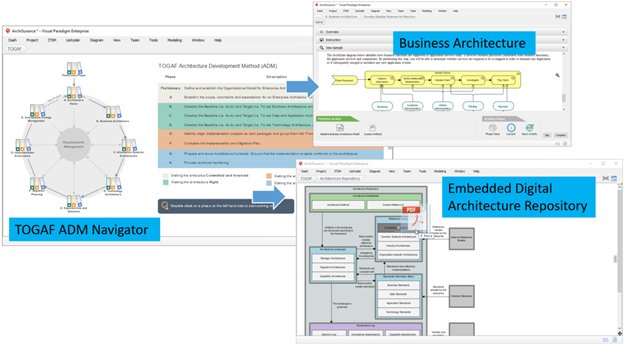
💡 Example: For a Digital Transformation project, the tool pre-activates Phases A (Vision), B (Business Architecture), and D (Technology Architecture)—and disables irrelevant steps like legacy system inventory (unless needed).
The tool integrates the TOGAF Series Guides directly into the ADM workflow—making the “spokes” of the ecosystem actionable and visible.
| Feature | Benefit |
|---|---|
| Embedded Series Guide Icons | Click to see real-world examples, templates, and best practices from guides like Enabling Enterprise Agility or Integrating Risk and Security. |
| Role-Based Views | Architects see technical deliverables; leaders see governance and maturity metrics; business teams see value streams and capability maps. |
| Dynamic Deliverable Generator | Automatically generates placeholders for key artifacts (e.g., Architecture Vision, Capability Roadmap, Risk Register). |
✅ Result: Teams don’t just follow the ADM—they execute it with confidence, guided by real-world expertise.
Forget text-heavy documents. The Interactive ADM Canvas provides a drag-and-drop, timeline-based view of the entire ADM process.

Phases are visual nodes with status indicators (planned, in progress, completed).
Deliverables are linked to each phase with clickable details.
Dependencies and feedback loops are color-coded and auto-generated (e.g., Phase B → Phase C).
Agile sprints can be mapped into the ADM timeline (e.g., “Vision Sprint” in Phase A).
🎨 Visual Impact: Stakeholders instantly grasp progress, bottlenecks, and next steps—no training needed.
The tool comes with industry-specific and use-case-specific ADM templates, powered by the TOGAF Series Guides:
| Template | Use Case | Built With |
|---|---|---|
| Agile Enterprise Architecture | Fast-paced product teams, sprints, continuous delivery | Enabling Enterprise Agility, ADM Practitioners’ Approach |
| Secure by Design Architecture | High-risk environments (finance, healthcare) | Integrating Risk and Security |
| Digital Business Transformation | Customer-centric innovation, omnichannel strategy | Digital Business Reference Model, Business Architecture: Value Streams |
| Sustainable IT Architecture | ESG compliance, carbon footprint reduction | Environmentally Sustainable IS |
🚀 Kickstart in Minutes: Choose a template → Customize → Begin architecture work.
EA isn’t a solo mission. The tool enables seamless teamwork:
Real-time collaboration across architects, business analysts, IT leads, and executives.
Comment threads on deliverables (e.g., “Is this capability aligned with the value stream?”).
Audit trail of changes and approvals—critical for governance and compliance.
Export to PDF, PowerPoint, or Jira for stakeholder presentations or project handoff.
✅ Governance Built In: No need to build custom tracking—compliance with TOGAF principles is visible and traceable.
The tool doesn’t force a single methodology. It adapts to your team’s way of working:
| Delivery Model | How the Tool Adapts |
|---|---|
| Traditional (Waterfall) | Full ADM cycle with milestone gates and sign-offs |
| Agile/Scrum | Phases are mapped to sprints; deliverables are iterative and incremental |
| Hybrid | Mix of phased and iterative approaches—flexible, configurable |
🎯 Perfect for: Organizations transitioning from traditional to agile EA.
“We used to spend 3 weeks just planning the ADM. Now, with Visual Paradigm, we start in 2 hours.”
— Lead EA Architect, Global Financial Services Firm
“The visual canvas helped our business team understand the architecture process for the first time. We’re now aligned from day one.”
— Digital Transformation Lead, Healthcare Provider
“The Integrating Risk and Security guide is embedded in the tool—so we never miss a security checkpoint in Phase A.”
— Security Architect, Tech Startup
| Feature | Benefit |
|---|---|
| ✅ Instant ADM Start | No more “Where do we begin?” confusion |
| ✅ Visual, Interactive ADM Canvas | Clear, intuitive navigation for all stakeholders |
| ✅ Embedded TOGAF Series Guides | Access to best practices without leaving the tool |
| ✅ Pre-Built Templates | Accelerate delivery for common use cases |
| ✅ Role-Based Views & Collaboration | Break down silos and improve alignment |
| ✅ Agile & Hybrid Support | Work the way your team does |
| ✅ Governance & Compliance Tracking | Prove adherence to TOGAF standards |
Download Visual Paradigm (free trial available)
Select “TOGAF ADM” from the New Project menu
Choose a template (e.g., “Agile Enterprise Architecture”)
Customize the project (name, team, timeline)
Click “Start ADM” — and begin building your architecture in real time
🎁 Bonus: The tool includes TOGAF 10 certification prep mode, with exam-style questions tied to each ADM phase.
The TOGAF ADM isn’t a hurdle—it’s a launchpad.
With Visual Paradigm’s TOGAF ADM Tool, EA teams stop wrestling with process and start delivering value.
From first-time architects to seasoned EA leaders, this tool transforms the ADM from a theoretical framework into a practical, visual, and collaborative engine for enterprise transformation.
📘 Your Next Step:
👉 Try the free 30-day trial of Visual Paradigm at https://www.visual-paradigm.com
👉 Select “TOGAF ADM” and start your next architecture project in minutes.
Empower your team. Accelerate your vision. Architect with confidence.
Seamlessly Integrating ArchiMate into TOGAF’s Architecture Development Method: This resource highlights how to automate the ADM process using a visual Process Navigator and standard diagrams to simplify the enterprise architecture journey.
 Accelerating TOGAF 10 Adoption with Visual Paradigm: A Practical Guide for Modern Enterprise Architecture Teams
 TOGAF 10: The Evolution of Enterprise Architecture for the Digital Age
Step-by-Step Tutorial: How to Build a Complete Enterprise Architecture Using TOGAF ADM, ArchiMate, C4, and Visual Paradigm (with AI Support)
TOGAF 10: The Evolution of Enterprise Architecture for the Digital Age
Step-by-Step Tutorial: How to Build a Complete Enterprise Architecture Using TOGAF ADM, ArchiMate, C4, and Visual Paradigm (with AI Support)
 Comprehensive Guide: Making TOGAF ADM Agile – A Modern, Practical Approach with Visual Paradigm & AI