 Visual Paradigm Desktop |
  Visual Paradigm Online


In the dynamic world of business, organizations do not operate in a vacuum. Whether you are a startup founder, a product manager, or a social entrepreneur, the ability to anticipate and adapt to external forces is often the difference between success and obsolescence. While internal assessments like the Business Model Canvas or Lean Canvas focus on your value proposition and operations, understanding the broader landscape requires a different set of tools.
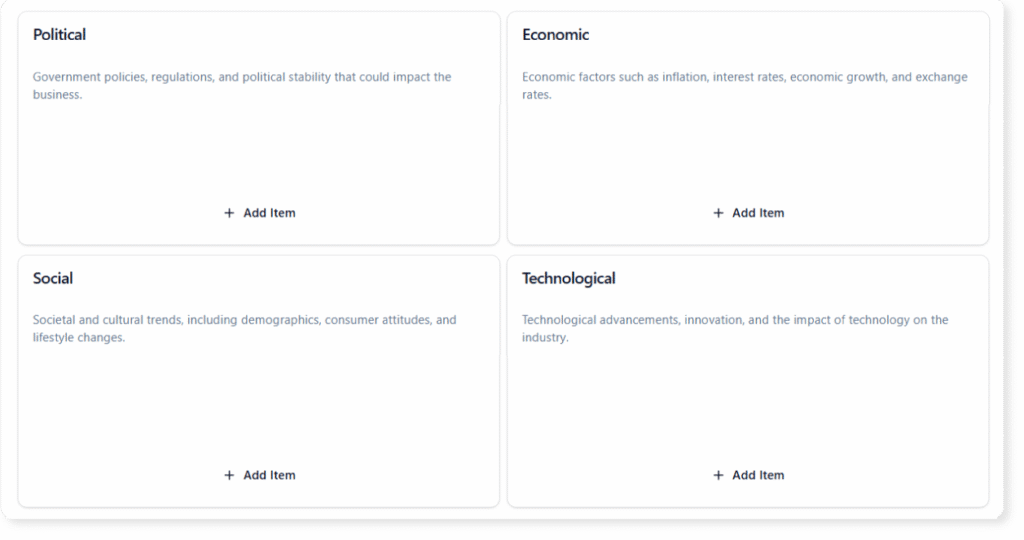
This is where PEST Analysis becomes essential. As a fundamental strategic framework, PEST allows leaders to scan the macro-environmental factors—Political, Economic, Social, and Technological—that shape industries. By identifying these external influences early, businesses can pivot strategies to mitigate threats and capitalize on emerging opportunities.
Before diving into application, it is crucial to understand the four pillars of the PEST framework. This tool is designed to look outward, analyzing the “big picture” forces that are largely beyond the direct control of an organization but heavily influence its trajectory.
It is common to confuse PEST with other strategic tools. To clarify:
Traditional strategic planning can be labor-intensive, often requiring days of research to identify relevant external factors. Visual Paradigm AI transforms this process by leveraging artificial intelligence to generate, refine, and analyze strategic canvases instantly.
Visual Paradigm’s AI-powered tools address the common pain points of blank-page syndrome and data overload.
To understand the practical application of PEST Analysis, let us explore how it applies to distinct industry scenarios.
An EV company must navigate a complex web of government incentives and infrastructure challenges.
| Factor | Analysis Points |
|---|---|
| Political | Government subsidies for green vehicles, import tariffs on raw materials, and carbon emission regulations. |
| Economic | Fluctuating oil prices affecting EV appeal, battery manufacturing costs, and consumer disposable income. |
| Social | Growing environmental awareness, range anxiety among drivers, and urbanization trends reducing car ownership. |
| Technological | Advances in solid-state batteries, expansion of fast-charging networks, and autonomous driving software integration. |
A global franchise faces pressure from health advocates and supply chain volatility.
| Factor | Analysis Points |
|---|---|
| Political | Health regulations regarding sugar/fat content, minimum wage increases, and food safety standards. |
| Economic | Global supply chain costs, impact of inflation on menu pricing, and labor market tightness. |
| Social | Shift towards plant-based diets, demand for ethical sourcing, and “on-the-go” lifestyle habits. |
| Technological | Adoption of self-service kiosks, app-based delivery platforms, and AI in inventory management. |
Conducting a PEST analysis is not a one-time event but a continuous cycle of monitoring. Follow these steps to maximize effectiveness:
Whether you are using a Mission Model Canvas for a non-profit or a Blue Ocean Strategy layout for a startup, understanding the external environment is the foundation of sound decision-making. PEST Analysis provides the necessary lens to view these external forces clearly.
By combining this classical framework with modern tools like Visual Paradigm AI, teams can move from passive observation to active strategic planning, ensuring they remain resilient in the face of political, economic, social, and technological change.
Resources
What Is the Business Model Canvas? Why Use Visual Paradigms & AI Tools: This comprehensive guide explains the Business Model Canvas, its core components, and how visual paradigms and AI-powered tools enhance strategic planning and business innovation.
AI-Powered Business Model Canvas Builder – Instant Strategy Design: An AI-driven tool that automates the creation of business model canvases, offering intelligent suggestions and real-time insights to accelerate business planning.
AI Canvas Tool – Intelligent Design for Business Frameworks: An AI-powered canvas application that helps users generate and refine business models, value propositions, and strategy frameworks with smart suggestions and automation.
AI Business Model Canvas Tool – Smart Strategy Development: A comprehensive AI-enhanced solution for building and refining business models with intelligent insights, real-time feedback, and collaborative features.
AI Canvas Editor Release Update: Introduces an AI-powered canvas editor that enhances diagram creation through intelligent suggestions and automated layout optimization.
AI-Powered Business Model Canvas Tool Guide: A step-by-step guide on using an AI-enhanced tool to generate and refine business model canvases with intelligent input and real-time recommendations.
Mission Model Canvas | AI-Powered Strategy Tool by VP: October 28, 2025 – Coordinate live sessions with your team using the built-in timer and export your final canvas or reports into professional formats such as Word, Markdown, or CSV. … The Mission Model Canvas is specifically designed for non-profits, government agencies, social enterprises, and any organization where the primary goal is mission achievement rather than profit.
Comprehensive Tutorial: AI-Powered Business Canvas Toolkit with Visual Paradigm: This page provides a detailed guide on using an AI-enhanced Business Model Canvas toolkit integrated with Visual Paradigm for automated business strategy development.
AI Canvas Tool – Visual Paradigm: An AI-driven tool within Visual Paradigm that enables users to generate and refine business canvases through intelligent automation and natural language input.
Mastering the Business Model Canvas with AI: Step-by-Step Guide Using Visual Paradigm: This blog post offers a structured walkthrough of leveraging AI capabilities in Visual Paradigm to create, customize, and optimize Business Model Canvases efficiently.
How the AI Business Model Canvas Builder Works – Visual Paradigm: This page explains the functionality of the AI-powered Business Model Canvas Builder, highlighting how machine intelligence automates canvas creation and strategic insight generation.
Deep Learning AI Canvas | Strategy Tools Analysis Canvas Template: Edit Localized Version: 深度學習 AI 畫布(TW) | 深度学习 AI 画布(CN) View this page in: EN TW CN · Visual Paradigm Online (VP Online) is an online diagram software that supports analysis canvases, various charts, UML, flowchart, rack diagram, org chart, family tree, ERD, floor plan, etc .
Product Canvas | AI-Powered Strategy Tool by VP: Build products people love. Combine strategy, design, and feedback into one visual space with our AI-powered Product Canvas to bring ideas to market faster.
Lean UX Canvas | AI-Powered Strategy Tool by VP: October 28, 2025 – Create a complete strategy framework in moments. Simply describe your vision, and the AI canvas generator transforms it into a structured, insight-rich canvas that helps you visualize, plan, and refine your next big idea.
Lean Canvas – Visual Paradigm: October 28, 2025 – Our application is designed to be your strategic partner, providing intelligent tools to enhance every step of your planning process for the Business Model Canvas. … Have a startup idea? Just enter ‘a mobile app for local home-cooked meal delivery’ and let our AI generate a complete Lean Canvas, outlining the problem, solution, and key metrics.
 Mastering the VRIO Framework: A Comprehensive Guide to Strategic Resource Analysis
Integrating Strategy and Design: The Role of Visual Paradigm AI in Project Initiation
Overcoming Inconsistency: A Comprehensive Guide to Coherent AI-Generated UML
Comprehensive Guide to UML Class Diagrams: From Basics to AI-Powered Design
Mastering the VRIO Framework: A Comprehensive Guide to Strategic Resource Analysis
Integrating Strategy and Design: The Role of Visual Paradigm AI in Project Initiation
Overcoming Inconsistency: A Comprehensive Guide to Coherent AI-Generated UML
Comprehensive Guide to UML Class Diagrams: From Basics to AI-Powered Design